Friday, April 25, 2008

Come, dirty your hands

Remember the childhood days when you loved to play with sand, but the response from your parent was less than enthusiastic? Or, how as a parent yourself, you try to keep your child away from mud?

Joe Kissel comes up with this interesting thing of the day:

“Children, I have observed, seem to have an innate affinity for dirt. No matter how recently a parent has dressed the child in freshly laundered clothes, no matter how carefully the parent has attempted to keep the child geographically separated from any substance that might soil or stain, it is just not possible to keep a child clean for more than 60 seconds….. Kids clearly have a talent for finding dirt, but also, dirt finds them. If you’re a parent, you know what I’m talking about.

But that’s changing now, thanks to the renaissance of a traditional Japanese art form known as dorodango, shiny mud balls (or, more specifically, hikaru dorodango, ultra-glossy mud balls). Parents are now not only actively encouraging their kids to play in the mud, they’re getting their own hands dirty too as they spend hours refining ordinary dirt into elegant sculptures. “

Joe Kissel concludes:

"I have yet to try dorodango myself, but I love the idea that you can make something so beautiful with three ingredients (dirt, water, and a rag) that virtually anyone in the world can obtain for free. As any child knows, mud is one of life’s simple pleasures. "
Now, what were the other things that I was prevented from doing, as a child?

A tale of the city

Charlie Broker, the self-confessed nocturnal creature, writes about his amazing journey into a whole new world that he thought was essentially inhabitable – mornings. He is astonished to find real, live people around. He establishes contact with an entirely new species- the commuters.

But, he quotes The Economist that thanks to the ongoing technological revolution, the commuter of yesteryear is gradually being replaced by the "urban nomad" of tomorrow and location is becoming increasingly irrelevant.

“The upshot of all this being that the early morning commute is set to slowly dissipate from a concentrated frenzy of furrow-browed scampering into a sort of fuzzy, laid-back cloud in which worker bees drift hither and thither, sometimes staying at home, sometimes buzzing round town….The very notion of geography has been shattered as surely as if someone had written the word "geography" on a plate and hurled it to the floor in a touristy Greek restaurant. And it'll be a bit less cramped at the bus stop as a result.”

So, can we all work from wherever we are? Does it mean the death of the office as we know it? Will cities be made irrelevant and will people begin the reverse migration to their villages?

Not quite. There are others who point out that the quintessence of a city is its ability to provide the conditions for constant interaction and, therefore, innovation. The amount of interaction and also the intensity lead to mutual learning from one another and offer the potential to combine different types of knowledge that support innovation. Not all cities have been innovative, but most innovations have happened in cities. You need a ‘spatial base’ for innovation systems to flourish.

That’s why platforms such as schools, universities, offices are also necessary. These are enablers of knowledge transactions, by ensuring close proximity.

In his book, “Cities in Civilisation”, ( I just read this review), Peter Hall argued that "great cities are central to civilization because their very size and complexity make them natural sites for “the innovative milieu.” Only the greatest cities can bring together the critical mass of creative people to overcome cultural inertia. Within these urban networks of innovators, new paradigms take shape that transform civilization. Here lies the justification and the salvation of the city."

Hall believes that the cultural centrality of cities will continue and even intensify, despite the success of space-conquering technologies of communication that seemingly have made the city obsolete.
Heck, I need to go back to my office tomorrow.

Friday, April 18, 2008

Pre-taped, live shows

What happens when you try to pre-tape a call-in show? I found this episode hilarious. (via).

Reminded me of the maddening, circular references in the book “Catch 22”, such as this one :


Maj. Major Major Major: Sergeant, from now on, I don't want anyone to come in and see me while I'm in my office. Is that clear?
First Sgt. Towser: Yes, sir? What do I say to people who want to come in and see you while you're gone?
Maj. Major Major Major: Tell them I'm in and ask them to wait.
First Sgt. Towser: For how long?
Maj. Major Major Major: Until I've left.
First Sgt. Towser: And then what do I do with them?
Maj. Major Major Major: I don't care.
First Sgt. Towser: May I send people in to see you after you've left?
Maj. Major Major Major: Yes.
First Sgt. Towser: You won't be here then, will you?
Maj. Major Major Major: No.
First Sgt. Towser: I see, sir. Will that be all?
Maj. Major Major Major: Also, Sergeant, I don't want you coming in while I'm in my office asking me if there's anything you can do for me. Is that clear?
First Sgt. Towser: Yes, sir. When should I come in your office and ask if there's anything I can do for you?
Maj. Major Major Major: When I'm not there.
First Sgt. Towser: What do I do then?
Maj. Major Major Major: Whatever has to be done.
First Sgt. Towser: Yes, sir.

Let the battle begin.....

The advertisements for IPL league dub the event as a “karmayudh” and show the captains in war paint and battle gear - holding spears, daggers and other assorted missiles. As the first match starts today, conches will be blown and blood-curdling cries heard.

Why should sports be promoted as ‘war’ and why should such a promotion appeal to people at all? Does it pander to the innate aggressiveness in all of us?

Why are most video-games for kids, all about killing the enemy by shooting, bombing, blasting, maiming, piercing, blowing to smithereens, etc? Aren’t we inculcating in them a destructive mindset?

What explains the idiocy of parents buying toy guns and water-pistols for their toddlers, knowing well that these can lead to aggressive conduct? Why should Lego, known for their range of constructive building blocks, come out with their toy gun series?

Is there a link between ‘playing’ with toy guns as a child and aggressive behaviour as an adult? Just as the big cats of Africa train their cubs to fight and attack, through the medium of aggressive play, are we using toy guns to consciously prepare the kids for the rough adult life, by training them to become militant and violent?.

Google search shows that a study was conducted in 1976 by Charles W. Turner and Diana Goldsmith, psychologists at the University of Utah. Children were observed playing with neutral toys like blocks and airplanes and then with toy guns. The researchers found that the children exhibited more physical and verbal aggression after playing with guns. Isn't this a no-brainer?

But, toy makers disagree and argue ( source) that today’s toy guns provide a modern extension of the role of toys in enhancing children's play experiences. They point out that children have played fantasy games involving the triumph of good over evil for centuries. Before guns, there were bows and arrows. Such ''rough and tumble,'' is often a healthy way for children, especially boys, to resolve competitiveness and form friendships.

Probably, we are all born not with just an instinct for survival, but with an aggressive drive. As the Devil in Shaw’s “Man and Superman’ states:.

And is Man any the less destroying himself for all this boasted brain of his? Have you walked up and down upon the earth lately? I have; and I have examined Man's wonderful inventions. And I tell you that in the arts of life man invents nothing; but in the arts of death he outdoes Nature herself. In the arts of peace Man is a bungler. I have seen his cotton factories and the like, with machinery that a greedy dog could have invented if it had wanted money instead of food. I know his clumsy typewriters and bungling locomotives and tedious bicycles: they are toys compared to theMaxim gun, the submarine torpedo boat. There is nothing in Man's industrial machinery but his greed and sloth: his heart is in his weapons.

That sums it up well. Man’s heart is in his weapons. So, it’s war out there. All the time.

Thursday, April 17, 2008

The morning entertainment

I am beginning to get hooked to the Deccan Chronicle. Endless fun, it gives me.

Monday’s edition carried details of an MMS floating around, showing a Tamil actress kissing someone who was believed to be a local, married businessman with kids. The correspondent reported that when the actress was asked for her views, she emphatically denied that the photo was hers. She went on to add that someone had obviously doctored the photo, supplanting a look-alike of hers, just to tarnish her image. She lamented that some unscrupulous elements were misusing technology with a view to injuring people like her who hailed from cultured backgrounds.

Tuesday’s edition carried a report that the photograph was indeed that of the Tamil actress, and the kissing mate was none other than her husband whom she had married three years back and divorced later. When the actress was contacted, she confirmed that the photo was taken on the evening of her wedding, during a private function, where only select photographers were present. One of the photographers must have leaked the photo out, betraying our trust, she said. The newspaper, to enhance the credibility of the report, carried a couple of more photographs from the same wedding reception.

Also, Tuesday’s edition carried a sensational front-page article on how the police had tapped into the phone of even the Chief Secretary of the State. It said that an audiotape of the tapped conversation was in the possession of the newspaper. A transcript was published for public consumption.

On Wednesday, the paper reported that the Govt had ordered an enquiry into the episode. Not to investigate why or how the tapping was done, but to find out how the audiotape had fallen into the hands of the newspaper.

Endless fun, I tell you. .

Statins save lives

A study has apparently pointed out that statin drugs do not prevent heart attacks by lowering cholesterol. No, sir, they don’t. Statins prevent heart attacks by controlling inflammation. That’s how they do it.

I remember Mad magazine once came up with a wise observation that, contrary to popular belief, bulls don’t get affected by red colour at all. The reason they attack you when you display red colour is because they hate being mistaken for cows, which are the ones that do get affected by the red colour.

Does it matter whether bulls attack you because they are affected by the red colour themselves or because they are angry that you have mistaken them for cows? In either case, they attack you.

Does it matter how statins prevent heart attacks- whether by attacking the inflammation or by attacking the cholesterol? In either case, they attack. So gulp them down, whatever may be your cholesterol level.

The fact is that the CEOs of many drug companies are stressed out due to falling revenues and it is incumbent on all of you to go out right now and buy the statins to prop up the sales. The statins may not help your heart one bit. But by swallowing one or two a day, you will prevent the heart-attacks of all those CEOs. Or, should that be hearts-attack?

On birthdays and baseball pros.

“Why do so many pro-baseball players have their birthdays in August?” asks Slate in this article, and then proceeds to offer an explanation.

The pattern is unmistakable. From August through the following July, there is a steady decline in the likelihood that a child born in the United States will become a major leaguer.

One possibility, of course, is that the zodiac sign under which a person is born is a key determinant, as was argued in the book, The Baseball Astrologer.

But, there is a a better explanation.

“The magical date of Aug. 1 gives a strong hint as to the explanation for this phenomenon. For more than 55 years, July 31 has been the age-cutoff date used by virtually all nonschool-affiliated baseball leagues in the United States. Youth baseball organizations have long used that date to determine which players are eligible for which levels of play… The result: In almost every American youth league, the oldest players are the ones born in August, and the youngest are those with July birthdays. …. Twelve full months of development makes a huge difference for an 11- or 12-year-old. The player who is 12 months older will, on average, be bigger, stronger, and more coordinated than his younger counterpart, not to mention more experienced. And those bigger, better players are the ones given opportunities for further advancement. Other players, who are just as skilled for their age, are less likely to be given those same opportunities simply because of when they were born.


It will be interesting to see if there is such a pattern in schools. In Chennai schools, for instance, the cut-off date for admission is July 1st. Meaning that the child should be three years old on June 1st of the year, to qualify for admission into kindergarten. Do children born in June shine better as students, as they would be the oldest in class?

Monday, April 14, 2008

Do you know what you are looking for?

Noam Chomsky in an interview ( Source: “What we say goes”) , while acknowledging the benefits of the Internet, points to this flip side :

Built into the Internet is a system for creating cults. So, for example, if I had a blog, which I don’t, and I put up something that is slightly novel and maybe questionable interpretation of some event- the Bush administration is trying to poison the water in Boston or something, to pick at random- tomorrow somebody else would say, “That’s right, but it’s worse than you think.”. And pretty soon you would develop a cult of people proving that the Bush administration is trying to poison the world’s water. It’s extremely easy to get caught up in this kind of cultlike behaviour, which has a cocoon-like property similar to other religious cults, immune to evidence, immune to
argument.


There is an element of truth in what he says, but will not the same apprehension be equally valid in the case of various devices- mobile phones, photo-copying machines and suchlike? They also have the potential to move and distort information at great speed.

So, what would Noam Chomsky suggest to someone surfing the Internet?

Surfing the Internet makes about as much sense as for, say, a biologist to read all the biology journals. You will never learn anything that way. No serious scientist does that .The literature is massive. You get flooded by it. A good scientist is one who knows what to look for, so you disregard tons of stuff and you see a little thing somewhere else. The same is true for a good newspaper reader. Whether it’s in print or on the Internet, you have to know what to look for. This requires knowledge of history, an understanding of the backgrounds, a conception of the way the media functions as filters and interpreters of the world. Then you know what to look for. And the same is true on the Internet.

What Chomsky misses out is that the knowledge of history and an understanding of the backgrounds can also be provided by the same Internet.

Sunday, April 13, 2008

David Brooks writes in his column, in the New York Times :

They say the 21st century is going to be the Asian Century, but, of course, it’s going to be the Bad Memory Century. Already, you go to dinner parties and the middle-aged high achievers talk more about how bad their memories are than about real estate. Already, the information acceleration syndrome means that more data is coursing through everybody’s brains, but less of it actually sticks. It’s become like a badge of a frenetic, stressful life — to have forgotten what you did last Saturday night, and through all of junior high….

Society is now riven between the memory haves and the memory have-nots….
As one of the have-nots, I can understand what David Brooks is trying to say, With the finite RAM size of our brains and with more data coursing through relentlessly, the only option is to develop the ability to selectively forget the past. A neural program must be developed which would do some ‘housekeeping’ of the brain and send unwanted data to the recycle bin, to be permanently deleted if kept in storage for more than 48 hours. Aspects of the past which we find painful or useless can be picked out for disposal.

In the nineteenth century, writers and philosophers seem to have explored this theme of ‘forgetting’ in some detail. In his book, the Haunted Man, Charles Dickens has a Professor of Chemistry, Redlaw, being given the gift of forgetting ‘sorrow, wrong and troubles in his life”. With the painful incidents of the past removed from memory, Professor Redlaw experiences inexplicable anger and bitterness, and the moral of the story is explained as “it is important to remember past sorrow and wrongs, so that you can forgive the wrong-doer and unburden your soul from the misery”. Otherwise, you end up unbalanced and filled with emptiness.

That’s typical nineteenth-century drivel. If he were to write the story now, Dickens will have the Professor re-inforcing his memory cells with vivid description of the wrong-doer, so that he will not forget to have his revenge. While cluttering his brain with such trivia, the Professor will not be able to remember what he did on Saturday night….

Monday, April 07, 2008

Absolut truth

A map that Absolut vodka used in an ad campaign seems to have hurt American sentiment, according to this blog that tracks unusual maps.

The map shows what the US-Mexican border would look like in an ‘absolut’ (i.e. perfect) world: a large part of the US’s west is annexed to Mexico.


The blog explains:


Large swathes of the western US used to be part of Mexico. In 1836, American settlers proclaimed the independence of Texas, formally a Mexican territory. The US annexation of Texas in 1845 prompted the Mexican-American War (1846-1848), after which Mexico was forced to cede 525,000 square miles of territory (42% of its pre-war territory, 12% of the US’s current territory).

Mexico didn’t have much choice: a US army occupied Mexico City, and the alternative was total annexation. The Mexican Cession consisted of the territories of Alta California and Nueva Mexico, out of which were eventually formed the US states of California, Nevada and Utah, and parts of Arizona, Colorado, New Mexico and Wyoming.

In this ‘absolut’ version of the world, the US and Mexico are about the same size.


But, what I found most interesting was the response of Absolut to the American protest:


We are sorry if we offended anyone. This was not our intention. We will try to explain. Though you may not agree, I hope you understand.”


“We have a variety of executions running in countries worldwide, and each is germane to that country and that population. This particular ad, which ran in Mexico, was based upon historical perspectives and was created with a Mexican sensibility. In no way was this meant to offend or disparage, nor does it advocate an altering of borders, nor does it lend support to any anti-American sentiment, nor does it reflect immigration issues. Instead, it hearkens to a time which the population of Mexico may feel was more ideal.”


“Obviously, this ad was run in Mexico, and not the US — that ad might have been very different.”


I found this refreshingly candid. No multi-national organisation can have one global marketing campaign. As the jargon goes, they have to think global, but act local. So, national and regional sensibilities have to be factored in all the time. This will obviously create issues that will need tackling. A map of India, cut off at the LOC, will invite a stern notice from the Govt of India. And, if drawn the Indian way, will anger Pakistan.

And, within India, you never can say what part of the ad will affect the sensibility of which religious group or linguistic community. When this happens, the usual response is to apologise profusely or to withdraw the ad and come out with one that is neutral in all respects ( and terribly dull, in the process)

So, when Absolut tells an ‘injured’ party, honestly, that they were appealing to the Mexican perception of an ideal world, which may not necessarily tally with the USA’s, I admire the stand they are taking.

Sunday, April 06, 2008

The lightning rods

Bryan Caplan of EconLog links to an interview (1922) in which Hitler explains in a sober and quite dispassionate manner, why he was singling out the Jews for extermination, though fully aware that they had contributed immensely to science, art, literature, economics, etc.

It is manifestly clear and has been proven in practice and by the facts of all revolutions that a struggle for ideals, for improvements of any kind whatsoever, absolutely must be supplemented with a struggle against some social class or caste.

My object is to create first-rate revolutionary upheavals, regardless of what methods and means I have to use in the process. Earlier revolutions were directed either against the peasants, or the nobility and the clergy, or against dynasties and their network of vassals, but in no case has revolution succeeded without the presence of a lightning rod that could conduct and channel the odium of the general masses.

With this very thing in mind I scanned the revolutionary events of history and put the question to myself against which racial element in Germany can I unleash my propaganda of hate with the greatest prospects of success? I had to find the right kind of victim, and especially one against whom the struggle would make sense, materially speaking. I can assure you that I examined every possible and thinkable solution to this problem, and, weighing every imaginable factor, I came to the conclusion that a campaign against the Jews would be as popular as it would be successful.

There are countless instances in India when political parties have used caste, religion or language to whip up public sentiment and to appeal to the tribalism inherent in people. The propaganda of hatred offers the highest probability of success. The trick is to find the ‘right kind of victim’ to unleash and direct one’s venom on. Hitler knew this. And every politician worth his salt knows this and uses it to good effect.

Take note

I wince when I watch my daughter attend various coaching classes, take tons of notes and later commit to memory, thousands of Chemistry equations, hundreds of Physics formulae and pages and pages of theory. . The whole thing is a futile exercise as none of that stuff is going to help her cope with the real world, I feel. All that trivia and minutiae have a short shelf life- up to the examinations. And then she would discard all that junk from her brain and move on.

So, why do it at all? With so many ‘guide’ books available in the market, why should she attend lectures and take copious, hand-breaking notes? Why subject generations of students to this form of torture? What purpose does it serve?

Jonah Lehrer of Frontal Cortex offers this perspective:

It's easy to be misled into thinking that the real purpose of taking organic chemistry or "The 19th century English Novel" is to learn about benzene rings or the writing habits of Charles Dickens. But that's an illusion. What nobody bothers to tell you is that you will forget everything, that all those chemical equations will be purged from your hippocampus shortly after the semester is over.

Rather, the real purpose of all those big lecture classes is to teach you how to learn. You are being given an education in education, forced to develop the kind of thinking habits that will allow you to synthesize, memorize and analyze information later on, in real life. The content of the lecture notes is virtually irrelevant. What's important is the fact that you know how to take notes in the first place
.

So - stretching the point beyond taking notes - education or a degree is not an end in itself. The process merely arms you with the basic tools to cope with the real world. You learn how to learn.

A humble suggestion

In an interesting article in The Hindu, D.Balasubramanian, noted science writer discusses, in one broad sweep, the argument between the Government and animal activists over culling of animals such as the kangaroo to keep their numbers in check, how Le Chatelier’s principle comes into play and how human beings introduce an anthropo-centric bias of individual liberty into the proceedings. He asks, “Is the individual the crucial moral entity in nature, as we have decided it should be in human society? We simply may require a different sort of ethics to guide our dealings with the natural world, one as well suited to the particular needs of plants and animals and habitat (where sentience counts for little), as rights seem to suit us and serve our purposes today”.

He concludes that we should accept reality and cut the number (in each species) to a level that offers enough food and space to lead a sustainable level.

By numbers, of course, he means the population of kangaroos, pigs, elephants, monkeys, etc.

This, I feel, is not fair. The restriction on numbers should apply to human beings as well, and there should be a system that regulates the human population through periodic culling. And, in order to ensure transparency in the process, we should leave it to a master computer, which has access to all relevant data on all species, including human beings, to decide which species must go in for culling, how many and where. With human beings, it should also identify the individuals and the ID No. And, if a blogger, his or her URL.

There are several ways of implementing this idea and I don’t want to trouble you with too many details, which can be worked out as we go along. Naturally, the exercise will have to be kick started in India and China. A good beginning can be made, if the number of human beings in each of these countries can be kept to 1 billion. Anything above this has to be eliminated by ‘culling’

What criteria can we lay down for the culling of human beings? (Warning, the next para may affect the sensibilities of young mothers)

One good suggestion was made by the Irish writer, Jonathan Swift, as early as the 18th century. Making what he called as a ‘Modest proposal” ( albeit, in a different context), Swift recommended that “a hundred thousand babies, about a year old, could be sold at a price, as they would make a most delicious, nourishing and wholesome food, whether stewed, roasted, baked or boiled. They could be sold to the persons of quality and fortune through the kingdom; always advising the mother to let them suck plentifully in the last month, so as to render them plump and fat for a good table. A child will make two dishes at an entertainment for friends; and when the family dines alone, the fore or hind quarter will make a reasonable dish, and seasoned with a little pepper or salt will be very good boiled on the fourth day, especially in winter.”

Swift was quick to aver that he had no personal interest in this proposal as “I have no children by which I can propose to get a single penny; the youngest being nine years old, and my wife past child-bearing.” I may add that I don’t have any vested interest in promoting Swift’s idea either, as both my daughters are over a year old, and have no market value, under the scheme. My support to this idea arises out of pure altruism and with a noble view to maintain a proper ecological balance on Planet Earth

Swift’s scheme would be one way of controlling the population. But, I am aware that this may not be acceptable to all, especially some of the young mothers in the blogosphere. So, I am open to other suggestions. Unless, some pea-brained person comes up with a wild thought that persons over 50 years of age are the most appropriate specimens for culling. Then, I will have something to say.


Saturday, April 05, 2008

Keep running on that treadmill

I had taken a week off from work last month. On one of those blissful days, happening to walk idly past a traffic signal at 9.00 am, I was happy to note that thousands of people in hundreds of cars and buses were rushing to their offices or factories, to toil, to sweat and to earn. If time-motion cameras were to be placed at vantage points, I thought, it would capture, to telling effect, the entire sequence of humanity on the move, the wheel of commerce spinning, the ensuring of livelihood by most, the pursuit of success by many… The most satisfying part was watching the whole scene from the sidelines, instead of participating in the mad scramble.

If only I could do it everyday, watch all the hard work being done, from the side lines….

In fact, during the break, I had picked up Jerome K Jerome’s book, “The idle thoughts of an idle fellow”. Just the sort of title that appealed to me. Though he lived in the nineteen century, I felt that here, at last, was an author, who was going to preach the virtue of laziness and contentment, and raise a clarion call to put an end to the insanity of this success-obsessed world. Which I would then cite to justify my aversion to hard work and burning ambition.

And, sure enough, in one of his essays, “On getting on in this world”, he gets off to a good start,

“..sitting in my arbor by the wayside, smoking my hookah of contentment and eating the sweet lotus-leaves of indolence, I can look out musingly upon the whirling throng that rolls and tumbles past me on the great high-road of life. Never-ending is the wild procession. Day and night you can hear the quick tramp of the myriad feet--some running, some walking, some halting and lame; but all hastening, all eager in the feverish race, all straining life and limb and heart and soul to reach the ever-receding horizon of success. Mark them as they surge along--men and women, old and young, gentle and simple, fair and foul, rich and poor, merry and sad--all hurrying, bustling, scrambling….


Ha, he is warming to the theme, I thought. Dripping with sarcasm. He is going to knock the stuffing out of those maniacs who perpetuate the myth that hard work was vital for success. Way to go, Jerome.

Suddenly, Jerome changes tack and puts a same-side goal. He says,

Contented, unambitiuos people are all very well in their way. I have not a word to say against contented people so long as they keep quiet. But do not, for goodness sake,let them go strutting about, as they are so fond of doing, crying out that they are the true models for the whole species. Why they are the deadheads, the drones in the great hive, the street crowds that lounge about, gaping at those who are working’.

Hell, it is as if the prescient Jerome K Jerome had caught me standing near the traffic signal, idly gaping at humanity on the move.

He goes on :

The contented people never knew the excitement of expectation nor the stern delight of accomplished effort, such as stir the pulse of the man who has objects, and hopes, and plans. To the ambitious man life is a brilliant game- a game that calls forth all his tact and energy and nerve- a game to be won, in the long run, by the quick eye and the steady hand, and yet having sufficient chance about its working out to give it all the glorious zest of uncertainty.

Why this guy must give a suggestive title of “idle thought of an idle fellow” to his book, and lure me to buy it, I can’t understand.

In another part of the book, he says “It is impossible to enjoy idling thoroughly unless one has plenty of work to do. There is no fun in doing nothing when you have nothing to do. Idleness, like kisses, to be sweet must be stolen”.

I better get back to work.

Saturday, March 29, 2008

When the floods come...

There is a story on Israeli tenacity, that goes like this::

“Scientists predict that in a month's time an enormous natural catastrophe will be visited upon the earth as a result of which the whole surface of the globe will be covered with water. Thereupon the Pope issues from Rome an encyclical exhorting his flock to make use of the remaining days of grace to seek salvation in Christ and to hope for resurrection. The chief Mufti of the grand mosque on Mecca issues a fatwa to all the true believers in Allah and His prophet Mohammed assuring them that they will go straight to Paradise where great pleasures await them. And the Chief Rabbi of Jerusalem calls upon all his brothers, the Children of Israel, saying, “We have four weeks to learn how to live under water."

I was reminded of this when I read this interview ( via Sepia Mutiny)) of Lee Kuan Yew. Minister Mentor, Singapore, in which he discusses the possibility of the island getting flooded due to global waming and then adds nonchalantly: “ we are already in consultations with Delft in Holland to learn how we can build dikes!”

While many of the countries keep talking about global warming or wishing it away, it is typical of Singapore to take a pragmatic approach and start preparations to tackle the eventuality.

My luxury splurge

Happened to pick up a copy of today’s issue of Mint, at the Mumbai airport. It carries a special feature on “Luxury Splurge”.

It has some useful tips on how you can spend your annual bonus that your company has generously doled out to you. The ideas are divided into three broad categories, for those earning bonuses under Rs 10 lakhs, for those earning between Rs 10 lakhs and Rs 50 lakhs and finally, those over Rs 50 lakhs.

Pleased that I was fitting into one of the categories, viz the one between zero and 10 lakhs, albeit closer to the former than the latter, I read the whole piece.

The suggested ways to spend the bonus are :

1) Participate in Bloomsbury Auctions, London on 22nd May, for collection of classic works such as Henri Cartier- Bresson’s “Marseilles” at Rs 4.8 to 5.6 lakhs
2) Buy a Vellus Aureum Zegna Suit for Rs 6 lakhs ( note Suit is spelt with a capital “S’)
3) Enjoy a 30-course dinner at El Bulli, Spain ( price around Rs 1.43 lakhs, plus Business Class Air fare approximately Rs 1.43 lakhs)

None of these appealed to me and just when I was beginning to lose interest, I spotted this suggestion to go in for a Vu LCD Television, costing only Rs 29,000. The kind of price, at last, that was within my striking distance. The fine print however said that this was a water-proofed, 15 inch TV, perfect for in-shower channel surfing. Meant, I surmised, for those who suffer from severe withdrawal symptoms if denied the facility of watching TV while in the bath.

I think I will spend my entire bonus on fitting a shower in my drawing room, so that I am not denied the pleasure of having a bath, while watching TV.

Saturday, March 15, 2008

Only 99.5% similar.

The journey of mankind spanning 150000 years. (via).

So, we all originated from one place, kept multiplying and moving from place to place. So, that should make us all genetically quite similar, right?

Mark Bagel, evolutionary biologist, says we could differ more than we thought. Modern genomic studies reveal a surprising, compelling and different picture of human genetic diversity. We are on average only about 99.5% similar to each other genetically. This is a new figure, down from the previous estimate of 99.9%.

Isn’t 99.5% good enough? Why is this Bagel being so finicky about a mere 0.5%? To put what may seem like miniscule differences in perspective, he says we are somewhere around 98.5% similar, maybe more, to chimpanzees, our nearest evolutionary relatives. Modern humans spread out of Africa only within the last 60-70,000 years, little more than the blink of an eye when stacked against the 6 million or so years that separate us from our Great Ape ancestors
.
Bagel says that the new figure for us, then, is significant. It derives from among other things, many small genetic differences that have emerged from studies that compare human populations. Some confer the ability among adults to digest milk, others to withstand equatorial sun, others yet confer differences in body shape or size, resistance to particular diseases, tolerance to hot or cold, how many offspring a female might eventually produce, and even the production of endorphins — those internal opiate-like compounds. We also differ by surprising amounts in the numbers of copies of some genes we have.

He concludes, “What this all means is that, like it or not, there may be many genetic differences among human populations — including differences that may even correspond to old categories of 'race' — that are real differences in the sense of making one group better than another at responding to some particular environmental problem.”

I am not sure if Bagel is right when he says that we are more different than we had thought, but I am more than convinced that we remain much closer to chimpanzees than we would like to believe.

Saturday, March 08, 2008

On skirts, hairstyle and stubble

We are all aware of the old theory about economic cycles in the USA and how the wearing of shorter skirts by women is an indicator of prosperity. Shorter hemlines were in fashion during the Roaring twenties and the Swinging Sixties, both periods of boom. During the great depression of the thirties, long skirts were in vogue.

Now comes a theory, based on data collected over 20 years in Japan, that show that it is the length of the hair that really matters. Japanese women start wearing their hair short when the economy is worsening and let it grow longer when times are getting better.

Indian women have had long hair all the time and only a tiny minority wears skirts. So, we may not be able to find statistics to link these with our GDP growth. Maybe, we could cull out data on the neckline of blouses of heroines of Bollywood movies over the decades, to see if there is some correlation.

So, while I have not been able to track the economic cycles in India and the relevant correlating factors and metrices, what I have done is study the indicators of Tendulkar’s batting performance. Based on the records that I have painstakingly maintained for the last twenty years or so, I find that Tendulkar scores more runs on days that he hasn’t shaved.

Of course, we have to ignore the data for the first few years of his career, as he was not old enough to shave, but when you look at photographs after 1995 or so, on days he had scored over 50 runs, you will notice the unmistakable stubble.

So, the question some of you might have is why doesn’t Tendulkar sport a beard all the time? Why does he bother to shave when he knows that it impairs his performance?

My response to that is, why don’t the American women wear short skirts all the time, or the Japanese women grow long hair, when these are clear indicators of economic prosperity? Why bother to wear long skirts or cut hair shorter when such reckless acts are known to cause a downturn?

Never forget that indicators are what economists and analysts come up with, retrospectively, to prove a point about the past. They should never ever be used as pointers to the future.

Correct your diaries

In a significant study, scientists have determined that the Grand Canyon could be 11 million years older than previously thought. So, the correct age may be 17 million years and not 6 million years. In case you were planning to hire a Time Machine to go back to when the Grand Canyon was taking shape, it is going to cost you three times more than what you had budgeted.

On a related note, I am amazed that some people still cling to the view that the Triassic age began 230 million years ago. This is completely wrong. Paleontologists first postulated in 1862 that dinosaurs must have appeared 230 million years back. But, another 146 years have passed since. So, the Triassic Age actually began 230 million and 146 years back. You might think that the increase is a small percentage of the total, but remember that 146 years is not insignificant. Hell, it is nearly three times my age.

Thursday, March 06, 2008

India, the land of the elephant

As regular viewers of the Discovery or National Geographic channels know, elephant society, within a herd, follows a hierarchy that is strictly based on age. There is the matriarch at the top and below her, the other animals descending in order of age. Older elephants teach younger ones how to behave, when to move to a different landscape and where to forage for food. The story of the elephant’s phenomenal long-term memory is true and is a key survival mechanism. Matriarchs can remember the exact location of watering holes that they had visited many decades back, and can uncannily lead their herds to the spot.

The matriarch lives far beyond her breeding age, and it is thought that this added life span is mainly to serve the purpose of mentoring the younger generations Thus, the older the elephant, the more valuable she is to her herd.

The Indian society has followed a similar structure for many centuries, probably because the elephant has always been an iconic symbol for us. The belief that a person gets wiser with age is still so prevalent. True, not all old people are wise ( making allowance for senility), but most wise people are old. This explains why octogenarians and even nonagenarians continue to cling to power or dominate the political scene in many states.

That is why the the Prime Minister , Dr.Manmohan Singh, has referred to Mr Vajpayee as the “Bhishma Pitamaha” and has urged the latter to pay heed to his conscience and support the nuclear deal.

In one stroke, he confronts Vajpayee with a false dilemma (follow conscience, support deal, you are good; don’t follow conscience, no support deal, bad boy) and manages to invoke the guru-shishya paradigm that is sacred to most Indians.

In the various generations that Bhishma was believed to have lived through ( or in the elephant societies of today) , there wouldn’t have been any perceptible change in technology, metallurgy, skill sets, etc. So, the correlation that older = wiser might have been true. Sagacity was a simple, arithmetical aggregate of learning from experiences, retaining it in memory and applying it appropriately. More real-life experiences, more encounters with people, the better the understanding of human behaviour, natural incidents and cycles, dangers, etc..

This has changed in the last few generations. Technological changes happen and is understood best and absorbed by the ‘younger’ lot. In the corporate world today, I would put the peak age at around 30 years or so, till when you look up to seniors ( = older) to learn from. Beyond this age, if you need to learn and update yourself, turn to the younger lot.

Update 08.03.08 : Rahul Gandhi, the 38-year old icon of Indian youth is quoted as saying that when his father Rajiv Gandi died, the voice of the country’s youth had died. Rajiv had died at the age of 47.

Meanwhile, on March 1st, M.K.Stalin, son of Chief Minister Mr M.Karunanidhi, and leader of the DMK’s Youth wing, celebrated his 55th birthday.

Wednesday, March 05, 2008

The death of the book?

An article ( Dec 2007) in The New Yorker, titled “Twilight of the Books’ discussed the decline in reading habit in the last few decades, coinciding with the advent and rise of television and, later, the internet.

This could affect the collective consciousness profoundly, it argues. If, over time, many people choose television over books, then a nation’s conversation with itself is likely to change. A reader learns about the world and imagines it differently from the way a viewer does; according to some experimental psychologists, a reader and a viewer even think differently. If the eclipse of reading continues, the alteration is likely to matter in ways that aren’t foreseeable.

This article is, of course, quite balanced and doesn’t argue that the change is necessarily bad; it merely states that the change will alter significantly the way we think. But there are many, (me, for instance) who cling to the view that there’s nothing to replace books.

Is this just a typical rant of a generation that was brought up to believe that reading books, the classics in particular, was the best way to educate self?.

Interestingly, at the end of the eighteenth century, when printing presses were well established and books were the primary tools of learning, William Wordsworth's friend Matthew, finding the poet sitting on a stone, urged him to quit dreaming and to read serious books--books through which the wisdom of the past sheds light on the problems of the present. Wordsworth responded with the poem, “The tables turned” in which he decried the reading habit and exhorted his friend to ‘quit his books, it’s a dull and endless strife; Let Nature be your teacher; One impulse from a vernal wood may teach you more of man, of moral evil and of good, than all the sages can…”. And concluded the poem with these stanzas, that have been much quoted since.

Sweet is the lore which Nature brings;
Our meddling intellect
Mis-shapes the beauteous forms of things:--
We murder to dissect.

Enough of Science and of Art;
Close up those barren leaves;
Come forth, and bring with you a heart
That watches and receives.

So, whenever a new order changes, there will be cribbers. The tussle between the change agents and those who resist change is an ongoing process.

Tuesday, March 04, 2008

If not P, then Q

When Opposition members raised some objections to the generous Rs 60000-crore farm loan waiver in his Budget , the Finance Minister retorted with an obviously, well-rehearsed political poser, “Are you for the farmer or against the farmer? Stand up and be counted”. Implication being that if you are for the farmer, you won’t be opposing this waiver. On the other hand, if you are against the farmer, then stand up and say so, let the voters know….

Such arguments have been used before. The most famous one being that of George W Bush when he stated, “Either you are with us or against us in the war on terrorism”.

A form of logic or argument known as disjunctive syllogism starts with the premise that either condition P exists or condition Q exists, then goes on to claim that as condition P is not seen to be existing, therefore condition Q it must be then. You can either be pro-farmer or anti-farmer. As you are not speaking for the farmer, you must be against him.

As an argument, and if the premises are right, then disjunctive syllogism is a valid one. But, what Bush and Chidambaram did was to convert this into a false dilemma. one in which two alternative statements are held to be the only possible options, when in reality there exists one or more other options which have not been considered. In other words, even if the two options are mutually exclusive, they are not collective exhaustive. For example, I may be for the farmer, but against irrational, populist sops. This doesn’t make me anti-farmer.

Either you agree with me or you are a crook.

Invisible....

The Hindu carries a short report every day on some religious discourse or other that was delivered recently. Quoting from one such discourse , today’s edition said that due to the Lord’s inscrutable power of Maya, human beings were unable to comprehend his divine nature and power, but his compassion is nevertheless received and felt by his true believers. There are no calves which do not know their mothers, and the mother knows her calves too. Similarly, with God and believers, concluded the sermon.

To be a good salesman, wrote Mark Stevens in his book, “God is a salesman”, turn to God for a few lessons. Focus on educating and instilling faith, rather than on selling. Like God, the best salespersons are invisible. They never look like they are trying to sell anything.

Exponents of Harikatha and authors who resort to abstract metaphors and similes, rarely find it necessary to substantiate their statements with logic or reasoning.

But, the ‘scientist’ in me naturally militates against such nonsense. Why should the fact that a cow knows all its calves be used as an argument to claim that God knows all his believers? What is the evidence that something that works for God will also work for a salesman?

And even if we accept the fact of the invisibility of God, we hit another barrier. The Russian writer, Yakov Perelman, while discussing H.G.Wells’ famous story “Invisible Man” in his delightful book, Physics for Entertainment (1913), pointed out that the main drawback of the invisible man was that he would be blind himself, as the human eye could ‘see’ only through a medium that absorbs incoming light. So, even if were to grant the omnipotent God the powers to spot the right individuals to dispense his/her favours, then we should, at the very least, be able to spot his/her eyes somewhere, if not his/her entire self.

A friend of mine, a scientist and who is also deeply religious heard me out and said that I was only confirming what he knew all along, that I was an extremely confused individual. Why should I try to apply cold scientific reasoning in all areas of my life, he asked? He himself found his peace of mind by clearly compartmentalizing his work and his personal life into which he infused a generous dose of religion and worship of God. His 9-to5 work was all about scientific methods of questioning, collecting evidence, examining one variable at a time under controlled conditions, etc. The other part of his life involved unquestioning, total faith. These two were mutually exclusive. Problems arise only when you try to apply the rigour of scientific inquiry into the domain of religious matters and faith. Don’t waste your time in trying to cloak an ancient ritual or practice in the garb of scientific analysis. It does not require such validation.

He added that, incidentally, the history of pursuit of science itself was replete with examples of individuals who succeeded through irrational faith rather than proper reasoning. We praise Edison for his tenacity in perfecting the light bulb, when the odds were stacked up against him and it was completely irrational to battle with such improbability. “I succeeded in my 1000th attempt. I learned 999 ways of how not to develop a light bulb”, he famously proclaimed. He was guided by pure faith that his efforts would succeed. Not by reason.

Even in the argument between the creationists and evolutionists, it is not as if the former clearly comprise the religious-minded while the latter are all scientifically-trained. A fair portion of the scientific community is people of faith. So, the argument is not between believers and non-believers. The conflict is more between people of faith who insist on a literal reading of the Bible and those of faith who don’t.

Thursday, February 28, 2008

The scientist and the story-writer.

Sujatha, the Tamil writer who passed away yesterday, was not only a gifted and versatile novelist and columnist; he was also a reputed scientist, who had led the design team at Bharat Electronics Ltd, that developed the electronic voting machine. This fact, I learnt, from the obituary that appeared in several newspapers today.

Popular perception is that scientific temper and literary orientation are not compatible. But, clearly, some individuals such as Sujatha seem to have been blessed with heightened capabilities, with respect to both the left and right sides of the brain. The nuclear scientist, Raja Ramanna, was also an accomplished pianist and had given several solo performances. Former President Kalam, a scientist by training, breaks into poetry, at the slightest opportunity.

In an article titled,” The scientist and the poet” Paul Cantor, Professor of English, University of Virginia, wrote:

….the scientist and the poet seem to us to be perpetually at odds. To the poet, the scientist seems unimaginative and literal-minded—with his head buried in the ground of facts, incapable of comprehending the larger significance of what he does. To the scientist, the poet seems to have his head up in the clouds, indulging in fantastic visions of what might be and losing sight of the way things really are. It is difficult for us to imagine a successful conversation between a scientist and a poet—they seem almost to speak different languages.

But before positing an unbridgeable gulf between science and poetry, it is well to remember that the great poet Goethe was also a scientist. He is of course best remembered for his imaginative works, such as Wilhelm Meister and Faust, but his contributions to science were not insignificant. Among other things, he was an accomplished botanist, he helped found the field of comparative anatomy, he coined the term morphology, and he anticipated the theory of evolution

Paul Cantor goes on to narrate how poets and writers, including die-hard romantics like Wordsworth, came to recognise the creative power in science. The same Wordsworth who was known more for his evocative images of towering mountains and thundering waterfalls even wrote a sonnet where he had described steamboats, viaducts and railways, as ‘sublime’.

Richard Feynman responded to criticism that a cold scientific view of the Universe robbed it of all its beauty :

Poets say science takes away from the beauty of the stars — mere globs of gas atoms. Nothing is "mere". I too can see the stars on a desert night, and feel them. But do I see less or more? The vastness of the heavens stretches my imagination — stuck on this carousel my little eye can catch one-million-year-old light. A vast pattern — of which I am a part... What is the pattern or the meaning or the why? It does not do harm to the mystery to know a little more about it. For far more marvelous is the truth than any artists of the past imagined it. Why do the poets of the present not speak of it? What men are poets who can speak of Jupiter if he were a man, but if he is an immense spinning sphere of methane and ammonia must be silent? ( wiki source).

Feynman also came up with this lovely poem, imagining himself standing on the sea front::

There are rushing waves...
mountains of molecules,each stupidly minding its own business...
trillions apart...
yet forming white surf in unison.

Ages on ages...
before any eyes could see...
year after year...
thunderously pounding the shore as now.
For whom, for what?...
on a dead planet
with no life to entertain.

Never at rest...
tortured by energy...
wasted prodigiously by the sun...
poured into space.
Its might makes the sea roar.

Deep in the sea,
all molecules repeat
the patterns of another
till complex new ones are formed.
They make others like themselves...
and a new dance starts.

Growing in size and complexity...
living things,
masses of atoms,
DNA, protein...
dancing a pattern ever more intricate.

Out of the cradle
onto dry land...
here it is standing...
atoms with consciousness..
matter with curiosity,
stands at the sea...
wonders at wondering...
I,.a universe of atoms,
an atom in the universe.


Well done, Hayden

After my post on IPL brand of tribalism, there have been some interesting developments. Hayden has been reprimanded for referring to Harbhajan as an obnoxious little weed. There is much discussion in the media.

On behalf of the fans of Chennai Super Kings, I would like to voice my protest at the treatment being meted out to Hayden, one of our star players. If the Mumbai team thinks that one of their members can continue to be an obnoxious weed, but one of our players cannot say so, they are sadly mistaken. As for you, Dhoni, can you please shut up and stop supporting Harbhajan?. Hell man, we have paid you Rs 6 crores and we expect you to get along amicably with your Chennai team mates, without bad-mouthing them.

And, will Shahrukh Khan please tell his auction prize, Ishant Sharma, to be a man and step into the ring, as suggested by Chennai star, Hayden, so that the matter can be settled in a gentlemanly way?

Wednesday, February 27, 2008

LPA

In a country where associations and clubs are started on the slightest pretext and for the most bizarre of reasons, nothing should surprise us. Yet, when I heard that a ‘Lovers Protection Association’ had been formed in Tiruchi, with one Karathe Muthukumar as its President, I sat up and took notice.

The Hindu reports that the association was formed ahead of Valentine's Day this year, to counter the menace of moral policing by the Hindu Munnani ( Note, this is a different Hindu and nothing to do with The Hindu). The Munnani had posted its volunteers at strategic points in the town to accost lovers and make tying of mangalsutras a pre-condition for the couples to enter the place as couples. The Lovers Protection Association then rallied to the support of these harassed couples.

Quite simply what these lovers wanted to do was to visit some temple or sit in a quiet spot, whispering sweet-nothings into each other’s ears. And the Munnani would not let them.

While I respect their right to keep whispering to their heart’s content, I ( a.k.a Mr. Unromantic) can’t help wondering, as R.K.Narayan reflected once, what these couples can possibly talk on for hours. Here’s RKN after a visit to a park:

Young couples sit in remote corners, in the shelter of bushes, conversing in whispers, their backs turned to the public. Day after day they sit there, I get very curious to know what they are saying. Of course, there must be an affirmation of each other’s dedication and devotion. It can’t go on repeated a thousand times day after day ad nauseam. They must have other things to talk about, their houses and parents or the hurdles in their way.

I would give anything to understand them. I wish them well and success to their romance. I know the whispers will cease ultimately, once they become man and wife. You can’t go on whispering all life. There will come a natural phase when you will shout at each other in the course of an argument or spend long pauses of silence, sitting in two chairs and staring ahead at a wall, a tree with no subject left for conversation. All that could be said has been said, followed by an unmitigated, pregnant silence. A perfect attunement and communication of minds has been attained where speech is superfluous. In Kamban’s Ramayana, where Rama and Sita are left alone after their wedding, they remain silent having nothing to say. The poet explains, “Those who were always together eternally as Vishnu and Lakshmi and separated only a moment ago have no need to talk”.


Had the British not been in India...........

At a seminar that I attended, a senior IAS official delivered a populist address in which he bemoaned the fact that the British had saddled us with bureaucratic processes and red tape that continued to plague us even today. He had no explanation to offer - nor did he feel that one was necessary- on why we have not changed the systems in the 60 years since they left us.

Another example of blame-the-British was an e-mail that did the rounds last year. It quoted Lord Macaulay as saying, in 1835, that the Indians were far too prosperous and knowledgeable and could be brought to heel only by replacing Sanskrit with English. A blogger, Gaurav Sabnis, had discussed this e-mail and had shown that it was a big hoax. (That the ‘true’ speech of Macaulay was even more damaging to our pride, we will not go into now)

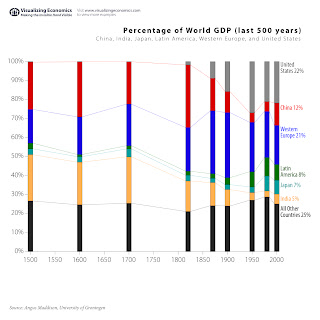
Another of those curse-the-British claims is that India was one of the richest countries in the world when the British came in. India’s contribution to global GDP was 25% in the year 1750. And, when the British left us in 1947, they had stripped us dry and made us paupers.

Sure enough, charts such as this one below ( source) can be used to corroborate above claim. It does look like the rise in prosperity of Western Europe coincided with the drop in GDP share of India.


But, as many economists have pointed out, correlation is not the same as causation. For, till mechanization improved productivity levels dramatically, GDP was directly proportional to the manual productivity of the human population, assuming that there were no other adverse factors at work. If India had 25% of the world’s population in the year 1750, it was logical that its contribution to global GDP would also be around 25%. Industrial revolution in England in the late 18th century changed these equations dramatically, as a machine could produce more goods much faster than several individuals put together.

Why did industrial revolution begin in England and not in India or China? Or, for that matter, why not in France or Spain? Tim Harford provides some answers in the chapter titled, “A million years of logic”, of his book, “The Logic of Life”.

As Harford explains, human beings respond to incentives. And England happened to provide the right incentives and the right conditions conducive for mechanization to take place. In 1750, England had the highest labour wages, anywhere in Europe, and certainly far more than in India or China. It also happened to have the cheapest fuel- coal- that could be transported through short distances. There was a strong incentive therefore to replace high-cost labour with devices such as steam engines that would use coal. Also, higher wages meant that there was a good customer base for cotton clothing and this provided the impetus to develop cotton spinning machines. So, many of the important innovations of the Industrial Revolution were calculated and deliberate responses to high British wages and cheap British coal.

Ok, coal being there was a matter of geographical happenstance. But, why did England have higher labour wages ? Harford points out that this was a result of England, along with Spain, France, Holland, etc possessing a well-entrenched merchant class, having been involved in flourishing trade across the Atlantic for over two centuries. And, among these countries, England was the first to move towards a free market with property rights, fair taxation and minimal trade barriers. This provided the security blanket for more investments. A society with more capital investment and more entrepreneurship is also a society that is likely to enjoy more wages.

And, why did England have a freer society than Spain, Germany or France? Here, Harford admits, we hit bedrock. It was a combination of ‘luck, politics and even theology”.

So, with or without the British ruling India, the former was well placed to usher in the industrial revolution and reap the full benefits. And, the latter, was always vulnerable to the economic threat of having its share of GDP reduced, as the productivity of its manual labour would have been no match for the might of the machines.

But, wouldn’t India too, if left alone, have marched on to its own industrial revolution? Alas, no. If we go by Harford’s logic, the incentives were simply not there. Labour was abundant and available at very low cost. Why replace that?

( Disclaimer: This does not purport to be an endorsement of British rule in India)

Tuesday, February 26, 2008

The IPL tribes

In an earlier post, I had quoted a professor describing modern-day tribalism as “a give-no-quarter and take-no-prisoners activism that demands satisfaction and accepts no compromise.”

Tribalism is most rampant in sports. Take cricket. An India vs Australia encounter, a Delhi vs Mumbai Ranji Trophy match or a South Zone vs North Zone Duleep Trophy match brings out the worst kind of tribalism.

So, when the IPL announced that the teams would comprise players drawn from different countries, as in the European football league, I heartily approved of the idea. Tribalism needs a geographical region (village, state, zone or country) to flourish and by removing this dimension, IPL was helping develop a broader mindset, I thought.

But, sports need sponsors. Sponsors look for returns. Crowds don’t come in, if the game is not competitive enough. It will not get competitive unless passions and baser instincts are stirred. And this stirring will not happen unless tribal feelings are invoked in some manner. So, all teams have been instructed to prefix the name of the city, Chennai, Delhi, Mumbai, Bangalore, etc. Even if most of the players in the team would be from outside the city, the name of the city would serve the purpose of kindling the tribal spirit.

I wonder how it would have panned out if the teams had been allowed to take on ‘neutral’ names, with no city tags. Would it have bombed totally, with fans unable to identify or align themselves with any of the teams?

It would be interesting to see the new shape that tribalism would assume. If Delhi were to play Chennai, would I root for Dinesh Karthik when he is facing Murali? The former may be playing for Delhi, but he hails from Chennai. The latter may be playing for Chennai, and is a Tamilian too, but he is a Sri Lankan, not an Indian.

And what if I were to attend a match in Chennai and refuse to take sides? Would you call me disloyal to my home town, disinterested and disengaged?

As Don Bourdreaux says in this post :

“Being libertarian, I find no romance in collective action. The yearning to be part of a great collective "challenge or crusade" - be it conservative or "liberal" - reflects humans' tribal instincts. These instincts served a sound purpose during our hunter-gatherer past, but are today at odds with the individualism that makes us free and prosperous

…don't presume that if I choose not to join in any collective effort, or only in a collective effort involving fewer persons than the efforts you favor, that my life is somehow empty, my soul shriveled, my mind small, my heart uncaring, my habits contemptible. I myself might well wish to be part of a cause larger than myself -- I reserve that right -- but I promise never to force you to join with me; I promise never to presume that you are less of a person if you refuse to join my cause or even if you refuse to any collectively pursued cause

Saturday, February 16, 2008

My life! What a mess! Sigh!

An online magazine just published a book, Not Quite What I Was Planning. More than a year ago, they had challenged their readers to write their life story in six words. More than 15,000 did, and 832 of these life stories are in this book.

Apparently, the inspiration for this was Ernest Hemingway who is supposed to have written a six-word story:

“For sale. Baby shoes. Never worn.”

He called it his best piece of work.

Hmmm.

Hemingway could get away with it. Once these authors become famous, they can write any nonsense and it will pass off as masterpiece. Readers will find some hidden meaning and deep insights.

I have heard about an incident that happened in one of those Kavi Sammelans. A famous poet took out a piece of paper from his pocket and read out in a lyrical tone,

Poet : “Ek Kurta”
Audience : “Wah, Wah”
Poet : “Do Pyjama”
Audience : “Wah Wah”
Poet: “Ek Kurta, Do Pyjama, Teen Banian.”
Audience : “Wah, Wah”
Poet : “Oops, sorry, that was my laundry list. Here’s the poem…..”

So, if you can somehow become famous, then the halo effect will take over. Even your laundry list will be conferred the status of poetry. Same with this Hemingway story.

Last year, Wired magazine had invited a few sci-fi authors and writers to come up with their own six-word stories. Here’s the article. I liked these short stories

.
"Failed SAT. Lost scholarship. Invented rocket."- William Shatner
"Automobile warranty expires. So does engine".- Stan Lee
"Epitaph: Foolish humans, never escaped Earth".- Vernor Vinge
"Computer, did we bring batteries? Computer?"- Eileen Gunn
"Dinosaurs return. Want their oil back".- David Brin
"Steve ignores editor's word limit and"- Steven Meretzky

Want to give it a try? If you can come up with six word stories, send them across to me. I promise to read them.

Tuesday, February 12, 2008

Adam or Madam

In his book, The Logic of Life, the author, Tim Harford applies economic theory while discussing the sensitive subject of marriage.

He explains that there is interplay of three factors- economies of scale, division of labour and comparative advantage, in assigning roles and responsibility in a marriage.

Let start with the male parent. For the sake of this discussion, let us give him a short and sweet name, say, Raj. And, let us refer to the female parent as – here we will let our imagination go wild- the “wife”. For the sake of convenience, we will drop the inverted commas and call her simply as the wife.

Now, let’s say that these two parents- Raj and wife- have two daughters who are growing up and need attention. Lunch bags have to be packed, pencils need to be sharpened, pens need to be inked, rulers have to be scaled, etc. So, money has to be earned to buy all these things and energy expended in managing the tasks that these things are meant for.

Adam Smith’s principle of division of labour says that each parent must do specialised work, just as in a pin factory, one specialist draws the metal, the other hammers the head, the third inserts them into a piece of paper. Similarly, it doesn’t make sense for each parent to share all the responsibilities equally. Two specialists in respective fields are many times better than two handymen. Make no mistakes, says Tim Harford, marriage is the oldest pin factory of all.

‘A household in which both parents work part-time on their careers and part-time looking after children and the home does not make rational economic sense. Two halves are much less than a whole. Economies of scale dictate that, logically, one partner should apply himself or herself full-time to paid work. The other should work at home-making, and only work for money if there is some spare time available after the household chores. So far this is classic Adam Smith.’

The rule of ‘economy of scale’ dictates that one parent working full time can earn more than two parents working half time each. So, only one parent must go out to work, while the other must get down to household chores. The question is who?

In the hunter-gatherer days and even upto the ‘50s and ‘60s, it was believed that the male parent was better at outdoor work ( and therefore ‘earning’) while the female parent was a specialist at managing household work. But, this was only a partial application of the principle of comparative advantage.

In the case where wife is four times better than husband at house-work and only twice as better at earning money, then it was wrongly concluded that the task of house work should be entrusted to wife. The fact that she was also twice as good in earning money was relegated to the background. ‘The logic of comparative advantage highlighted something that most men—except economists—have found it hard to get their heads around: there is no reason to believe that men were breadwinners because they were any good at it. They might simply have been breadwinners because getting them to help around the house would have been even worse.’

This truth, as we will see, applies to the couple, Raj and wife, who form part of our case study. It so happens that Raj is one of those poor suckers still stuck in an old-economy company, where an increment of 5% in salary, once in a year, is considered par for the course. Whereas wife is in the IT sector, where as is well known, employees go to office only to collect letters from employers that grant them increments once a week, plus stock options and a company-sponsored holiday for entire family in an exotic locale once a month.

So, it makes sound economic sense for wife to apportion her time equally between office and home, earning money for the family during the day and finishing all the household chores in the evening and night, she offering comparative advantage on both counts.

Now, Raj has his own strengths. He is a better blogger than his wife and is in the top one-percentile of the population of over a billion people. He is also a better golfer than his wife, and a better badminton player too. So, clearly, the family would immensely benefit from his specialist roles of blogger in the mornings, golfer in the afternoon and a badminton player in the evenings.

All in all, a happy family. What’s more, a sound economic unit, that Tim Harford would approve of. Each performing specialist roles that offer comparative advantages.


Update (14/02/08).

I am surprised that a reader has presumed that the character Raj is me, and wife is my wife . I ought to have mentioned that this was merely a case study and that if any of the names or characters bears any resemblance to any living person, it is purely coincidental.

I also discussed this case study with a Professor of Economics and sought his opinion. He agrees that the conclusion follows sound reasoning grounded in classical economic theory. He however cautions that some narrow-minded economist might give a twist to the last part and say that Raj cannot, on the one hand, give up work citing reason that he is not a specialist and, on the other hand, choose to be a generalist dividing his time between blogging, golfing and, er, badmintoning. He must specialise in one of these.

As an aside, wasn’t it Harry Truman who said, “Give me a one-armed economist. All the ones I know keep saying, on the one hand, on the other….”

So, if Raj can only find an one-armed economist, he can become a generalised specialist of all three activities and contribute to his family welfare.

Thursday, February 07, 2008

The tribal spirit

According to a study conducted by Robin Dunbar, a British anthropologist, there is a “cognitive limit (roughly 150) to the number of people with whom one can maintain a stable relationship”. Beyond 150, the human brain must resort to some combination of hierarchical schemes, stereotypes, and other simplified models in order to understand so many people.

This 150 itself can be achieved only under circumstances where more than 42% of the group’s timing was spent on social grooming. That’s why only groups under intense survival pressure, such as subsistence villages, nomadic tribes, and historical military groupings have, on average, achieved the 150-member mark

The Dunbar number of 150 is directly proportional to the size of the neocortex of the human brain. For primates with smaller brains, the number is even smaller. Thus, the tendency to limit group sizes is hard-wired in our brains and, at different stages in human evolution, has manifested itself as a different form of tribalism. Malcolm Gladwell touched on this aspect while discussing social groups in his book, The Tipping Point.

Up to a degree, tribal behaviour needed to be encouraged as it conferred evolutionary advantage on the group. In the past, this helped in formation of small homogenous groups (villages, townships, religious groups, etc) but once the critical number was reached, fissiparous tendencies took over. It could be in the form of fratricidal or territorial battles, religious wars or disputes over languages. History is replete with such examples.

Is tribalism a thing of the past and only to be found in history books?

No. An article by Dave Frohnmayer, President, University of Oregon (written in 1998, I found this by following a wiki link) argues that tribalism is well and alive. And what is New Tribalism? It is the growth of a politics based upon narrow concerns, rooted in the exploitation of divisions of class, cash, gender, region, religion, ethnicity, morality and ideology. A give-no-quarter and take-no-prisoners activism that demands satisfaction and accepts no compromise. It is a raw permissiveness that escalates rhetorical excess sometimes even to physical violence. And it is an environment where our political system of limited government is asked to take on social and religious disputes that the system cannot possibly resolve.

The group size may have exceeded the Dunbar number due to explosion in population, but the behaviour remains.

Thus, when Karunanidhi uses the Tamil card and rhetoric to fan the flames of linguistic fervour, when the Thackerays ( Bal or Raj) invoke the Maratha spirit to drive their followers into a state of frenzy, or when the BJP plays the Hindu vs Muslim game, they are simply exploiting the innate tribalism that is woven into our genes. In short, “the monkey in us” unconsciously responds to these calls of the wild.

Nationalism is also a form of tribalism, but which we need to put up with. It ensures a larger group identity, reduces the number of such tribes globally and provides administrative and logistical convenience. Global trade ought to have provided the impetus for breakdown of national borders and man-made barriers.

Alas, however much Thomas Friedman may rave, globalization of trade and commerce cannot happen when tribalisation of mind-set is rampant.

So, the only development that can bring human beings together is if an alien group from a distant star was to attack Earth. Perhaps then, our tribal instinct will make us cling to one of our kind, against a common enemy.


Wednesday, February 06, 2008

Conversation with daughter-22

Daughter: I am a little confused with these proverbs. One tells me that ‘too many cooks spoil the broth’, while another tells me that “more hands make light work”.

Me: You mean like “the early bird gets the early worm”, but “the early worm gets eaten by the early bird”?

Daughter: I don’t get that, but what I meant was if “two is company, three’s a crowd”, how can “more the merrier” be true?

Me: You don’t question proverbs. And, they are not meant to advise you how to handle a situation. They are used to explain a situation after you have messed it up.

Daughter: Thanks. As always, you were a great help.

Me: Now get lost, you precocious brat, while I record this conversation, for posterity, in my ongoing dad-daughter-dialogue series.

A week after my daughter had this moment of epiphany, I picked up a book called, “ A Man of My Words”, by Richard Lederer ( Original price Rs 1073, special price Rs 249, You save Rs 824, Landmark Sale), in which an entire chapter is devoted to this subject. Lederer observes :


“A proverb is a well-known, venerable saying rooted in philosophical or religious wisdom. Just about everybody knows some proverbs, and we often base decisions on these instructive maxims. But when you line up proverbs that spout conflicting advice, you have to wonder if these beloved aphorisms aren’t simply personal observations masquerading as universal truths:

How can it be true that you should look before you leap, but make hay while the sun shines? It’s better to be safe than sorry, but nothing ventured, nothing gained. Haste
makes waste, but he who hesitates is lost. Patience is a virtue, but opportunity knocks but once. Slow and steady wins the race, but gather ye rosebuds, while ye may. A stitch in time saves nine, but better late than never. Don’t count your chickens before they are hatched, but forewarned is forearmed. Never put off till tomorrow what you can do today, but don’t cross the bridge till you come to it. There’s no time like the present, but well begun is half done. All things come to him who waits, but strike while the iron is hot. Fools rush in where angels dare to tread, but faint heart never won fair maiden….. Absence makes the heart go fonder, but out of sight, out of mind.

......So, all you have to do is figure out which proverb to use under which circumstances. Quite apparently, whichever side of an argument one takes, one can usually find a proverb to support it. That’s why Cervantes wrote, “There is no proverb that is not true”, while Lady Montagu proclaimed that “general notions are generally wrong”.

I wish I had picked up this book before I had the conversation with daughter. I could have impressed her with some scholarly stuff. After all, opportunity knocks but once. But then, there's no point in crying over spilt milk.

Tuesday, February 05, 2008

Boyle's walk

Mark Boyle of the UK is travelling to India. That’s not big news, but he plans to walk the whole distance. Even that’s been done by travelers in the past. What makes his journey unusual is that he will carry no money with him. Not even traveller’s cheques or credit cards.

Mark Boyle is a freeconomist. No, not a freakonomist, but one who is part of the freeconomy movement which seeks to create a moneyless society. “The more money we accumulate” he says, “the more it leads to a breakdown of community”.

“We need to get back to a more communal way of living”, he believes.

Hmm, must be some rich kid wanting to do something different.

As I don’t have enough money to join him on his adventure, I will just wish him good luck.

And, what’s got into BBC News? The map that they have published in the article on Mark Boyle is neither authentic nor true. I have seen maps where the disputed area of Kashmir is shown in either Pakistan or India. Here they have represented the entire Jammu & Kashmir as an independent country. But, in fairness to BBC, they have left out Scotland and Wales from UK too. So, it squares things up.

Update 29/02/08 : Mark Boyle had to abandon his journey at Calais, France.

Monday, February 04, 2008

Quiet typewriter proprietor wrote quite proper poetry

Contrived, no doubt, but whenever Technorati decides to scan the blogosphere for the longest blog title typed out by using any one line of the standard Qwerty keyboard, I want mine to figure in the list of top 100. Wish me luck.

Try your repertoire too

Sunday, February 03, 2008

Let's join the crowd

Jonah Lehrer of Frontal Cortex links to a video of a prank ( The day New York froze) and says it reminds him of that Stanley Milgram experiment where people were made to stop on busy New York City sidewalks and look up. When only one person was stopped, about 4 percent of pedestrians joined the man and looked at whatever he was looking at. But as Milgram increased the crowd size, more and more people stopped and stared. In other words, it was a positive feedback loop. A bigger crowd staring at the sky led to even bigger crowds. And everybody was looking at nothing. Such is the power of "social validation", he explains.

Jonah then notes wryly that perhaps this is what explains the popularity of American Idol.

If I can add, equally wryly, this perhaps explains the popularity of Shah Rukhkhan’s movies as well as the several brain-stopping serials on television. The first 5000 naïve people fell for the publicity gimmicks, then the next 5000 thought that maybe there was something to it and joined in; then the next 10000 and so on, till the critical mass was acquired. Then the snowballing went on uncontrollably.

In some situations, I am part of the first 5000; in some other situation, I am in the ‘join-the-crowd’ mode and in certain others, I cling to the exterior of the snowball. The pull of the correspondence bias, is hard to resist.


Even if we are staring at nothing.

Raj's heroism and moral courage

“The City Police on Wednesday presented an autorickshaw driver a cash prize for displaying honesty and sense of citizenship in returning a bag left in the vehicle by a passenger, which contained money and valuable documents.”
Once in a while we see such news items.

It is a sad reflection of the times that we live in that a simple act of honesty, needs to be rewarded. What is actually being recognised here is that the ‘auto-driver” deserves praise not so much for being honest as for not being dishonest, which he well could have been. For, isn’t that the default setting now? That’s why, such news items appear only “once in a while”.

(To test this theory, I am curious to know if such an act would fetch a reward in Singapore).

A very similar observation can be made in the case of the accolades showered on Adam Gilchrist, the Australian batsman, on his retirement. The man is eulogised for his willingness to accept that he is out. When he knows he has snicked a ball, he doesn’t wait for the umpire to lift his finger. He starts walking back to the pavilion. Just as Phantom was referred to as a “ghost who walks”, Gilchrist is a “man who walks”.

Nirmal Shekhar, sports writer for The Hindu, who tries to infuse as much poetry into his columns as possible, waxed lyrical on an incident in which Gilchrist had, you guessed it, walked:

There was not even the slightest hesitation as he walked. But, then, knowing the man, you would expect him to, wouldn't you?

So what's new? He did it in Chennai, when his team was staring at a possible defeat. He has done it before that. And, surely, he will do it again. In the event, what's the fuss all about?

Ah, how smugly we get used to goodness of character! How easily we brush aside moral issues of timeless significance! Almost dismissively we accept moral courage in the competitive cauldron of modern sport! We take for granted the behaviour of a few heroic men like Gilchrist as a matter of habit.

Here lies Gilchrist's greatness. He will live and play the only way he knows how to: fairly, honourably, as a good sport…….In the high-noon of professional sport when commercial pressures have re-ordered the sporting arena and have effected a evaluation of values, if someone had written a piece of sports fiction with a Gilchrist-like hero, he might have been thought of as old-fashioned.

…..Winning and losing pale into insignificance when compared to such matters of principle, when put alongside such heroic acts of moral courage as enacted by Gilchrist time and again.


From a simple act of honesty, the incident is blown up to be an exhibition of rare moral courage and extreme display of heroism! In fact, Nirmal Shekar goes out of his way to dissuade the reader from taking such behaviour for granted.

So, when I voluntarily pay my income tax on what I earn, when I stop at the red light even where there is no cop around, when I don’t steal my neighbour’s newspaper in the morning when it is lying outside his locked house, when I don’t purloin the paintings from the hotel room I stayed in, when I don’t walk away with the helmet that a scooterist has carelessly left behind on his vehicle while parking, I deserve all the brownie points. For, these are acts of rare courage emanating from a person of high moral fibre and exemplary character.

Makes me feel good.

Friday, February 01, 2008

Major and minor offence

In the Harbhajan Singh imbroglio, the text of the verdict delivered by Justice Hansen refers to the following cross-questioning of witness:

“Mr V.R.MANOHAR (lawyer, defending Harbhajan) : I put it to you that apart from the other Indian abuses he said to you the words “teri maki”?

Symonds: Possibly; I don’t recall, I don’t know that language.”

Finally, as we all know, the more serious charge of racism was dropped and Harbhajan was punished for a smaller offence of having used abusive language. Sharad Pawar and others have gone on record that justice had finally been done, and he would never have tolerated it, if any Indian cricketer had been accused of racial abuse.

I am personally very unimpressed with this Manohar. Can’t the BCCI find a lawyer who is slightly more proficient in English? Someone who can use a grammatically more correct name of “I am Manohar” instead of “V.R.Manohar”?

That side, I am very impressed with his questioning technique and his understanding of the nuances of law. Should be used in other situations, say, one in which an accused is under trial, for an attempted rape.

Defence lawyer to victim: I put it to you that defendant was not trying to rape you, but merely trying to choke you to death.

Victim: Now that you tell me, that’s quite possible,. If he had only mentioned his true intentions, I wouldn’t have panicked

Judge : Case dismissed. Preosecution has failed to provide sufficient evidence. Defendant is acquitted of the more serious charge of rape. However, for the minor offence of attempted murder, which the accused has graciously admitted as true, I fine him an amount equal to half his monthly salary.