Tuesday, March 04, 2008

If not P, then Q

When Opposition members raised some objections to the generous Rs 60000-crore farm loan waiver in his Budget , the Finance Minister retorted with an obviously, well-rehearsed political poser, “Are you for the farmer or against the farmer? Stand up and be counted”. Implication being that if you are for the farmer, you won’t be opposing this waiver. On the other hand, if you are against the farmer, then stand up and say so, let the voters know….

Such arguments have been used before. The most famous one being that of George W Bush when he stated, “Either you are with us or against us in the war on terrorism”.

A form of logic or argument known as disjunctive syllogism starts with the premise that either condition P exists or condition Q exists, then goes on to claim that as condition P is not seen to be existing, therefore condition Q it must be then. You can either be pro-farmer or anti-farmer. As you are not speaking for the farmer, you must be against him.

As an argument, and if the premises are right, then disjunctive syllogism is a valid one. But, what Bush and Chidambaram did was to convert this into a false dilemma. one in which two alternative statements are held to be the only possible options, when in reality there exists one or more other options which have not been considered. In other words, even if the two options are mutually exclusive, they are not collective exhaustive. For example, I may be for the farmer, but against irrational, populist sops. This doesn’t make me anti-farmer.

Either you agree with me or you are a crook.

Invisible....

The Hindu carries a short report every day on some religious discourse or other that was delivered recently. Quoting from one such discourse , today’s edition said that due to the Lord’s inscrutable power of Maya, human beings were unable to comprehend his divine nature and power, but his compassion is nevertheless received and felt by his true believers. There are no calves which do not know their mothers, and the mother knows her calves too. Similarly, with God and believers, concluded the sermon.

To be a good salesman, wrote Mark Stevens in his book, “God is a salesman”, turn to God for a few lessons. Focus on educating and instilling faith, rather than on selling. Like God, the best salespersons are invisible. They never look like they are trying to sell anything.

Exponents of Harikatha and authors who resort to abstract metaphors and similes, rarely find it necessary to substantiate their statements with logic or reasoning.

But, the ‘scientist’ in me naturally militates against such nonsense. Why should the fact that a cow knows all its calves be used as an argument to claim that God knows all his believers? What is the evidence that something that works for God will also work for a salesman?

And even if we accept the fact of the invisibility of God, we hit another barrier. The Russian writer, Yakov Perelman, while discussing H.G.Wells’ famous story “Invisible Man” in his delightful book, Physics for Entertainment (1913), pointed out that the main drawback of the invisible man was that he would be blind himself, as the human eye could ‘see’ only through a medium that absorbs incoming light. So, even if were to grant the omnipotent God the powers to spot the right individuals to dispense his/her favours, then we should, at the very least, be able to spot his/her eyes somewhere, if not his/her entire self.

A friend of mine, a scientist and who is also deeply religious heard me out and said that I was only confirming what he knew all along, that I was an extremely confused individual. Why should I try to apply cold scientific reasoning in all areas of my life, he asked? He himself found his peace of mind by clearly compartmentalizing his work and his personal life into which he infused a generous dose of religion and worship of God. His 9-to5 work was all about scientific methods of questioning, collecting evidence, examining one variable at a time under controlled conditions, etc. The other part of his life involved unquestioning, total faith. These two were mutually exclusive. Problems arise only when you try to apply the rigour of scientific inquiry into the domain of religious matters and faith. Don’t waste your time in trying to cloak an ancient ritual or practice in the garb of scientific analysis. It does not require such validation.

He added that, incidentally, the history of pursuit of science itself was replete with examples of individuals who succeeded through irrational faith rather than proper reasoning. We praise Edison for his tenacity in perfecting the light bulb, when the odds were stacked up against him and it was completely irrational to battle with such improbability. “I succeeded in my 1000th attempt. I learned 999 ways of how not to develop a light bulb”, he famously proclaimed. He was guided by pure faith that his efforts would succeed. Not by reason.

Even in the argument between the creationists and evolutionists, it is not as if the former clearly comprise the religious-minded while the latter are all scientifically-trained. A fair portion of the scientific community is people of faith. So, the argument is not between believers and non-believers. The conflict is more between people of faith who insist on a literal reading of the Bible and those of faith who don’t.

Thursday, February 28, 2008

The scientist and the story-writer.

Sujatha, the Tamil writer who passed away yesterday, was not only a gifted and versatile novelist and columnist; he was also a reputed scientist, who had led the design team at Bharat Electronics Ltd, that developed the electronic voting machine. This fact, I learnt, from the obituary that appeared in several newspapers today.

Popular perception is that scientific temper and literary orientation are not compatible. But, clearly, some individuals such as Sujatha seem to have been blessed with heightened capabilities, with respect to both the left and right sides of the brain. The nuclear scientist, Raja Ramanna, was also an accomplished pianist and had given several solo performances. Former President Kalam, a scientist by training, breaks into poetry, at the slightest opportunity.

In an article titled,” The scientist and the poet” Paul Cantor, Professor of English, University of Virginia, wrote:

….the scientist and the poet seem to us to be perpetually at odds. To the poet, the scientist seems unimaginative and literal-minded—with his head buried in the ground of facts, incapable of comprehending the larger significance of what he does. To the scientist, the poet seems to have his head up in the clouds, indulging in fantastic visions of what might be and losing sight of the way things really are. It is difficult for us to imagine a successful conversation between a scientist and a poet—they seem almost to speak different languages.

But before positing an unbridgeable gulf between science and poetry, it is well to remember that the great poet Goethe was also a scientist. He is of course best remembered for his imaginative works, such as Wilhelm Meister and Faust, but his contributions to science were not insignificant. Among other things, he was an accomplished botanist, he helped found the field of comparative anatomy, he coined the term morphology, and he anticipated the theory of evolution

Paul Cantor goes on to narrate how poets and writers, including die-hard romantics like Wordsworth, came to recognise the creative power in science. The same Wordsworth who was known more for his evocative images of towering mountains and thundering waterfalls even wrote a sonnet where he had described steamboats, viaducts and railways, as ‘sublime’.

Richard Feynman responded to criticism that a cold scientific view of the Universe robbed it of all its beauty :

Poets say science takes away from the beauty of the stars — mere globs of gas atoms. Nothing is "mere". I too can see the stars on a desert night, and feel them. But do I see less or more? The vastness of the heavens stretches my imagination — stuck on this carousel my little eye can catch one-million-year-old light. A vast pattern — of which I am a part... What is the pattern or the meaning or the why? It does not do harm to the mystery to know a little more about it. For far more marvelous is the truth than any artists of the past imagined it. Why do the poets of the present not speak of it? What men are poets who can speak of Jupiter if he were a man, but if he is an immense spinning sphere of methane and ammonia must be silent? ( wiki source).

Feynman also came up with this lovely poem, imagining himself standing on the sea front::

There are rushing waves...
mountains of molecules,each stupidly minding its own business...
trillions apart...
yet forming white surf in unison.

Ages on ages...
before any eyes could see...
year after year...
thunderously pounding the shore as now.
For whom, for what?...
on a dead planet
with no life to entertain.

Never at rest...
tortured by energy...
wasted prodigiously by the sun...
poured into space.
Its might makes the sea roar.

Deep in the sea,
all molecules repeat
the patterns of another
till complex new ones are formed.
They make others like themselves...
and a new dance starts.

Growing in size and complexity...
living things,
masses of atoms,
DNA, protein...
dancing a pattern ever more intricate.

Out of the cradle
onto dry land...
here it is standing...
atoms with consciousness..
matter with curiosity,
stands at the sea...
wonders at wondering...
I,.a universe of atoms,
an atom in the universe.


Well done, Hayden

After my post on IPL brand of tribalism, there have been some interesting developments. Hayden has been reprimanded for referring to Harbhajan as an obnoxious little weed. There is much discussion in the media.

On behalf of the fans of Chennai Super Kings, I would like to voice my protest at the treatment being meted out to Hayden, one of our star players. If the Mumbai team thinks that one of their members can continue to be an obnoxious weed, but one of our players cannot say so, they are sadly mistaken. As for you, Dhoni, can you please shut up and stop supporting Harbhajan?. Hell man, we have paid you Rs 6 crores and we expect you to get along amicably with your Chennai team mates, without bad-mouthing them.

And, will Shahrukh Khan please tell his auction prize, Ishant Sharma, to be a man and step into the ring, as suggested by Chennai star, Hayden, so that the matter can be settled in a gentlemanly way?

Wednesday, February 27, 2008

LPA

In a country where associations and clubs are started on the slightest pretext and for the most bizarre of reasons, nothing should surprise us. Yet, when I heard that a ‘Lovers Protection Association’ had been formed in Tiruchi, with one Karathe Muthukumar as its President, I sat up and took notice.

The Hindu reports that the association was formed ahead of Valentine's Day this year, to counter the menace of moral policing by the Hindu Munnani ( Note, this is a different Hindu and nothing to do with The Hindu). The Munnani had posted its volunteers at strategic points in the town to accost lovers and make tying of mangalsutras a pre-condition for the couples to enter the place as couples. The Lovers Protection Association then rallied to the support of these harassed couples.

Quite simply what these lovers wanted to do was to visit some temple or sit in a quiet spot, whispering sweet-nothings into each other’s ears. And the Munnani would not let them.

While I respect their right to keep whispering to their heart’s content, I ( a.k.a Mr. Unromantic) can’t help wondering, as R.K.Narayan reflected once, what these couples can possibly talk on for hours. Here’s RKN after a visit to a park:

Young couples sit in remote corners, in the shelter of bushes, conversing in whispers, their backs turned to the public. Day after day they sit there, I get very curious to know what they are saying. Of course, there must be an affirmation of each other’s dedication and devotion. It can’t go on repeated a thousand times day after day ad nauseam. They must have other things to talk about, their houses and parents or the hurdles in their way.

I would give anything to understand them. I wish them well and success to their romance. I know the whispers will cease ultimately, once they become man and wife. You can’t go on whispering all life. There will come a natural phase when you will shout at each other in the course of an argument or spend long pauses of silence, sitting in two chairs and staring ahead at a wall, a tree with no subject left for conversation. All that could be said has been said, followed by an unmitigated, pregnant silence. A perfect attunement and communication of minds has been attained where speech is superfluous. In Kamban’s Ramayana, where Rama and Sita are left alone after their wedding, they remain silent having nothing to say. The poet explains, “Those who were always together eternally as Vishnu and Lakshmi and separated only a moment ago have no need to talk”.


Had the British not been in India...........

At a seminar that I attended, a senior IAS official delivered a populist address in which he bemoaned the fact that the British had saddled us with bureaucratic processes and red tape that continued to plague us even today. He had no explanation to offer - nor did he feel that one was necessary- on why we have not changed the systems in the 60 years since they left us.

Another example of blame-the-British was an e-mail that did the rounds last year. It quoted Lord Macaulay as saying, in 1835, that the Indians were far too prosperous and knowledgeable and could be brought to heel only by replacing Sanskrit with English. A blogger, Gaurav Sabnis, had discussed this e-mail and had shown that it was a big hoax. (That the ‘true’ speech of Macaulay was even more damaging to our pride, we will not go into now)

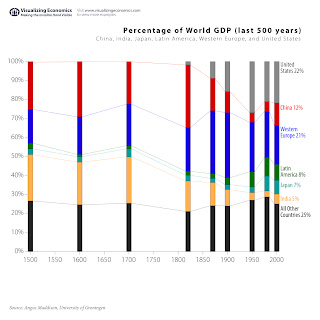
Another of those curse-the-British claims is that India was one of the richest countries in the world when the British came in. India’s contribution to global GDP was 25% in the year 1750. And, when the British left us in 1947, they had stripped us dry and made us paupers.

Sure enough, charts such as this one below ( source) can be used to corroborate above claim. It does look like the rise in prosperity of Western Europe coincided with the drop in GDP share of India.


But, as many economists have pointed out, correlation is not the same as causation. For, till mechanization improved productivity levels dramatically, GDP was directly proportional to the manual productivity of the human population, assuming that there were no other adverse factors at work. If India had 25% of the world’s population in the year 1750, it was logical that its contribution to global GDP would also be around 25%. Industrial revolution in England in the late 18th century changed these equations dramatically, as a machine could produce more goods much faster than several individuals put together.

Why did industrial revolution begin in England and not in India or China? Or, for that matter, why not in France or Spain? Tim Harford provides some answers in the chapter titled, “A million years of logic”, of his book, “The Logic of Life”.

As Harford explains, human beings respond to incentives. And England happened to provide the right incentives and the right conditions conducive for mechanization to take place. In 1750, England had the highest labour wages, anywhere in Europe, and certainly far more than in India or China. It also happened to have the cheapest fuel- coal- that could be transported through short distances. There was a strong incentive therefore to replace high-cost labour with devices such as steam engines that would use coal. Also, higher wages meant that there was a good customer base for cotton clothing and this provided the impetus to develop cotton spinning machines. So, many of the important innovations of the Industrial Revolution were calculated and deliberate responses to high British wages and cheap British coal.

Ok, coal being there was a matter of geographical happenstance. But, why did England have higher labour wages ? Harford points out that this was a result of England, along with Spain, France, Holland, etc possessing a well-entrenched merchant class, having been involved in flourishing trade across the Atlantic for over two centuries. And, among these countries, England was the first to move towards a free market with property rights, fair taxation and minimal trade barriers. This provided the security blanket for more investments. A society with more capital investment and more entrepreneurship is also a society that is likely to enjoy more wages.

And, why did England have a freer society than Spain, Germany or France? Here, Harford admits, we hit bedrock. It was a combination of ‘luck, politics and even theology”.

So, with or without the British ruling India, the former was well placed to usher in the industrial revolution and reap the full benefits. And, the latter, was always vulnerable to the economic threat of having its share of GDP reduced, as the productivity of its manual labour would have been no match for the might of the machines.

But, wouldn’t India too, if left alone, have marched on to its own industrial revolution? Alas, no. If we go by Harford’s logic, the incentives were simply not there. Labour was abundant and available at very low cost. Why replace that?

( Disclaimer: This does not purport to be an endorsement of British rule in India)

Tuesday, February 26, 2008

The IPL tribes

In an earlier post, I had quoted a professor describing modern-day tribalism as “a give-no-quarter and take-no-prisoners activism that demands satisfaction and accepts no compromise.”

Tribalism is most rampant in sports. Take cricket. An India vs Australia encounter, a Delhi vs Mumbai Ranji Trophy match or a South Zone vs North Zone Duleep Trophy match brings out the worst kind of tribalism.

So, when the IPL announced that the teams would comprise players drawn from different countries, as in the European football league, I heartily approved of the idea. Tribalism needs a geographical region (village, state, zone or country) to flourish and by removing this dimension, IPL was helping develop a broader mindset, I thought.

But, sports need sponsors. Sponsors look for returns. Crowds don’t come in, if the game is not competitive enough. It will not get competitive unless passions and baser instincts are stirred. And this stirring will not happen unless tribal feelings are invoked in some manner. So, all teams have been instructed to prefix the name of the city, Chennai, Delhi, Mumbai, Bangalore, etc. Even if most of the players in the team would be from outside the city, the name of the city would serve the purpose of kindling the tribal spirit.

I wonder how it would have panned out if the teams had been allowed to take on ‘neutral’ names, with no city tags. Would it have bombed totally, with fans unable to identify or align themselves with any of the teams?

It would be interesting to see the new shape that tribalism would assume. If Delhi were to play Chennai, would I root for Dinesh Karthik when he is facing Murali? The former may be playing for Delhi, but he hails from Chennai. The latter may be playing for Chennai, and is a Tamilian too, but he is a Sri Lankan, not an Indian.

And what if I were to attend a match in Chennai and refuse to take sides? Would you call me disloyal to my home town, disinterested and disengaged?

As Don Bourdreaux says in this post :

Being libertarian, I find no romance in collective action. The yearning to be part of a great collective "challenge or crusade" - be it conservative or "liberal" - reflects humans' tribal instincts. These instincts served a sound purpose during our hunter-gatherer past, but are today at odds with the individualism that makes us free and prosperous

…don't presume that if I choose not to join in any collective effort, or only in a collective effort involving fewer persons than the efforts you favor, that my life is somehow empty, my soul shriveled, my mind small, my heart uncaring, my habits contemptible. I myself might well wish to be part of a cause larger than myself -- I reserve that right -- but I promise never to force you to join with me; I promise never to presume that you are less of a person if you refuse to join my cause or even if you refuse to any collectively pursued cause

Saturday, February 16, 2008

My life! What a mess! Sigh!

An online magazine just published a book, Not Quite What I Was Planning. More than a year ago, they had challenged their readers to write their life story in six words. More than 15,000 did, and 832 of these life stories are in this book.

Apparently, the inspiration for this was Ernest Hemingway who is supposed to have written a six-word story:

“For sale. Baby shoes. Never worn.”

He called it his best piece of work.

Hmmm.

Hemingway could get away with it. Once these authors become famous, they can write any nonsense and it will pass off as masterpiece. Readers will find some hidden meaning and deep insights.

I have heard about an incident that happened in one of those Kavi Sammelans. A famous poet took out a piece of paper from his pocket and read out in a lyrical tone,

Poet : “Ek Kurta”
Audience : “Wah, Wah”
Poet : “Do Pyjama”
Audience : “Wah Wah”
Poet: “Ek Kurta, Do Pyjama, Teen Banian.”
Audience : “Wah, Wah”
Poet : “Oops, sorry, that was my laundry list. Here’s the poem…..”

So, if you can somehow become famous, then the halo effect will take over. Even your laundry list will be conferred the status of poetry. Same with this Hemingway story.

Last year, Wired magazine had invited a few sci-fi authors and writers to come up with their own six-word stories. Here’s the article. I liked these short stories

.
"Failed SAT. Lost scholarship. Invented rocket."- William Shatner
"Automobile warranty expires. So does engine".- Stan Lee
"Epitaph: Foolish humans, never escaped Earth".- Vernor Vinge
"Computer, did we bring batteries? Computer?"- Eileen Gunn
"Dinosaurs return. Want their oil back".- David Brin
"Steve ignores editor's word limit and"- Steven Meretzky

Want to give it a try? If you can come up with six word stories, send them across to me. I promise to read them.

Tuesday, February 12, 2008

Adam or Madam

In his book, The Logic of Life, the author, Tim Harford applies economic theory while discussing the sensitive subject of marriage.

He explains that there is interplay of three factors- economies of scale, division of labour and comparative advantage, in assigning roles and responsibility in a marriage.

Let start with the male parent. For the sake of this discussion, let us give him a short and sweet name, say, Raj. And, let us refer to the female parent as – here we will let our imagination go wild- the “wife”. For the sake of convenience, we will drop the inverted commas and call her simply as the wife.

Now, let’s say that these two parents- Raj and wife- have two daughters who are growing up and need attention. Lunch bags have to be packed, pencils need to be sharpened, pens need to be inked, rulers have to be scaled, etc. So, money has to be earned to buy all these things and energy expended in managing the tasks that these things are meant for.

Adam Smith’s principle of division of labour says that each parent must do specialised work, just as in a pin factory, one specialist draws the metal, the other hammers the head, the third inserts them into a piece of paper. Similarly, it doesn’t make sense for each parent to share all the responsibilities equally. Two specialists in respective fields are many times better than two handymen. Make no mistakes, says Tim Harford, marriage is the oldest pin factory of all.

‘A household in which both parents work part-time on their careers and part-time looking after children and the home does not make rational economic sense. Two halves are much less than a whole. Economies of scale dictate that, logically, one partner should apply himself or herself full-time to paid work. The other should work at home-making, and only work for money if there is some spare time available after the household chores. So far this is classic Adam Smith.’

The rule of ‘economy of scale’ dictates that one parent working full time can earn more than two parents working half time each. So, only one parent must go out to work, while the other must get down to household chores. The question is who?

In the hunter-gatherer days and even upto the ‘50s and ‘60s, it was believed that the male parent was better at outdoor work ( and therefore ‘earning’) while the female parent was a specialist at managing household work. But, this was only a partial application of the principle of comparative advantage.

In the case where wife is four times better than husband at house-work and only twice as better at earning money, then it was wrongly concluded that the task of house work should be entrusted to wife. The fact that she was also twice as good in earning money was relegated to the background. ‘The logic of comparative advantage highlighted something that most men—except economists—have found it hard to get their heads around: there is no reason to believe that men were breadwinners because they were any good at it. They might simply have been breadwinners because getting them to help around the house would have been even worse.’

This truth, as we will see, applies to the couple, Raj and wife, who form part of our case study. It so happens that Raj is one of those poor suckers still stuck in an old-economy company, where an increment of 5% in salary, once in a year, is considered par for the course. Whereas wife is in the IT sector, where as is well known, employees go to office only to collect letters from employers that grant them increments once a week, plus stock options and a company-sponsored holiday for entire family in an exotic locale once a month.

So, it makes sound economic sense for wife to apportion her time equally between office and home, earning money for the family during the day and finishing all the household chores in the evening and night, she offering comparative advantage on both counts.

Now, Raj has his own strengths. He is a better blogger than his wife and is in the top one-percentile of the population of over a billion people. He is also a better golfer than his wife, and a better badminton player too. So, clearly, the family would immensely benefit from his specialist roles of blogger in the mornings, golfer in the afternoon and a badminton player in the evenings.

All in all, a happy family. What’s more, a sound economic unit, that Tim Harford would approve of. Each performing specialist roles that offer comparative advantages.


Update (14/02/08).

I am surprised that a reader has presumed that the character Raj is me, and wife is my wife . I ought to have mentioned that this was merely a case study and that if any of the names or characters bears any resemblance to any living person, it is purely coincidental.

I also discussed this case study with a Professor of Economics and sought his opinion. He agrees that the conclusion follows sound reasoning grounded in classical economic theory. He however cautions that some narrow-minded economist might give a twist to the last part and say that Raj cannot, on the one hand, give up work citing reason that he is not a specialist and, on the other hand, choose to be a generalist dividing his time between blogging, golfing and, er, badmintoning. He must specialise in one of these.

As an aside, wasn’t it Harry Truman who said, “Give me a one-armed economist. All the ones I know keep saying, on the one hand, on the other….”

So, if Raj can only find an one-armed economist, he can become a generalised specialist of all three activities and contribute to his family welfare.

Thursday, February 07, 2008

The tribal spirit

According to a study conducted by Robin Dunbar, a British anthropologist, there is a “cognitive limit (roughly 150) to the number of people with whom one can maintain a stable relationship”. Beyond 150, the human brain must resort to some combination of hierarchical schemes, stereotypes, and other simplified models in order to understand so many people.

This 150 itself can be achieved only under circumstances where more than 42% of the group’s timing was spent on social grooming. That’s why only groups under intense survival pressure, such as subsistence villages, nomadic tribes, and historical military groupings have, on average, achieved the 150-member mark

The Dunbar number of 150 is directly proportional to the size of the neocortex of the human brain. For primates with smaller brains, the number is even smaller. Thus, the tendency to limit group sizes is hard-wired in our brains and, at different stages in human evolution, has manifested itself as a different form of tribalism. Malcolm Gladwell touched on this aspect while discussing social groups in his book, The Tipping Point.

Up to a degree, tribal behaviour needed to be encouraged as it conferred evolutionary advantage on the group. In the past, this helped in formation of small homogenous groups (villages, townships, religious groups, etc) but once the critical number was reached, fissiparous tendencies took over. It could be in the form of fratricidal or territorial battles, religious wars or disputes over languages. History is replete with such examples.

Is tribalism a thing of the past and only to be found in history books?

No. An article by Dave Frohnmayer, President, University of Oregon (written in 1998, I found this by following a wiki link) argues that tribalism is well and alive. And what is New Tribalism? It is the growth of a politics based upon narrow concerns, rooted in the exploitation of divisions of class, cash, gender, region, religion, ethnicity, morality and ideology. A give-no-quarter and take-no-prisoners activism that demands satisfaction and accepts no compromise. It is a raw permissiveness that escalates rhetorical excess sometimes even to physical violence. And it is an environment where our political system of limited government is asked to take on social and religious disputes that the system cannot possibly resolve.

The group size may have exceeded the Dunbar number due to explosion in population, but the behaviour remains.

Thus, when Karunanidhi uses the Tamil card and rhetoric to fan the flames of linguistic fervour, when the Thackerays ( Bal or Raj) invoke the Maratha spirit to drive their followers into a state of frenzy, or when the BJP plays the Hindu vs Muslim game, they are simply exploiting the innate tribalism that is woven into our genes. In short, “the monkey in us” unconsciously responds to these calls of the wild.

Nationalism is also a form of tribalism, but which we need to put up with. It ensures a larger group identity, reduces the number of such tribes globally and provides administrative and logistical convenience. Global trade ought to have provided the impetus for breakdown of national borders and man-made barriers.

Alas, however much Thomas Friedman may rave, globalization of trade and commerce cannot happen when tribalisation of mind-set is rampant.

So, the only development that can bring human beings together is if an alien group from a distant star was to attack Earth. Perhaps then, our tribal instinct will make us cling to one of our kind, against a common enemy.


Wednesday, February 06, 2008

Conversation with daughter-22

Daughter: I am a little confused with these proverbs. One tells me that ‘too many cooks spoil the broth’, while another tells me that “more hands make light work”.

Me: You mean like “the early bird gets the early worm”, but “the early worm gets eaten by the early bird”?

Daughter: I don’t get that, but what I meant was if “two is company, three’s a crowd”, how can “more the merrier” be true?

Me: You don’t question proverbs. And, they are not meant to advise you how to handle a situation. They are used to explain a situation after you have messed it up.

Daughter: Thanks. As always, you were a great help.

Me: Now get lost, you precocious brat, while I record this conversation, for posterity, in my ongoing dad-daughter-dialogue series.

A week after my daughter had this moment of epiphany, I picked up a book called, “ A Man of My Words”, by Richard Lederer ( Original price Rs 1073, special price Rs 249, You save Rs 824, Landmark Sale), in which an entire chapter is devoted to this subject. Lederer observes :


“A proverb is a well-known, venerable saying rooted in philosophical or religious wisdom. Just about everybody knows some proverbs, and we often base decisions on these instructive maxims. But when you line up proverbs that spout conflicting advice, you have to wonder if these beloved aphorisms aren’t simply personal observations masquerading as universal truths:

How can it be true that you should look before you leap, but make hay while the sun shines? It’s better to be safe than sorry, but nothing ventured, nothing gained. Haste
makes waste, but he who hesitates is lost. Patience is a virtue, but opportunity knocks but once. Slow and steady wins the race, but gather ye rosebuds, while ye may. A stitch in time saves nine, but better late than never. Don’t count your chickens before they are hatched, but forewarned is forearmed. Never put off till tomorrow what you can do today, but don’t cross the bridge till you come to it. There’s no time like the present, but well begun is half done. All things come to him who waits, but strike while the iron is hot. Fools rush in where angels dare to tread, but faint heart never won fair maiden….. Absence makes the heart go fonder, but out of sight, out of mind.

......So, all you have to do is figure out which proverb to use under which circumstances. Quite apparently, whichever side of an argument one takes, one can usually find a proverb to support it. That’s why Cervantes wrote, “There is no proverb that is not true”, while Lady Montagu proclaimed that “general notions are generally wrong”.

I wish I had picked up this book before I had the conversation with daughter. I could have impressed her with some scholarly stuff. After all, opportunity knocks but once. But then, there's no point in crying over spilt milk.

Tuesday, February 05, 2008

Boyle's walk

Mark Boyle of the UK is travelling to India. That’s not big news, but he plans to walk the whole distance. Even that’s been done by travelers in the past. What makes his journey unusual is that he will carry no money with him. Not even traveller’s cheques or credit cards.

Mark Boyle is a freeconomist. No, not a freakonomist, but one who is part of the freeconomy movement which seeks to create a moneyless society. “The more money we accumulate” he says, “the more it leads to a breakdown of community”.

“We need to get back to a more communal way of living”, he believes.

Hmm, must be some rich kid wanting to do something different.

As I don’t have enough money to join him on his adventure, I will just wish him good luck.

And, what’s got into BBC News? The map that they have published in the article on Mark Boyle is neither authentic nor true. I have seen maps where the disputed area of Kashmir is shown in either Pakistan or India. Here they have represented the entire Jammu & Kashmir as an independent country. But, in fairness to BBC, they have left out Scotland and Wales from UK too. So, it squares things up.

Update 29/02/08 : Mark Boyle had to abandon his journey at Calais, France.

Monday, February 04, 2008

Quiet typewriter proprietor wrote quite proper poetry

Contrived, no doubt, but whenever Technorati decides to scan the blogosphere for the longest blog title typed out by using any one line of the standard Qwerty keyboard, I want mine to figure in the list of top 100. Wish me luck.

Try your repertoire too

Sunday, February 03, 2008

Let's join the crowd

Jonah Lehrer of Frontal Cortex links to a video of a prank ( The day New York froze) and says it reminds him of that Stanley Milgram experiment where people were made to stop on busy New York City sidewalks and look up. When only one person was stopped, about 4 percent of pedestrians joined the man and looked at whatever he was looking at. But as Milgram increased the crowd size, more and more people stopped and stared. In other words, it was a positive feedback loop. A bigger crowd staring at the sky led to even bigger crowds. And everybody was looking at nothing. Such is the power of "social validation", he explains.

Jonah then notes wryly that perhaps this is what explains the popularity of American Idol.

If I can add, equally wryly, this perhaps explains the popularity of Shah Rukhkhan’s movies as well as the several brain-stopping serials on television. The first 5000 naïve people fell for the publicity gimmicks, then the next 5000 thought that maybe there was something to it and joined in; then the next 10000 and so on, till the critical mass was acquired. Then the snowballing went on uncontrollably.

In some situations, I am part of the first 5000; in some other situation, I am in the ‘join-the-crowd’ mode and in certain others, I cling to the exterior of the snowball. The pull of the correspondence bias, is hard to resist.


Even if we are staring at nothing.

Raj's heroism and moral courage

“The City Police on Wednesday presented an autorickshaw driver a cash prize for displaying honesty and sense of citizenship in returning a bag left in the vehicle by a passenger, which contained money and valuable documents.”
Once in a while we see such news items.

It is a sad reflection of the times that we live in that a simple act of honesty, needs to be rewarded. What is actually being recognised here is that the ‘auto-driver” deserves praise not so much for being honest as for not being dishonest, which he well could have been. For, isn’t that the default setting now? That’s why, such news items appear only “once in a while”.

(To test this theory, I am curious to know if such an act would fetch a reward in Singapore).

A very similar observation can be made in the case of the accolades showered on Adam Gilchrist, the Australian batsman, on his retirement. The man is eulogised for his willingness to accept that he is out. When he knows he has snicked a ball, he doesn’t wait for the umpire to lift his finger. He starts walking back to the pavilion. Just as Phantom was referred to as a “ghost who walks”, Gilchrist is a “man who walks”.

Nirmal Shekhar, sports writer for The Hindu, who tries to infuse as much poetry into his columns as possible, waxed lyrical on an incident in which Gilchrist had, you guessed it, walked:

There was not even the slightest hesitation as he walked. But, then, knowing the man, you would expect him to, wouldn't you?

So what's new? He did it in Chennai, when his team was staring at a possible defeat. He has done it before that. And, surely, he will do it again. In the event, what's the fuss all about?

Ah, how smugly we get used to goodness of character! How easily we brush aside moral issues of timeless significance! Almost dismissively we accept moral courage in the competitive cauldron of modern sport! We take for granted the behaviour of a few heroic men like Gilchrist as a matter of habit.

Here lies Gilchrist's greatness. He will live and play the only way he knows how to: fairly, honourably, as a good sport…….In the high-noon of professional sport when commercial pressures have re-ordered the sporting arena and have effected a evaluation of values, if someone had written a piece of sports fiction with a Gilchrist-like hero, he might have been thought of as old-fashioned.

…..Winning and losing pale into insignificance when compared to such matters of principle, when put alongside such heroic acts of moral courage as enacted by Gilchrist time and again.


From a simple act of honesty, the incident is blown up to be an exhibition of rare moral courage and extreme display of heroism! In fact, Nirmal Shekar goes out of his way to dissuade the reader from taking such behaviour for granted.

So, when I voluntarily pay my income tax on what I earn, when I stop at the red light even where there is no cop around, when I don’t steal my neighbour’s newspaper in the morning when it is lying outside his locked house, when I don’t purloin the paintings from the hotel room I stayed in, when I don’t walk away with the helmet that a scooterist has carelessly left behind on his vehicle while parking, I deserve all the brownie points. For, these are acts of rare courage emanating from a person of high moral fibre and exemplary character.

Makes me feel good.

Friday, February 01, 2008

Major and minor offence

In the Harbhajan Singh imbroglio, the text of the verdict delivered by Justice Hansen refers to the following cross-questioning of witness:

Mr V.R.MANOHAR (lawyer, defending Harbhajan) : I put it to you that apart from the other Indian abuses he said to you the words “teri maki”?

Symonds: Possibly; I don’t recall, I don’t know that language.”

Finally, as we all know, the more serious charge of racism was dropped and Harbhajan was punished for a smaller offence of having used abusive language. Sharad Pawar and others have gone on record that justice had finally been done, and he would never have tolerated it, if any Indian cricketer had been accused of racial abuse.

I am personally very unimpressed with this Manohar. Can’t the BCCI find a lawyer who is slightly more proficient in English? Someone who can use a grammatically more correct name of “I am Manohar” instead of “V.R.Manohar”?

That side, I am very impressed with his questioning technique and his understanding of the nuances of law. Should be used in other situations, say, one in which an accused is under trial, for an attempted rape.

Defence lawyer to victim: I put it to you that defendant was not trying to rape you, but merely trying to choke you to death.

Victim: Now that you tell me, that’s quite possible,. If he had only mentioned his true intentions, I wouldn’t have panicked

Judge : Case dismissed. Preosecution has failed to provide sufficient evidence. Defendant is acquitted of the more serious charge of rape. However, for the minor offence of attempted murder, which the accused has graciously admitted as true, I fine him an amount equal to half his monthly salary.

Monday, January 28, 2008

What's in a name?

There was a time when tennis used to be a simple, uncomplicated game. You had Rod Laver playing Stan Smith, and Pat Cash fighting it out with Boris Becker. All decent players, with easy-to-pronounce, run-of-the-mill, down-to-earth, no-nonsense names. No spraining or twisting the tongue, when you uttered them. No breaking the jaw muscles. No danger of gasping for breath and reaching for your inhalers. No straining your asthmatic lungs.

Then, mysteriously, somewhere down the road, the Russians, the Serbs and the Croatians with indecipherable, unpronounceable and unspellable names took over the game and started tormenting the followers of the sport. Letters of the alphabet such as ‘y’ and ‘z’ which had never been known for centuries by primates or human beings, suddenly made a startling appearance, causing much confusion and sending even seasoned commentators into a tizzy. One such worthy, suffered asphyxiation when he tried to read out the name of a Russian player, without the aid of an oxygen mask. Post mortem later revealed the presence of a few ‘y’ and ‘z’ chromosomes in his cells.

It all started with a guy from Croatia by the name of Goran Ivanesevic. It was believed that his most powerful weapon was his serve. But that was not the real reason. It was his terrifying name that did the trick. Imagine that a player with a timid name such as John Brown is on one side of the court and is about to receive a serve from someone who calls himself Ivanesevic. The name keeps ringing in Brown’s sensitive ears, he gets these involuntary convulsions, the pressure mounts steadily and, in the meantime, Ivanesevic has already delivered an ace. And before poor Brown can pronounce the opponent’s name in full and wake up from his trance, Ivanesevic goes on to win the match. Brown is carried out in a stretcher in a delirious state.


Or remember Slobodan Zivojinovic, the Serbian?. His name was so intimidating that opponents would break into a cold sweat, even when the referee announced, “ Jim Courier on my left and Slobodan Zivojinovic on my right. Play about to begin. Love all”. When someone sports a name like Zivoninovic, how do you love him? You can only fear him. In the blink of an eye, Slobodan would metamorphose into Fast-Bodan. No wonder Jim went into premature retirement and started his own Courier service.

Now you have Novok Djokovic who won the Australian Open, beating Jo-Wilfried Tsonga in the finals. Before the match started, there were animated discussions between the two, with the former wanting to know if the ‘t’ was silent in the latter’s surname and the latter commenting on the utter stupidity of the former adding a ‘d’ to his surname. Finally Djokovic prevailed as his name conveyed a sense of raw power, that Tsongo’s name lacked. I somehow felt Tsorry for Tsongo, as he was simply out-named.

The women’s tennis circuit has some pretty formidable line-up as well. I remember that once upon a time there was just Navratilova and her eight sisters, Ekratilova, Do-ratilova, Teen-ratilova, etc. Then along came Anna Kournikova from Anna Nagar. But, now you have Anastiya Miskina, Yelena Dementyava, Vera Zvonaryova ,Svetlana Kuznetsova, Lina Krasnorutskaya and Myasthenia Gravis. What chance does someone with a tame and docile name like Sania Mirza have, unless she changes it to Sanialana Mirzavonsky through a gazette notification and produces photostat copies in triplicate certified by a notary public?

Yes, these Russian-types are taking over the tennis world. And looks like there’s no stopping these Djuggernauts.

In my opinion, the only way to contain the might of these Russians and Serbs is by unleashing the Brahmastra of a solid South Indian name. So, if you want to tackle Janko Tipsarevic, you send in someone with an impressive name of Jayamkondam Venkatasubramanian and rattle the hell out of him. Or Muttukadu Muthukumaraswamy. If you scan the general populace in Chennai, you will soon zero in on a few hundred names with 18 syllables each. Pack the Indian contingent with such luminaries. All these names like Leander Paes are completely useless and inadequate for the occasion. Though Maheshwaran Bhuthapathinathan may just about make it.

Even in cricket, I have always felt that the failure of Murali Kartick is because he has a pathetically truncated name. Remember that the famous spin quartet of the 70s had three South Indians by the names of Bhagwat Subramanian Chandrashekar, Erappali Anantrao Srivasa Prasanna and Srinivasaraghavan Venkatraghavan. When the batsmen realised that only 22 yards separated them from bowlers of such stature and such poly-syllabic names, they would simply surrender their wickets and abandon their positions. If Murali has to make it in life, he has to call himself Thiruvellikeni Muraliamanohar Karthikeyan. Then watch the wickets tumble.

Similarly, the story of P.T.Usha missing the medal by a whisker at the Los Angeles Olympics has been flogged long enough. Not many know that the media was responsible for the disaster, by referring to her as simply P.T.Usha. That proved to be her undoing. If only good sense had prevailed and her full name of Pilavulakandi Thekkaparambil Usha had been used, she would have won the gold by a good margin, leaving her opponents in a state of catatonic shock.

Thursday, January 24, 2008

The kangaroo court and after....

Amit Varma links to a transcript of the ‘verdict’ delivered by Mike Procter after a brief hearing, in the Harbhajan case.

There has been much criticism over the manner in which the hearing was conducted and non-adherence to the basic rules of evidence. It doesn’t require Soli Sorabjee to tell us that any higher court will tear this verdict to pieces.

We are all so conditioned by the belief that ‘let a thousand guilty go unpunished, but let not an innocent be victimized” that we insist on presence of unimpeachable and incontrovertible evidence. If a trial has to be fair, it must necessarily comply with this tradition, nay these rules, we scream.

But Mike Procter is not steeped in these legal niceties and relied entirely on his instinct. Absence of evidence, according to him, was not evidence of absence. And he ruled Harbhajan guilty.

Actually, I find merit in this approach. The bane of our legal system is that it lets too many criminals off the hook, merely because adequate evidence is not presented in the manner acceptable to the court, or because the Prosecution had not substantiated its argument with photographic proofs, certified by experts as genuine. The result being that a thousand obviously-guilty persons manage to slip through the loopholes in the system.

A fair trial does not necessarily render justice. If Harbhajan had really uttered those insults at Symonds, and got away due to absence of unassailable evidence, wouldn’t injustice be done to the latter? In a case of this sort, unless a camera happened to zoom in on the individual and also record the words spoken, no evidence can be presented, even though the event might have really occurred

In his book, “Moral Minds”, the evolutionary biologist, Marc Hauser has explored the theme of human morality. He proposes that people are born with a moral grammar wired into their neural circuits by evolution and that the grammar generates instant moral judgments which, in part because of the quick decisions that must be made in life-or-death situations, are inaccessible to the conscious mind. People are generally unaware of this process because the mind is adept at coming up with plausible rationalizations for why it arrived at a decision generated subconsciously.
.
So, by trusting his instinct to sum up the situation and satisfying himself that the insulting words had indeed been uttered, Procter was being guided by this moral grammar. By not clinging to conventional norms of fairness, Procter may have delivered justice in this case.

I have heard that the Australian tribunals that used to investigate charges against health professionals could decide on the case, expeditiously, through such an informal hearing. Some years back, the rules were amended to allow the accused the right to insist on a formal hearing.

The same recourse is now available to Harbhajan, He has gone on appeal and will be tried by a New Zealand Judge. No doubt, one who would stick to the book and, in the absence of evidence, dismiss the charges against Harbhajan as the Prosecution had not proved its case beyond reasonable doubt.

Of course, you might argue that Procter may simply be biased against Indians. I will accept that statement if you can furnish clear evidence to back that up.

Tuesday, January 22, 2008

The enterprising natives

"A VOYAGE to India has hitherto been regarded as a very arduous undertaking. After being confined for five months in a ship, crossing the equator twice, rounding the Cape of Good Hope, and being exposed to many of the trials and dangers of the ocean, one is quite prepared to welcome the sight of the port whither he is bound.

No sooner is the anchor cast in the Madras Roads, than we seem in a new world; natives crowd the vessel, show you a number and variety of testimonials which they have received from gentlemen both in and out of India, and describe to you, in strange English, the inconveniences to which you must be exposed, should you venture to land without their guidance and protection.

Both sides of the ship now appear in a state of siege. Catamarans and Masula boats wait to be engaged, and their owners are anxious to gain your approbation. You can scarcely keep your gravity while you look at the grotesque appearance of the natives on the Catamarans, sitting on a small and contemptible raft in the midst of the sea, and steering the frail bark in triumph through the waves. It is a more serious concern when you descend into the Masula boat, which is to bear you through a surf that often dashes, with tremendous violence, upon the shore.

Sitting under an awning which shelters you from the sun, and embarked in a boat which, though strong and serviceable, is entirely under the management of a Hindoo pilot and Hindoo sailors, you advance in safety, through the breakers, in which a jolly-boat or a wherry, though manned with British tars, would be dashed to pieces in a moment; where many a brave man has been lost, and where many more would have perished, but for the expertness and enterprise of the natives on the Catamarans, who dive into the deep, lay hold of the sufferers, and bear them in safety to the beach.

Sure as you are that they will deceive you, if possible, and that for money alone such deeds are per-formed, yet the first services which the natives render to you, inspire you with confidence: you feel yourselves secure under their superintendence, in the midst of danger; and some of the best feelings of your nature are called into exercise, while the missionary remembers that he is the ambassador of mercy to them.

Young Mr. Munro, afterwards Sir Thomas Munro, on his arrival at Madras, engaged one of these men, and congratulated himself on meeting with such a clever fellow. His servant, after looking into his sea-chest, said, "Oh, sir! this will never do; nobody in this country wears buff waistcoats, and breeches, and thread stockings, nor sleeps upon mattresses: sheets and blankets are useless in this warm climate. You must get a table and chairs, and a new bed." He carried off all the clothes, which he valued at six guineas, to dispose of them, and never -returned".

( From the book, BRITISH INDIA . IN ITS RELATION TO DECLINE OF HINDOOISM, AND THE PROGRESS OF CHRISTIANITY BY REV. WILLIAM CAMPBELL, published in 1839 ( Source : Google Books)

Money's worth at Perth

Kangaroolations to the Indian team on winning the Perth test. I am glad they took my well-timed advice seriously. Call me a maverick, rebel or a freak, but in the face of such strong criticism, I have always believed that, at the end of the day, the team that bats more sensibly, bowls more intelligently and fields more diligently gets to win. At the end of the day, your total number of runs in both the innings must be more than your opponents’.

Some cynics insist that what is more important, at the end of the day, is that you must humour the umpires and keep them on the right side. But, I have always believed that you can keep the umpire on the right, only if you are bowling over the wicket. When you bowl around the wicket, he will necessarily be on your left. Of course, if you are a left-arm bowler, it works the other way, but you get the message.

Incidentally why do commentators keep using expressions such as “at the end of the day” and “ I have always believed…?

As Don Bradman said once, “At the end of the day, what matters is not only what you did at the end of the day. What you did during the rest of the day is equally important.” You won’t find this in any compilation of quotations, and this is the first time that it has appeared in print. I heard that famous quote of Don Bradman in a Tamil remake movie called Billa Bradman. I have always believed that movies are better than books.

There were several interesting moments in the test match. But, when the task was daunting, Ponting was found wanting and this will keep his critics taunting and haunting him. He batted miserably. He was quite comfortable against R.P.Singh, but struggled against Ishant Sharma. No wonder that , by the end of the day, (this time it is literal), he kept humming the tune, “I shall Singh, I shall Singh, I shan’t Sharma, I shan’t Sharma”. This soulful humming provided him some much-needed relief. I have always believed that music is a great palliative for a troubled mind.

Some people describe this as the biggest win ever for India. This is meaningless. When a nerdy looking commentator asked Rahul Dravid, which win he considered more special, Perth, Adelaide, Trent Bridge, Johannesburg or Kolkata, he rightly said that he had always believed that, at the end of the day, each was special in its own way.

I am reminded of the questions addressed to a guy called Arasu in a Tamil magazine, “Kumudam”. A typical question would be, “Compare : Sridevi’s eyes, Khusboo’s teeth and Hema Malini’s cheeks”. The venerable Arasu’s answer would be, ‘One twinkles, the other sparkles, the third wrinkles” or something equally profound. What he means to convey is that each is special in its own way. Don’t compare. I have always believed that the same truth applies to test match wins as well..

Can we repeat the performance at Adelaide? I have always believed that once is a fluke, back-to-back wins a mere coincidence and 16 consecutive wins a freakish streak. So, let’s keep our fingers crossed. Although, I admit, it is tough to walk around for a week with crossed fingers. But, I have always believed that no sacrifice is too big for the cause of the nation. At the end of the day, each one of us must do whatever we can and always believe in ourselves.

Friday, January 18, 2008

Conversation with daughter-21

(Walking back with daughter after her ‘theatre’ class)

Daughter: Where’s the car? Don’t tell me we are walking back.

Me: We are going to walk back, you brat. It takes just 10 minutes to reach home.

Daughter: 10 minutes! My aching feet!

Me: You know, I used to walk for miles, when I was your age. School, shop, playground, everywhere.

Daughter: But, it must have been so easy those days. Not so much of traffic….

Me: That’s why you need to walk now. There’s simply too much traffic already. Why add one more car?

Daughter: But, your parents let you go walking alone. I am sure you will never permit me.

Me: Suppose I permit you, will you go walking to school?

Daughter: No.

Me: So, it’s nothing to do with my permitting you.

Daughter: Oh, Oh. You are dragging me into a complicated conversation again.

Me: What do you mean, I am dragging you?

Daughter : And I know why you are doing it. You are searching for something to blog about.

Wednesday, January 16, 2008

News round-up

I understand that the orange colour of the carrot is the result of Dutch cultivation in the 17th Century, when patriotic growers turned a vegetable which was then purple into the colour of the national flag.

How terrible. Was the orange also purple in colour originally? Imagine having purple juice every morning. And, imagine if a patriotic Indian had attempted a tri-colour carrot. Having two red Karats in the CPI is bad enough.

Anyway, scientists in the US say they have created a genetically-engineered carrot that provides extra calcium.

They hope that adding the vegetable to a normal diet could help ward off conditions such as brittle bone disease and osteoporosis in older women.

However, don’t start taking calcium based on above study because calcium supplements may increase the risk of a heart attack in older women, New Zealand research suggests. The University of Auckland team followed 1,471 healthy postmenopausal women for five years. Each woman either took a daily calcium supplement, or a dummy pill. Heart attacks were more common in the group who took the supplements.

But, don’t stop taking calcium on the basis of this report. Anyone who has been advised by their doctor to take calcium supplements to protect their bones should not stop doing so in light of this study alone without medical advice, says Judy O'Sullivan, British Heart Foundation.

Good news elsewhere on the medical front. Finally, a drug has been approved for the treatment of Fibromyalgia. And now the bad news. Such a disease may not exist

India walks out of agreement ,with Australia, of trusting the fielder's word on contentious low catches. In retaliation, Australia reversed its earlier decision to sell uranium to India. (Source) as the latter had not signed the non-proliferation treaty. Should Indians try to hit back by injecting bacteria from cows into the intestines of kangaroos?

Meanwhile, the Americans are also bad-mouthing the Indians. Here is a comparison of quality of engineers from American and Indian universities. “Dozens of employers asked to compare American engineers to their much-vaunted colleagues from India and China agreed that “in education, training, quality of work, you name it, in every which way, Americans are better.” Even the best schools in those countries “don’t hold a candle to our best schools,” he continues. Newly hired American university graduates “become productive within 30 days or so. If you hire a graduate of an Indian university, it takes between 3 and 6 months for them to become productive.”


But, before recruiting Americans, bear in mind that many Americans remain ignorant about much of science,. Many are unable to answer correctly when asked whether Earth moves around the Sun (it does).

Monday, January 14, 2008

Cliche Corner

I understand that Sachin Tendulkar spent some time with Yuvraj Singh and gave him some valuable tips, to break his lean trot with the bat. And what were they? After analysing the latter’s game and thinking long and hard, he dispensed the wise advice that Yuvraj should tighten his game for the first 15 minutes of an innings.

You might think that such rudimentary stuff is meant for 12-year old schoolboys attending coaching classes for the first time, and not to someone playing Test cricket. But, apparently, it is never too late to be taught the basics. Any time is funda time. No opportunity is to be missed for mouthing cricketing clichés.

So, here are some useful tips for the Indian cricket team as they get ready to face the Aussies in the third test match to be played at Perth from the 16th.

It is absolutely important that the openers give us a good start and the middle order builds on that foundation and consolidates. The tail-enders should also chip in with some useful contribution. Every little bit counts, trust me..

Knowing the way the Perth wicket behaves, my advice to the batsmen would be to get their eyes in, keep their heads down, watch the ball carefully, leave the wide deliveries alone, punish the loose ones, keep the scoreboard moving with singles and twos, pierce the field for the occasional boundary or more by placing the ball well, rotate the strike cleverly, and avoid mix-up in running between the wickets.

When it is our turn to bowl, the Indians must pitch the ball at the right length and maintain a tight line. A couple of early break-throughs, followed by a few more wickets will put the team right on top, believe me. Medium pacers must make the ball move away or into the batsmen, depending on whether they are attempting an out-swinger or an in-swinger. Spinners should vary the arc, flight, spin and the pace judiciously to keep the batsmen guessing. Don’t believe the story spread by the Aussies that the ball spins in the opposite direction in the southern hemisphere, due to negative Coriolis effect. And, avoid bowling no-balls at any cost. Make sure that, at the point of delivery, both your feet are planted well behind where the umpire is standing.

The importance of fielding cannot be overemphasised. Every run saved when you are fielding is one run less to chase when you are batting. When throwing in from the deep, make sure that the ball goes straight into the wicket-keeper’s hands, unless you are aiming to knock the stumps at the bowler’s end. Grab all catches that come your way, for, if I may coin an ingeniously original phrase, catches win matches.

The wicket-keeper must not stand too close to the stumps as to be beaten by the faster deliveries, nor stand too far as to miss stumping chances. He should stand somewhere between first slip and leg-slip, on the line perpendicular to the one connecting the square-leg umpire and point.

And, finally, some words for the Indian captain. You must be in control of the situation at all times, either by leading from the front or by pushing from the back. Remember to win the toss and decide correctly on whether to bat or field first. Set the field to suit the circumstances and to contain the batsmen. Bear in mind that the Indian cricketers are our ambassadors and should, at least, perform as well as the cars of that name. Incidentally, I hope that you remembered to have your car removed from your garage in your residence at Bangalore. As Wasim Akram pointed out once, it is always a good idea to take this precaution.. If you win the match, the crowd will notice that you don’t have a car and will gift you one. If you lose the match, the crowd will not be able to find your car to burn it.

I am sure that if these simple tips are followed, the Inspired Indians can take the pants off the Awesome Aussies.

Sunday, January 13, 2008

The moral sense

In an article in The New York Times, Steven Pinker asks:

Which of the following people would you say is the most admirable: Mother Teresa, Bill Gates or Norman Borlaug? And which do you think is the least admirable?

For most people, it’s an easy question. Mother Teresa, famous for ministering to the poor in Calcutta, has been beatified by the Vatican, awarded the Nobel Peace Prize and ranked in an American poll as the most admired person of the 20th century. Bill Gates, infamous for giving us the Microsoft dancing paper clip and the blue screen of death, has been decapitated in effigy in “I Hate Gates” Web sites and hit with a pie in the face. As for Norman Borlaug . . . who the heck is Norman Borlaug?

Yet a deeper look might lead you to rethink your answers. Borlaug, father of the “Green Revolution” that used agricultural science to reduce world hunger, has been credited with saving a billion lives, more than anyone else in history. Gates, in deciding what to do with his fortune, crunched the numbers and determined that he could alleviate the most misery by fighting everyday scourges in the developing world like
malaria, diarrhea and parasites. Mother Teresa, for her part, extolled the virtue of suffering and ran her well-financed missions accordingly: their sick patrons were offered plenty of prayer but harsh conditions, few analgesics and dangerously primitive medical care.

These examples show that our heads can be turned by an aura of sanctity, distracting us from a more objective reckoning of the actions that make people suffer or flourish.


Today, a new field is emerging, says Steven Pinker, that uses illusions to unmask a sixth sense, the moral sense.. Far from debunking morality, then, the science of the moral sense can advance it, by allowing us to see through the illusions that evolution and culture have saddled us with and to focus on goals we can share and defend. The science of moral sense can help in clarifying what morality is and how it should steer our actions.

We could do with a thorough grounding in this science, don’t you think?

And maybe, the next time, a Miss World aspirant, if asked who she would like to be born as if given a choice, would not come out with the cliched reply "Mother Teresa".

Dear Diary-12

Dear Diary,

I had to get up six times last night to apply Odomos on self. Otherwise, I would have been carried away by the mosquitoes into a far-off domain, unknown to and unseen by human beings.

I have been soaking up tons of this stuff and I suspect that I constantly exude the aroma of lemongrass from the tiny pores of my skin. This explains why people get alerted to my imminent arrival in a room, a few minutes before I reach there. They probably get this tingling sensation in their olfactory nerves that forewarns them.

If you have read the Asterix comics ( who hasn’t?), you will know that all the Gauls energise themselves with a magic potion prepared by their druid, before they get into battle. All except Obelix, who had fallen into a cauldron of magic potion when he was a baby, and consequently was conferred the benefit for life, and was spared the burden of having to re-charge himself every now and then.

I wish I had been dropped into a huge cauldron containing a concentrated paste of Odomos , when I was a child and had attained life-long immunity to mosquitoes. Would have saved me the hassle of getting up six times a night, for life.

Friday, January 11, 2008

To doubt is to rebel...

This absorbing report ( courtesy, Google Books) written by a British Railway Engineer in the year 1847, was in the nature of a ‘project viability study’ for the construction of railway lines in India, involving private capital and Sovereign guarantees..

It makes an evaluation of the potential for passenger and freight traffic, the fares that could be reasonably charged, the competition from conventional bullock carts and waterways, the likely return on capital employed, the inhibitions of the natives while accepting anything new, the availability of timber, the problem of white ants eating into the timber, the caste prejudices and the need for earmarking separate carriages for Mohamedans, upper caste, lower caste Hindoos and ladies, etc. It even addresses the concern whether “pilgrims in India would avail themselves of a railway, as the act of going on a pilgrimage was an act of mortification which required the pilgrim to walk on foot” and states confidently that “no pilgrim walks out of choice; all of them would take advantage of a cheap and quick conveyance if offered to them”

The report concludes with this grand vision:

…” In all probability, the line will not stop at the frontier, but will pass on into Persia, and perhaps eventually into Turkey, until at last it reaches Constantinople; and then we shall be able to pass from London to Calcutta in less than a week.”

Conscious of the disbelief that such a wild and reckless statement could cause, the author adds:

We know that to most persons this would appear a visionary expectation, but in everything relating to the achievements of steam, the visionary people have been far oftener right than those who plume themselves so much with their practical sagacity. It was visionary twenty years ago to talk of a speed exceeding ten miles per hour on a railway; it was visionary to expect steam vessels to navigate the open ocean; it was visionary to maintain a steam communication with India by way of the Red Sea and the Egyptian desert; it was visionary to connect Ostend by railway with Constantinople, which is now doing or done; and until the other day it was visionary to project a railway from Delhi to Calcutta;

Every great step in the world’s progress has at the first been visionary; but the rapidity with which steam works its enchantments, confounds the arithmetic of practical stolidity. Practical men, it appears, have yet to learn that in such anticipations, “to doubt is to rebel” and that in resolving the question of the probabilities of human progress, rashness lies in scepticism than in faith.

Wednesday, January 09, 2008

Had it been......

At lunch, on the last day of the second test match at Sydney, I heard an animated discussion between Ravi Shastri and Wasim Akram over a ‘life’ that Dravid had enjoyed. Andrew Symonds had just dropped a catch that Dravid had offered. But, to complicate matters, the replay showed that it was off a no-ball. To further complicate matters, the umpire had not declared it a no-ball.

So, Ravi Shastri’s sage comment was that, had Symonds caught the ball, Dravid would have been out, even though it was off a no-ball, because the umpire had not called it so. So, Dravid should consider himself very lucky. I switched off the TV at this point, as my head was spinning like a ball delivered by Shane Warne, had he been playing that day and had he been bowling, which he wasn’t, because he had retired and wasn’t in the team..

When I started to appreciate the game of cricket, many decades back, things were blissfully uncomplicated. There was no need to worry over imaginary situations or agonise over missed chances or earned lives. Batting was simple and binary. Either you were out or not out. And you moved on or moved out.

Not so, today. You have to consider all likely outcomes in all parallel universes, weigh all possibilities and discuss all hypothetical angles. All. Not many.

What if the bowler had bowled a no-ball, the umpire had not called it so, then Dravid had offered a catch, Symonds had caught it off the second bounce, but claimed that he had actually caught it, and the umpire had given Dravid out?

What if the bowler had not bowled a no-ball, but the umpire had called it that, Dravid had spooned the ball to second slip, and the fielder had taken it, but Dravid continued to bat?

What if the umpire had not called it a no-ball, Dravid had offered a catch, the fielder had taken it, Dravid had walked back, but the camera had missed out the angle in the first place and Ravi Shastri did not know that it was a no-ball and nobody was any wiser?

What if, just at the time Harbhajan Singh had called Andrew Symonds an oversized primate, a huge tree had crashed in the forest close by, and the resulting noise had drowned out the racial abuse that Harbhajan had hurled, and nobody had heard it , least of all Ravi Shastri? What would Mike Procter’s verdict have been, if the matter had been referred to him? Harbhajan uttered those damaging words all right, but nobody heard him in the din of the tree crashing. Would he be guilty or not guilty?

Yes, one has to consider all possibilities. And, as Sherlock Holmes liked to pontificate, once you eliminate all that is impossible, whatever remains, however improbable, is the truth.

But, here’s a rider to that. Nothing is impossible for Ravi Shastri.

Update : What if you had not read this post or if I had not heard Ravi Shastri talking about the no-ball that the umpire had not noticed and which might have accounted for Dravid’s wicket had Symonds not dropped the ball? Would the world still be the same? Wouldn’t it be an interesting thought experiment like the Schrodinger’s cat?

Tuesday, January 08, 2008

On mobile phones.

There’s this old yarn about a man who was in a bar, merrily drinking away, when his mobile phone rang. It was his wife, on the other end. “How did you find out I was at the bar?” he enquired incredulously.

I thought this was dumb, but Police in South Africa's capital, Pretoria, claim to have caught the "dumbest criminal" this year. (Source : BBC News)

The man walked into a station to report that he had been held up at gunpoint by a gang who had stolen his mobile phone.

But when the detective phoned the number of the phone reportedly stolen, it rang in the complainant's pocket.

My advice to all of you is to keep your mobile phones in silent mode. Just in case you have to carry it in your pocket to report its loss to the Police.

Monday, January 07, 2008

Goodness Gaseous!

In the circles I move in, I am viewed as quite a broad-minded chap. Just because I am an engineer by profession, I don’t look down condescendingly on those less-fortunate ones such as doctors, teachers, pilots, accountants and scientists to name a few.

There are people ,I know, who make a living out of exploring the Antarctic, some who specialize in the study of the behaviour of wart-hogs in Africa and even those like Red Adair who get a high out of putting out wild fires from oil wells. It takes all sorts to make this world.

So, when I read that Dr.Michael Levitt, the gas guru, has spent the better part of his life, comparing the, er, exhaust emissions of men and women and publishing factoids about, flatus, my reaction is quite subdued. To each his own fetish, I say. To each his own chosen vocation. Each to answer his own calling, I conclude and leave Dr.Levitt to his, er, fartistic pursuit.

I also have this ability to look at the brighter side of things. So, when I come across this piece which explains that scientists in Australia are trying to inject kangaroo bacteria into the intestines of cows, to make the latter let out methane-free gas like the former, I don’t complain, “ Why can’t cows learn to keep their rumblings abdominal less phenomenal like the kangaroo?”. Instead I thank the benevolent Lord that he had not programmed the methane-rich cow to jump 9.14 metres into the air like the kangaroo and with each leap spread its gaseous bounty all over the place. The Lord God made them all, I reason, and ours is not to tinker with his creations. He who made it knew what it needed to emit, better than a man like me, I praise Him and move on.

Barrier to entry

When the G8 countries force us to submit to safeguards, before permitting us to source fuel for nuclear power plants, or when they ask us to exercise restraint before adding more coal-based plants, I see red.

These countries have built up such a stockpile of nuclear arsenal and when India is poised to enter the club, they start sermonising us. And, when we try to improve our per-capita consumption of energy from the current pathetic levels, they warn us about the hazards of CO2 and global warming. This, after their vulgar consumption of energy for several decades now, during which they have wrecked the planet and brought us close to extinction.

What oligopolistic hypocrisy! Use up fuel mindlessly, spew CO2 recklessly, but introduce entry barriers for new entrants aspiring to cross the consumption threshold.

And now, I hear that Tata’s much-publicised 1-lakh car is about to hit the market.

I again turn red. As if our roads are not choked enough and as if our cities are not polluted enough. Do we really want to open the floodgates and unleash thousands of small cars into our roads and paralyse the arterial roadways and the bronchial airways? Why can’t these guys be contented with their scooters and mopeds?

Those of us who were the first to buy and own cars must get together and place some entry barriers to prevent these senseless new aspirants from crossing the 4-wheel threshold and choking the road with their 1-lakh cars.

Update : While I was trying to bring out the 'double standards' we all follow, blogger Coyote is quite harsh on the critics of the car, "This is just incredible arrogance, attempting to deny millions of people the prosperity which western environmentalists already share..".

Sunday, January 06, 2008

Use less useless stuff.

I had, once, done some back-of-the-envelope calculations which revealed that a total sum of Rs 2,50,000/- gets blown up each year by parents of 25 kids in my daughter’s class, in purchase of useless stuff for birthday parties.

It is an example of Metcalfe’s law that states that the value of a network is proportional to the square of the number of users. Though stated in the context of tele-communcations, this has implications in many fields.

For instance, greeting card companies exploit this law to good effect. I send cards to 25 people who in turn send them to 25 people (including me) and the number of transactions keeps growing exponentially. This must be a business worth several crores.

Someone gave me a calendar last week which contains ‘useful’ information on auspicious dates and other astrological details. I threw it in the dustbin, the minute the person left. I read somewhere that the printing of diaries and calendars is a multi-crore business, but more than 95% of the stuff produced is never put to use. Ten of you present me stuff that I don’t need and never can use. I do the same thing to ten of you. And so on.

The excuse that producing such stuff and distributing them, keeps several people employed should never be accepted. It can be argued, in the same tone, that smoking, bootlegging, drug-peddling, etc provide gainful employment to many and help their families.

Also, to justify the practice as a necessary part of social intercourse is wrong. Greetings and best wishes can be expressed verbally and passionately, without the accompaniment of material accessories.

As the “Story of Stuff” points out, a linear process of production-consumption-disposal in a single planet with finite resources simply cannot last indefinitely. We can start with avoiding distribution of the completely useless New Year gifts.

Saturday, January 05, 2008

Visa Master

I had not heard of the Visa God of Hyderabad, before I saw this link to an article in WSJ. An extract:.

...., technical colleges sprouted up in the city's outskirts near Mr. Gopala Krishna's temple. Students started trickling by on their way home from school; many complained about their failed attempts to secure U.S. visas. That gave the priest an idea to sell the students on the deity by giving him a new persona, "Visa God." Mr. Gopala Krishna counseled the students in English, then told them to walk around the temple 11 times to get their wish. "I used to say, 'Go, this time you'll get it,'" he recalls.

Soon, Mr. Gopala Krishna started seeing dozens -- then hundreds -- of new visitors a day. In 2005, some local newspapers wrote about the Visa God, just as new U.S. visa restrictions were taking a toll. Mr. Gopala Krishna and his relatives also launched a Web site and a newsletter called Voice of Temples, with features like a primer of sample prayers for help in visa interviews.

Of course, this shouldn’t come as a surprise to us. Nothing ever happens in India without a religious ritual preceding and/or succeeding it. I am sure even the scientists at SHAR Space Centre consult astrologers before fixing the time of any launch. No design of any manufacturing facility or power plant in India is finalized without being cleared by experts on Vaastu Sastra. Religion, ritual, superstition, science and life are all rolled into a seamless, homogenous blurred reality..

In fact, we have been in this religious trance for several centuries, as Naipaul points out in his book, “ Area of darkness” that he wrote after visiting India for the first time in 1964. He says that it is just as well that Indians did not know or care too much about their history as they would not be able to bear to hear the terrible truth.

There was a glorious past all right, but that was over by the 10th century. Later, when the conquerors arrived from the west, we chose to go into our religious trance (which was the cause and which was the effect can be debated) and, except for sporadic and token protests, remained unconcerned about who the ruler was. Though their intentions were not altruistic, it required the British to partially wake us from the stupor. As some commentators point out, the importance of the year 1857 did not stem out of the Mutiny alone; it was also the year when the three Universities of Bombay, Madras and Calcutta were formed. Enrolment of Indians and the consequent awareness it created led to the first pan-Indian calls for Swaraj.

Among the first generation of Indians to be educated, many could not come to terms with the dichotomy created by scientific facts on the one hand and religious beliefs on the other. The story of Ramunajam, the mathematician, is an illustration. Though the exposure to and the passion for the subject pulled him to England, he credited his acumen to the goddess Namagiri and continued to believe that he was merely an instrument to demonstrate her powers. In his biography of Ramanujam titled, “The man who knew infinity”, Robert Kanigel narrates several instances where Ramanujam was ‘haunted’ by what he thought were the visions of the goddess, that often disrupted the flow of his work.

Nothing has changed today, but we are more comfortable in confronting the dichotomy. It doesn’t strike us as funny that we should start a Research Institute that would seek out facts based on scientific rigour and methods, yet will carefully avoid the Rahukala while inaugurating the facility. Sophisticated fire alarms are installed in modern buildings, but are de-activated on Friday afternoons, when the weekly puja takes place.

So, if a student of engineering and an IT professional see nothing irrational in invoking the blessings of the Visa God, before going to the US consulate, should we be surprised?.

Friday, January 04, 2008

The face that dad drew

(Via), I enjoyed this three-part story (Part 1, Part 2 and Part 3) narrated by a son, looking into the history of a face that his dad had been drawing for the last 60 years.

"My father has been drawing this same ‘face’ on my birthday cards and cakes for as long as I remember. I recently started pressing him for info about this face that he’s been drawing for 60 years and it all unfolded with a completely unexpected and satisfying ending."

Nexus

In her article in the “Corporate Dossier” ( supplement to The Economic Times), Rama Bijapurkar writes:

… Ironically, the infrastructure collapsing all around us will make some sectors gain. To illustrate this with an example. Too much air traffic and too little airport capacity may lead to enormous waste of time and energy and aircraft fuel. And for each person delayed at the airport, there is the cascading effect of at least three more people whose day is derailed as a result. But then the cell phone industry is laughing all the way to the bank- people are on the phone all the time, re-scheduling again and again and again. ..The food business at airports have gained- so many bored travellers, quaffing beverages and as the supply of food at airports grows (dimsums are now available at Delhi airport) they are spending more than they usually would have.

Though she hasn’t stated it in so many words , finally, I understand the business model of these low-cost airlines. Lure people with incredible low fares and ensure their footfall at the airport. Once they enter and are held captive there due to delayed flights, they will spend two to three times the cost of their airfare on mobile phone calls and snacks at the cafeteria. I suspect that the phone companies and the caterers then pass on a hefty commission to the airline that obliged them with the delay in the first place. The airline thus recovers more than the full fare. The whole thing is like the seemingly complicated but elegantly simple structuring that Enron used to conjure up.

Almost all the interactive and reality shows on TV collude with the mobile phone companies to make millions of viewers send out messages that are charged much higher. So, the theory of airline-phone nexus is not too far-fetched.

Thursday, January 03, 2008

(Un)real world

Why do children ( or,for that matter,adults) spend so much time in an unreal world of fantasy, when there is evolutionary advantage in learning more about the real world?

Alison Gopnik, psychologist, UC Berkeley explains in her article, while responding to The Edge Annual Question 2008 “ What have your changed your mind about?”

For human beings the really important evolutionary advantage is our ability to create new worlds. Look around the room you're sitting in. Every object in that room - the right angle table, the book, the paper, the computer screen, the ceramic cup was once imaginary. Not a thing in the room existed in the pleistocene. Every one of them started out as an imaginary fantasy in someone's mind. And that's even more true of people - all the things I am, a scientist, a philosopher, an atheist, a feminist, all those kinds of people started out as imaginary ideas too. I'm not making some relativist post-modern point here, right now the computer and the cup and the scientist and the feminist are as real as anything can be. But that's just what our human minds do best - take the imaginary and make it real. I think now that cognition is also a way we impose our minds on the world.

…..When children learn and when they pretend they use their knowledge of the world to create new possibilities. So do we whether we are doing science or writing novels. I don't think anymore that Science and Fiction are just both Good Things that complement each other. I think they are, quite literally, the same thing.

So, ‘pretend play’ is not without some use. So, go right ahead and pretend that you are Superman, or Rajnikanth or whatever. That’s the way to unleash your creativity.