Saturday, August 23, 2008

On Boxers and terriers

A sports arena is nothing but a surrogate battleground, where primitive or baser instincts to kill and maim are vented out and channelized in a more sanitized form.

But the degree of refinement varies and some sports have not quite got out of their simian roots. In this category, I would count boxing and wrestling, which are barbaric at worst and moronic at best. I liken these events to bull fighting or the spectacle of Christians being fed to the lions in Roman times. Why these should be included as events in Olympics is more than I can understand. And, why we should make such a big deal over the bronze medals in these events, I can’t fathom.

I do realize that I am wrong in saying this. I still say that these events are stupid, but where I was wrong was in asking why these should be included in the Olympics. The Olympics is a grand ritual, and like in all rituals, you don’t question what goes into a ritual. The real objective of the Games is to promote harmony among sporting nations and to celebrate the human spirit that seeks to scale new heights.

So, it doesn’t matter what events actually go into the Olympics. It could be slingshots, carrom, snakes and ladders, hide and seek, pin-the-tail-on-the-donkey, anything. The grand ritual must be played out once in four years and, hopefully, bring out the best that human beings have to offer.

Note: My views on boxing and wrestling are.....my views. You are welcome to enjoy and patronize these sports, as well as to hold the view that the games I like- such as cricket, tennis and badminton- are juvenile.

Friday, August 22, 2008

Learning, not teaching is the objective of education

Knowledge@wharton reviews a book, Turning Learning Right Side Up: Putting Education Back on Track, by Russell L. Ackhoff and Daniel Greenberg.

“Traditional education focuses on teaching, not learning. It incorrectly assumes that for every ounce of teaching there is an ounce of learning by those who are taught…In most schools, memorization is mistaken for learning. Even young children are aware of the fact that most of what is expected of them in school can better be done by computers, recording machines, and cameras; and so on….Why doesn't education focus on what humans can do better than the machines and instruments they create?”

But, I like the explanation provided by Jonah Lehrer better.

….. the real purpose of all those big lecture classes is to teach you how to learn. You are being given an education in education, forced to develop the kind of thinking habits that will allow you to synthesize, memorize and analyze information later on, in real life. The content of the lecture notes is virtually irrelevant. What's important is the fact that you know how to take notes in the first place.

Osama's $144 target.

When oil prices crossed $ 144 a barrel last month, I read somewhere that this was exactly the figure that Osama Bin Laden had targeted as “the fair price of oil”.

Apparently, in a 1998 interview, he had claimed that “the United States has carried out ‘the biggest theft in history’ by buying oil from Persian Gulf countries at low prices. According to bin Laden, a barrel of oil today should cost $144. Based on that calculation, he said, the Americans have stolen $36 trillion from Muslims and owes each living Muslim about $ 30,000…"

This he said, ten years back, when oil price was less than $20 a barrel.

I couldn’t locate the 1998 interview on Google search, but I found this quote in a NYT article written in 2001:

''If bin Laden takes over and becomes king of Saudi Arabia, he'd turn off the tap,'' said Roger Diwan, a managing director of the Petroleum Finance Company, a consulting firm in Washington. ''He said at one point that he wants oil to be $144 a barrel'' -- about six times what it sells for now. "


So, the story is true. Did Osama single-handedly manipulate the oil prices and push it up just teasingly over the $144 mark, to prove his point, and then let it drop again?

Maybe, $144 a barrel is indeed the fair price of oil? Don’t look at how much it costs the Arabs to produce the oil. It may be only $5 a barrel. So, they may be making enormous profits. But, if we followed the same logic of cost of production, most of the items that we buy in the supermarket are overpriced by three to four times.

Instead, view it in the manner suggested by Coyote Blog- that oil even at $140 a barrel is a steal, a modern miracle, given the complexity involved in the exploration, drilling, transportation over thousands of miles, distribution, etc. When gasoline was selling at $2.5 a gallon in the US, he reminded the Americans that they were paying $3.5 a gallon for milk taken out from a local cow.

We pay more than Rs 25 a litre for a bottle of Coke. Don’t you think that a litre of petrol is worth at least twice as much, for all the efforts put in?

Thursday, August 21, 2008

Feudal spirit

Some of the drivers of the tourist cars that I hire in smaller towns have this tendency to jump out of their seats, to run around quickly to the other side and open the door for me, as soon as the car stops. Not that I am a VIP or something, but they do it for most passengers.

I once asked a driver why he was demeaning himself by this obsequious conduct. Surely, the passenger was perfectly capable of opening the door by himself and getting down from the car. Or was it because he felt that it would improve his chances of getting lavish tips? He replied that, in his experience, some of the passengers expected this behaviour from the driver. He had, at times, been rebuked sharply for not opening the door. How was he to distinguish between a passenger who did not expect the door to be opened and one who did? So, why take chances?

Foreign visitors, in fact, wonder that we have the luxury of toursit cars and drivers ( point-to-pont taxi services are different) used as they are to renting out cars at the airport and driving them around by themselves. We have a long way to go, but till that time, surely we can ensure some dignity for the driver?

Politicians, of course, revel in this kind of sycophancy. Most of them are waited upon hand and foot, with one serf carrying their bag, another holding an umbrella, yet another clearing the way in front, while His Lordship or Her Ladyship walks on majestically in and out of the car. When an MP boards a flight, an attendant will carry his briefcase and place it on the overhead rack.

“India may be changing at a disorienting pace, but one thing remains stubbornly the same: a tendency to treat the hired help like chattel, to behave as though some humans were born to serve and others to be served” says this article in the New York Times, while commenting on a provocative new film depicting India from a servant’s-eye view. The movie, “Barah Aana,” by Raja Menon, tells the story of three migrants to Mumbai from the ailing villages of northern India. They work as a chauffeur, a waiter and a security guard, sending most of their earnings home. They are heroes in their villages, but in Mumbai they are invisible men, enduring the callousness that comes with being an accessory to other people’s lives.

Wednesday, August 20, 2008

Towards a brand-less existence

As this visual representation of a typical day illustrates, brands rule our lives. When I wake up in the morning and step into my bathroom, I can count no less than 20 brands. Colgate, Oral B, Gillette, Old Spice, Parryware, and so on. The assault continues relentlessly through the day.

In defense of brands, they ensure consistency . I know that when I buy a tube of Colgate dental cream in Mumbai, it would taste and feel the same as the one that I use in Chennai. The brand provides me that comfort and obviates the need to do any further "due diligence" or tests of quality. Higher-end brands also confer status, and enhance the experience of consumption.

But, that belief is precisely what brand managers exploit, to lull unsuspecting consumers into a state of dependence or even addiction. Brands make you cross the line between functionality and luxury, and then guide you past the next line between luxury and ostentatious and even vulgar indulgence.

That’s what Neil Boorman thought too. Completely obsessed with labels, he decided to de-addict himself, by burning all the branded goods in his possession, in a well-publicised bonfire. In fact, he blogged about it, starting 180 days before the event and invited a fair share of appreciation as well as criticism. He shared his emotions, his withdrawal symptons, his feelings while letting go prized possessions and even underwent therapy sessions.

Note that Neil is not advocating a comfort-free life nor calling for a return to the hunter-gatherer days. He is seeking liberation from the tyranny of branded products. Start with downshifting yourself on the hierarchy of brands, he says. Instead of Nike shoes, you can seek out and purchase lesser brands or unbranded shoes that are comfortable to wear. Rather than the Apple computer, you can settle for an assembled one from a local shop. And so on. He admits that in a world dominated by brands, it is an uphill task finding such stuff, that too of desirable quality, but he feels that it is incumbent on us to put in the extra effort so as to get out of the tight grip of the brands.

Also, we must guard ourselves from elements that exploit this group of consumers who want to shun brands, by introducing a premium category of unbranded products. Case in point is organic food. Organic, hand-pounded rice used to be part of a poor-man’s diet till a few years back. Today, it sells at three times the price of regular, branded rice.

Do you believe that displaying the brand makes you feel good, or do you hold the view that brands genuinely enhance the quality of a product? Look at two scenarios below and try to find answers:

1) You love the Omega brand and what it stands for. Displaying the Omega brand on your wrist gives you enhanced status. So, during my next trip to China, I buy one of those 10-dollar “Omega” watches that look, feel and perform like the real one. It has the Omega name stamped clearly. Even the strap and the packaging are identical to the real one. I gift it to you without telling you where I bought it from. When you wear it, do you still get that aura that emanates from a genuine Omega?

2) You love the Polo T-shirts of Ralph Lauren. You believe that these shirts are of the highest quality and provide value for money. Now, I happen to know the place in Tiruppur where these shirts are made, and later passed on to the merchandisers and others for branding and logistics. It is the same shirt that Ralph Lauren sells to you at Rs 1200/- but I am getting it for you at Rs 400/- without the label or any other sign of the famous brand. Would you experience the same quality that you associate with the Ralph Lauren brand?

Brand managers will tell you that the tirade against brands is without basis as there are many other value additions that a brand brings to the table. But then, what else do you expect them to say?

Update 21/08/08: Gave this subject some more thought, after I had posted it. The extreme form of brand addiction, though endemic in western countries, may have affected only a minuscule portion of the population in India. But, we are moving in that direction as is evidenced by the shopping bags that Indians carry back from their foreign jaunts, and the mushrooming of malls whose sole purpose is to showcase the leading brands.

In the Indian context, brands used to signify, among other things, durability. A pair of slippers bought in a Bata showroom was expected to last longer than the one picked up from a platform vendor. But, brands of the Nike variety while claiming to promote durable products, also negate the principle by introducing upgrades and new styles rapidly, teasing you to buy a new pair when the old pair is good enough for a few more years.

But, as Neil Boorman points out, it is not as if somebody is compelling us to buy the aspirational brands. There is no evil empire shadowing us. The manipulation is subtle and subliminal. We are all part of the culture of extreme consumerism, and cannot point an accusing finger at anyone else, without three of the other fingers pointing back at us.

How about picking up branded goods at a sale? You get all that a brand promises, but at a price that is 40% cheaper. Good for the buyer, but bad for the brand, says Harish Bijoor, a branding consultant, in The Businessline today. Why is it bad for the brand? He explains:


"First, it exposes the profit numbers that retailers make to consumers. Consumers suddenly start wondering why retailers keep such huge margins. At times, this imagination of margin goes berserk in consumer minds and they do believe brands don’t necessarily make sense on the price side.


Second, ‘sales’ devalue brands. It brings into brand consumption sets of consumers who would have otherwise not come of their own volition. Such customers are really not positive influences for the brand in question.


Third, it habituates customers to the sale syndrome. Particularly in items such as shoes, fashion garments and durables, it makes customers wait for the annual sale to buy. This is bad for the brand, as the brand is not a brand at all in many ways. It is a brand for most part of the year, but assumes the avatar of a cheap commodity once a year, when it is bought during a sale.


There are several other downsides to a sale, but let me leave them aside for the moment for want of space. "

That's why brands, in a face-saving effort, tell you that the sale is meant to dispose off export surplus or 'seconds' with minor defects. So, don't assume that this is the full value of the brand, you naive suckers.

Friday, August 15, 2008

Chindia or Inhina.

In her book “ Smokes and Mirrors”, Pallavi Aiyar gives an absorbing account of her 5-year stint in China, and the many encounters with interesting people and a range of experiences, while as an English teacher at the Beijing Broadcasting Institute and later as the Correspondent for The Hindu. Inevitably, comparisons with India keep cropping up.

Towards the end of the stay, she asks herself the question, “If I could choose, would I rather be born Indian or Chinese?”

Difficult question with no black or white answers, she admits. One provided roads, schools and electricity, but stifled diversity, criticism and participation; the other allowed diversity, criticism and participation, yet achieved little in improving livelihoods and providing economic opportunities.

But if forced to reply in broad brush strokes she would assert: were she to be able to ensure being born even moderately well-off, she would plump for India over China. In India, money allowed to exist happily enough despite the failure of the Govt. No electricity, you could buy a genset. No police protection, you could have your own security agency. And so on.

On the other hand, were she to be born poor, she would take her chances in authoritarian China, where despite lacking a vote and the freedom that is taken for granted in India, the likelihood of her being decently fed, clothed and housed were considerably higher. More crucially, China would present her with greater opportunities for upward socio-economic mobility. So that even though she may have been born impoverished, there was a better chance she wouldn’t die as wretched in China as in India.

I am reminded of what Singapore’s Lee Kyuan Hew asserts frequently, that Asian countries are unfit and too indisciplined for democracy of the western variety. Some sacrifice of personal freedom and liberty was necessary, in the larger interest of society. But what he experimented with in Singapore worked in a country of that size, whereas in countries as large as China or India, you have to swing to either end of the democracy-autocracy balancing wheel.

Thursday, August 14, 2008

When you are old, after the gold...

“I have just been drilling holes on black paper all these years”, said Abhinav Bindra, in reply to one of the questions from the media, after winning his gold medal.

Well he drilled those holes in an air-conditioned rifle range that his indulgent dad had lovingly built for him.

If this is what it takes to win the Olympics, no wonder that we have had a dismal track record so far. Starting from the age of eight or even earlier, kids aspiring to be Olympic champions must focus relentlessly on an activity that will hopefully fetch them a medal, but will be completely useless for anything else in life. While the moment of glory, if and when it comes, will be something to cherish, what do you do next? And, for every Bindra that manages to win a medal, there will be 999 non-Bindras who don’t, despite spending much of their youth in this one-dimensional pursuit, ignoring their studies or their job career. What do they do with their lives, if they don’t have rich dads to fall back on?

Fat lot of good it would do to have participated in the high jump event at the Olympics, after practising for 12 years, bunking school and college, and pumping yourself with steroids. When you come back, what do you do with that skill? How do you earn a living? Jumping over walls may be an interesting pastime, and may impress a few passers-by, but you don’t get paid much for it.

That’s why Indian kids prefer to write code than to gamble away their youth shooting holes or splashing around in the water, aiming for the Olympic medal.

What about all those Chinese and American athletes who train for 10 years or more in their quest for an Olympic medal? What do they do after that? Well, everybody knows that the Chinese Govt takes care of their athletes for life. And, as for the Americans, I strongly suspect that they make a living by selling steroids to the new generation of Olympic hopefuls. And, the cycle goes on.

And, the reason I didn’t win an Olympic medal myself was because my dad refused to build an air-conditioned badminton court in our house.

Wednesday, August 06, 2008

The language circus

Every politician from Tamilnadu must be seen championing the cause of Tamil and be ever vigilant against any sneaky attempt to impose Hindi. The Hindi zealots keep pointing out that theirs is a language spoken by the vast majority and feel that every patriotic Indian must accept it as the lingua franca of the whole country.

Meanwhile, Hindi is having a rough time in Nepal. Nepali is the language spoken by the majority and is the sole language followed by courts and the Govt. Naturally, the Nepalese would not tolerate a language spoken by a minority to rear its head and insist that the language of the majority must rule supreme. (Though, Nepali is one of the recognized, official languages of India.)

Meanwhile, Nepali (or Nepalese) language is having a rough time in Bhutan. The minority Nepalese community has protested against the denial of the right of ethnic or linguistic minorities to enjoy their own culture and use their own language. Naturally, the Bhutanese insist that their language, Dzongkha is the only one officially allowed.

To come full circle, I would like to see protests from a handful of Bhutanese settled in Tamilnadu to make Dzongka one of the official languages in the state.

Monday, August 04, 2008

The grand design to resign and reign.

The Indian cricket team was criticized for losing the first Test against Sri Lanka, without so much as a fight in the second innings.

I wonder why ‘losing a game tamely’ is any worse than ‘losing a game bravely’. Defeat is defeat, and the record books are not going to add an asterix and a qualifying footnote, either way. If the odds are stacked against you, why expend energy in acts of misguided heroism and in pursuit of dumb martyrdom? If, say, India had managed to put up a huge total, avoided innings defeat, but the Lankans had beaten us by 3 wickets, we would have gone down fighting and it would appear to be a more honourable defeat, but so what?

Take Federer. 2-sets down in the Wimbledon final and then he wastes everybody’s time by winning the next two, only to lose the 5th set. Did it make any difference? What was the point he was trying to make? Why this vainglorious attempt?

But, all those pumped-up, adrenalin-charged, blood-thirsty, hairy-chested, never-say-die, mission-impossible types among you, with that raging fire in your aging bellies, will dismiss this attitude as defeatist and add that the spirit of competitiveness demands that you give out your best even when adversity stares you in the face. You must fight on the beaches, fight on the hills, fight in the air, but never, never give up, you orate in Churchilian fashion. The same spirit that makes Federer fight when he is losing, is the one that helps him win, you sermonize. This spirit is not a toggle switch that can be switched on and off, you lecture on. It has to be kept alive and kicking all the time, you pontificate. Otherwise, you end up a loser all the time, you preach and rest your case.

This argument doesn’t hold true. Consider the practice followed in chess, of a player sensibly resigning when he knows that it is stupid to carry on. We are not talking here of school boys, but hard core, ruthless, professionals trying to improve their ELO rating (or whatever it is that is the current rating system) all the time. So, when the player, grandmaster though he may be, realizes that the opponent is sitting pretty with a couple of extra pawns that are sporting smug smiles and positioned in vantage points, he doesn’t resort to any bravado and make an ass of himself. He doesn’t delude himself into thinking that he can still make the other guy blink in an eyeball-to-eyeball encounter. No, sir. He simply puts his tail between his legs, quietly resigns, shakes hands and walks out.

And, because he has resigned, and accepted defeat, is he a spineless coward lacking combative spirit? No. He just storms back to his room, pulls out the voodoo doll depicting his opponent and sticks several sharp pins in quick succession. This acts like a magic potion for the fight the next day; he comes out with war paint on and lets out an ominously shrill battle cry to frighten the daylights out of his opponent. If he had not given up on the 37th move and carried on till the 65th, do you think he would have had time to prepare for the next match, with the voodoo doll?

So, that’s what the Indian cricketers did in the first test. With a combined experience of over a 1000 tests, they must have known that it was futile to stretch the match to five days, when they had a huge first innings deficit to wipe out. Victory was remotely possible, but not probable. The team went into a huddle and brainstormed their way into a quick defeat, giving them an extra day at the beach. Of course, to get the fighting spirit back, the coach had to pass around voodoo dolls of Mendiz and Muralitharan, and assorted pins and needles that he had brought with him from South Africa.The tactical withdrawal in the first test and practical use of voodoo at the beach, helped in the second test.

Now, it is the turn of the Sri Lankans to spend some time with their voodoo dolls, after their stategic move not to stretch the second test to the fifth day.

May the team with the more powerful voodoo dolls win the third test.

Sunday, August 03, 2008

Conversation with daughter-24

Daughter: You know what my teacher has done? She has advanced the History test from Thursday to Wednesday. She can’t do that….

Me: It’s only Monday. You still have two days to prepare..

Daughter: That’s not the point. She can’t change the date ,once fixed.

Me: I understand your anger. Why don’t you complain to the Principal? If that doesn’t work, I will activate the Parents’ Association to obtain a stay from the High Court.

Daughter: Well, to tell you the truth, this test was supposed to be held last Thursday and she had postponed it by a week.

Me: Hey, why didn’t you complain when she changed the date that was fixed last week? Is change as in 'postponement' okay, but change as in 'advancing' the date is not okay?

Daughter: Nothing like that. That postponement change was mutually agreed. This advancing change is being done without our consent.

Monday, July 28, 2008

Gandhi and after...

"He was full of pieces he had picked up here and there: his mother’s love of fasting and austerities, the English common law, Ruskin’s idea of labour, Tolstoy’s Russian religious dream, the South African jail code, the Manchester No breakfast Association. His strong political cause- in South Africa and India- gave an apparent unity to all these impulses, but there was no real unity; the pieces did not fit together; no piece was indispensable….

…And when forty years or so later, the main cause had been won, and India became independent, it was those “outside” causes that made it hard for people to know what Gandhianism was. Was it the dhoti, the spinning wheel, the homespun, the Thoreau, the Ruskin, the sexual abstinence, the vegetarianism, the Christian hymns, the refusal to drink cow’s milk, the latrine-cleaning? It was impossible for anyone to be a complete Gandhian; no one could make that pioneer journey again; people had to take the one or two things they liked from the menu. In the main they took the homespun; that was the easiest and most stylish item. ….

,,, And still from time to time in the Indian press there is a cry for the Gandhians of today, and the regret that what had been the ‘greatest mass movement in history’ should have vanished so completely. The unspoken feeling is that Gandhi grew out of the Indian soil and the people who came after have turned away from wisdom that was open to them. There is little understanding that Gandhi had been created by the cultural incompetence of his three years in London, and then by his embattled twenty years in South Africa; those extraordinary conditions cannot be repeated, Indians hardly know about the long South African years and are unwilling to read about them, They feel that, being Indians, they possess Gandhi. They don’t have to study him; he is inside them and then can find in him what they wish."

Extracted from “ A writer’s people: ways of looking and feeling” by V.S.Naipaul

Update 30-07-08 : After posting this extract, I reflected on why I found it interesting, in the first place. After all, Gandhi is a subject that, over the last so many decades, has been dissected and analysed threadbare, as to become quite boring

Descriptions of Gandhi have been either too laudatory (as in hero-worship) or, in some cases, too critical. Whereas Naipaul, in this article (from where I extracted a few paragraphs) has viewed this subject dispassionately. Gandhi, he says, was made up of several parts that made a significant whole. Each part, by itself, was not indispensable. Conversely, hanging on to one part and believing that to be the whole Gandhi, like the blind men of Hindoostan, is also foolish. And, not all the parts would appeal to everybody. Like in a buffet meal, we are free to choose the elements we want to.

And, Gandhi was not a one-trick pony. He had several weapons in his armoury. Copying one or two out of his bag of tricks will not make one a Gandhian, just as sporting a beard cannot make one Tagore. Because Gandhi’s bag of tricks evolved through a unique combination of experiences and circumstances ( England, South Africa, etc) , that cannot be replicated. He was a product that materialised at the appropriate time.

Sunday, July 27, 2008

Cowardice, again and again and again....

As expected, some leaders have condemned the serial blasts at Bangalore as a cowardly act.

Why ‘cowardly” of all expressions? Are the leaders trying to snigger at the terrorists and make them realize the folly of their assumption that they are brave fighters for a cause? Or, do their speech writers simply dip into a template that has been unaltered for decades?

I had tried, in an earlier post, to find the answers. I found this passage linked to, in an article written by Paul Krugman.

“In truth, notions of "cowardice" and "bravery" are entirely irrelevant when we contemplate the horrors of terrorism.To call a terrorist “cowardly” is to substitute testosterone for morality. Somehow it isn’t enough to abhor an act of terrorism or even to promise to make the terrorist pay dearly. The rules demand that the terrorist be branded a sissy. This is not only a childish reflex, but one that weakens the moral force of the condemnation and thereby dishonors terrorism’s victims. After all, we don’t want brave people to slaughter innocent people any more than we want cowardly people to do so. Still, the public seems to demand that our presidents call terrorists cowards, and our presidents are too–well, cowardly–to deny them.”

Is it any better if a murderer of innocent people is a “brave murderer” instead of a “cowardly murderer”?

Saturday, July 26, 2008

Blogging was light again.....

I have expressed my amazement before at the commitment displayed by some bloggers, in offering elaborate explanations and profound apologies to their loyal readers if they failed to maintain their usual rate of posting."Blogging will be light, the next few days”, they would begin..

One worthy, I remember, after informing that he was planning a long holiday when he would not be able to access the internet, consoled his readers by pointing out that they could always dip into his archives.

Anyway, some of you would have noticed that blogging has been light, on this counter, for a few weeks. That’s because I was busy working on this post

R.I.P Series- 14

When one has observed the world for a few decades, as I have done, and as closely as I have, one realises that many of the devices that one had seen around the house in one’s childhood have either disappeared completely, or the functionality resides now in a completely different form or style.

The phones with the rotary dial (some without even the dial) were pensioned off and replaced with button-types, and later the cordless ones, and more recently the mobile phones. The humble mechanical type-writer gave way to the electronic one and later to the word processors, laptops and what-not. The bicycles of today, mercifully, still have two wheels, but look far more fancier now – though some relics of the past still exist. Spectacles have taken on new shapes and new materials and, in many cases, have been substituted with contact lens.

Watches have stuck to their analog dials, warding off the brief threat from the digital types, but the mechanism is completely different. You don’t have to ‘key’ them or ‘shake them’ to make them work. And, while fountain pens are still around, ball points and micro-tips are far more ubiquitous.

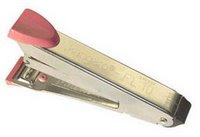
Two devices that I always felt have held their own and weathered the onslaught of progress are the nail-clipper and the stapler. If a person who had slipped into a coma in the sixties were to magically wake up today, he would struggle to recognise most of the contraptions strewn around, but the bulb of recognition will light up when he sees the nail-clipper or the stapler. And, for all you know, the light of recognition will not be from a bulb but from a CFL or LED lamp.

True, there have been attempts to spruce up the image of the stapler with more elegance and styling, but, for me, the style represented by Kangaro Model 10 has always been the one that comes to my mind when I think of a stapler. In fact, much of the iron content in my blood has come from the staple pins that shopkeepers would have thoughtfully used to close a packet of chips or masala peanuts and that would have dropped inside and mixed with the contents as I hurriedly tore open the packets to get my greedy hands in.


Alas, the days of the stapler are numbered, if we are to believe this post ( shared by Sowmya). The pin-type stapler model is on its way out. Welcome, the stitch variety.

R.I.P, pin stapler. Live on, nail clipper.

Sunday, July 13, 2008

Gender bias

Hillary Clinton lost the Democratic nomination for president because of "gender bias" in the news media, according to a Johns Hopkins University analysis that found the New York Democrat has attracted marked press discrimination. ( Source)

An article in Slate, in November last year, had discussed this possibility and had cited a study done in India, to predict that even if Hillary were to win the elections, she might not last more than one term.

The study that Slate referred to was one carried out by economists Esther Duflo and Petia Topalova.

In 1991, explains the article, almost none of India's village councils were headed by women; the 1991 constitutional amendment passed to redress this imbalance mandated the election of women as pradhans, or council heads, in a third of villages that were chosen entirely at random. This meant the villages reserved for female candidates were no different from other villages before the women-only elections.

Based on a survey they carried out, Duflo and Topalova found that the villages headed by women invested in more services that benefited the entire community than did those with gender-neutral elections, nearly all of which were won by men. Corruption was noticeably less. Issues such as supply of drinking water were tackled far better.

But, alas, the survey also brought the reality that ‘India's female pradhans were remarkably unappreciated for their efforts. Despite the objective upgrades in village amenities, both men and women living in villages headed by women expressed lower satisfaction with public services.’

Why this disconnect between the performance and recognition of female leaders? To find out the answer, Slate refers to another study. In an experiment on gender perceptions, psychologists Cameron Anderson and Francis Flynn gave one group of MBA students the original case study done by Harvard Business School on a venture capitalist, Heidi Roizen. Another group received a copy that was identical in every way, except that "Heidi" became "Howard."

How was Ms. Roizen perceived by students who read of her assertive style in the case? It depended whether she was presented as a man or as a woman.

‘Anderson and Flynn report that while both Howard and Heidi were rated as equally competent (they were the same person, after all), students described the female version of the character as overly aggressive, and were much less likely to want to work with or hire her. So the decisive, assertive traits that are often valued in leaders are received very differently when observed in women than when seen in men. Howard was a go-getter. Heidi was unlikably power-hungry.’

‘But there is some preliminary evidence (PDF), that the success of India's first wave of female pradhans is starting to change attitudes, perhaps bringing India one step closer to gender-neutral village politics.’

Hmm, I wonder how the findings on the Indian women pradhans would have been received had Esther Duflo been a man?


Sunday, July 06, 2008

@#$%!*

Without meaning to pass any moral judgement on fellow bloggers, I have often wondered, why so many of them feel the need to use ‘f’ and other ‘swear’ words routinely. In fact, some of these swear words are used as mere fillers, often out of context. As many of these said bloggers are excellent writers, this cannot be due to inadequate vocabulary. There must be a deeper reason.

But, why do we need to curse, at all? And why do most curse words invariably contain reference to a sexual act, some bodily functions or excreta?

Steven Pinker dwelt on this theme in his book, “The Stuff of thought”. ( I have not read the book, just a review). Pinker believes cursing is rooted in a primordial part of our brains and swearing was actually the first form of language. He points to the fact that brain-damaged patients who lose the power of articulate speech often retain the ability to curse like a sailor. "Since swearing involves clearly more ancient parts of the brain," Pinker says, "it could be a missing link between animal vocalization and human language." So, cursing is ‘animal behaviour’. The same parts of the brain are involved when you bump your head and yell, ‘Oh f#@&!' as when you step on a dog's tail and get a very sudden howl."

An article in New York Times, titled. “Almost before we spoke, we swore” explored the same subject. Cursing, it said, is a human universal. Every language, dialect or patois ever studied, living or dead, spoken by millions or by a small tribe, turns out to have its share of forbidden speech.

‘The very concept of a swear word or an oath originates from the profound importance that ancient cultures placed on swearing by the name of a god or gods. At the same time, there was a commandment that the “Lord’s name cannot be used in vain”. So, an ever-fresh selection of euphemisms about dirty subjects has long served as an impressive engine of linguistic invention.’

‘Using PET scans of the brain, investigators have examined the physiology of cursing, how our senses and reflexes react to the sound or sight of an obscene word, and how complex an act the urge to speak the unspeakable may be. Participants show signs of instant arousal. Their skin conductance patterns spike, the hairs on their arms rise, their pulse quickens, and their breathing becomes shallow. The person is gripped by a desire to curse, to voice something wildly inappropriate. Higher-order linguistic circuits are tapped, to contrive the content of the curse. The brain's impulse control center struggles to short-circuit the collusion between limbic system urge and neocortical craft, and it may succeed for a time. Yet the urge mounts, until at last the speech pathways fire, the verboten is spoken, and archaic and refined brains alike must shoulder the blame.’

Or, perhaps cursing is a coping mechanism, a form of anger management that is often underappreciated.

A chimpanzee who is really gearing up for a fight doesn't waste time with gestures, but just goes ahead and attacks. By the same token, nothing is more deadly than a person who is too enraged for expletives - who cleanly and quietly picks up a gun and starts shooting.

So, rather let him curse and let off steam, than pick up a gun to shoot you.

Saturday, July 05, 2008

Zero-intelligence investors

Whenever the Sensex dips a bit, the papers carry a photograph, the next day, of shell-shocked traders staring disbelievingly at the screen in front of them and watching the prices slide rapidly before their eyes. My usual reaction is, “Good. Serves the idiots right”. A system where stock prices don’t correlate with the fundamentals or the technical parameters is as good as a lottery to me.

In fact, the only correlation that I could discern, before I got over the madness, was that the Sensex would unfailingly rise, a few minutes after I had sold off some shares, and tumble a few minutes after I had bought some shares. In a manner of speaking, I was cross-subsidizing the Stock Market.

Jeffrey Kluger, author of the book “Simplexity”, writes about the ways of the stock market:

Never mind what you think about the exquisitely complex organism that is the world’s financial market. Never mind the hundreds of millions of thoughtful investors and their billions of well-considered trades. For every market analyst who sees traders as the informed and educated people they surely can be, there are scientists who see them another way entirely; as atoms in a box, billiard balls on a table, unthinking actors who obey not so much the laws of economics, as the laws of physics. The things that result from those actions may be undeniably extraordinary- the creation or destruction of trillions of dollars of wealth in a matter of hours- but down at the fine-grained level at which the transactions are made, the players themselves can be remarkably simple things.

..When the tide of the market shifts, most of us shift with it; when it flows back, the other way , we do the same. We like to think we are informed by trends, but often as not, we’re simply misled by them, snookered by what everyone else is doing into concluding that we ought to do the same.

..Economic models always begin with the assumption of perfect rationality, of a universe of logical people, all doing what they can to master their utility. But, physicists studying economics begin with the assumption that people can’t think.

I agree with the physicists. When a Ponzi scheme is exposed, one is always amazed, in hindsight, at the fact that so many seemingly sensible people allowed themselves to be conned.

Friday, July 04, 2008

Take a print-out of this post..

After reading through all the enlightening, online responses to the question, “What are you optimistic about?” posed by The Edge Foundation, in 2007, I still felt the need, recently, to pick up the book that has been published by them, with the same compilation.

Reading stuff online is all very well, but there’s nothing to beat the print version and the convenience of reading it wherever you want to, be it on a flight, in the bathroom, at work…

One of the contributors, Walter Isaacson, has expressed his optimism on this very point, namely, that he is hopeful about the future of printing technology:

I am very optimistic about print as a technology. Words on paper are a wonderful information storage, retrieval, distribution, and consumer product. That is why I appreciate the fact that many Edge forums are transformed into books, and it's why I hope someday that there is a gorgeous Edge Magazine that I can flip through and touch. Imagine if we had been getting our information delivered digitally to our screens for the past 400 years. Then some modern Gutenberg had come up with a technology that was able to transfer these words and pictures onto pages that could be delivered to our doorstep, and we could take them to the backyard, the bath, or the bus. We would be thrilled with this technological leap forward, and we would predict that someday it might replace the internet.

This is an interesting way of looking at progress, from both directions. Imagine if we had been going around only by automobiles for 500 years. Then some inventor came up with an amazing two-wheeled vehicle that eliminated the need to fill any fuel, which could be pedalled manually and which could be parked easily against a tree, and which did not belch out any smoke, we would be thrilled at this technological leap and predict that some day, this device- let’s call it the bicycle- might replace the car…

Wednesday, July 02, 2008

Why I look so young.

“If I am looking much younger now than ever, it is because I have stopped eating any food item that is white in colour- such as rice, milk, curd ,salt, sugar, etc, from the age of forty”, actor Rajnikanth is quoted in today’s papers.

I found this very interesting.

I have met, and I am sure you too have met, many people with their own dietary preferences. I know some hard core vegetarians, a few vegans, and one or two who swear by organically-grown vegetables and fruits.

Moving along the continuum, I have a vegetarian friend who is partial to fish and some who consume only white meat, not red meat. There is a European colleague who takes only red meat, mainly beef, that too after making sure that the cattle had been allowed to graze in open meadows (eating chicken, according to him, induces stress in our bodies, as the meat comes from creatures raised and traumatised in packed poultry farms. Avoid at all cost, he implores).

Some consultants recommend green leafy vegetables, some advise you to lay off fats and some like Atkins who have made a fortune by asking people to avoid carbohydrates. So, there are so many categories in which you can slot people based on the diet they prefer or the diet they steer clear of.

But, this is the first time I have come across a person who shuns food that is white in colour.

I too would like to start a new category. Suppose, I start a fad by limiting my diet to food substances that begin only with the letter ‘b’, like bread, butter, broccoli, biryani, bisi bela bath, bagala bath, beans, baby corn, beef, batata vada, burger, boori ( as poori is pronounced is some parts of Tamilnadu), barotta ( as pronounced in some parts of….), biscuits, bakery products, butterscotch ice cream… Raj’s B-Diet, it will be called. No, that won’t find me followers. Maybe, I should simply start a cult that avoids all items with names that begin with the letter “x’ or “z”. “The secret of my eternal youthfulness is that I have always shunned zebra meat…” I will proclaim

Sunday, June 29, 2008

Weather forecast by drinking wine.

In his book, “Super Crunchers”, the author Ian Ayres refers to the work done by Princeton economist, Orley Ashtenfelter, on the parameters that affect quality of wine. Ashtenfelter went on to develop a quantitative analysis to predict the price of wine, from the weather data in the year in which the grapes were grown. He had the temerity, says Ayers, to reduce his theory to a formula:

Wine quality= 12.145+0.00117 winter rainfall+0.0614 average growing season temperature- 0.00386 harvest rainfall.

Though this might prove useful to connoisseurs of wine and those who need to invest in the vineyards, I don’t see much practical use, outside this narrow domain.

If we can use Ashtenfelter’s formula in reverse, and predict the next year’s average temperature and harvest rainfall, based on the quality of wine sold this year, there might be some interesting applications.