Monday, July 28, 2008

Gandhi and after...

"He was full of pieces he had picked up here and there: his mother’s love of fasting and austerities, the English common law, Ruskin’s idea of labour, Tolstoy’s Russian religious dream, the South African jail code, the Manchester No breakfast Association. His strong political cause- in South Africa and India- gave an apparent unity to all these impulses, but there was no real unity; the pieces did not fit together; no piece was indispensable….

…And when forty years or so later, the main cause had been won, and India became independent, it was those “outside” causes that made it hard for people to know what Gandhianism was. Was it the dhoti, the spinning wheel, the homespun, the Thoreau, the Ruskin, the sexual abstinence, the vegetarianism, the Christian hymns, the refusal to drink cow’s milk, the latrine-cleaning? It was impossible for anyone to be a complete Gandhian; no one could make that pioneer journey again; people had to take the one or two things they liked from the menu. In the main they took the homespun; that was the easiest and most stylish item. ….

,,, And still from time to time in the Indian press there is a cry for the Gandhians of today, and the regret that what had been the ‘greatest mass movement in history’ should have vanished so completely. The unspoken feeling is that Gandhi grew out of the Indian soil and the people who came after have turned away from wisdom that was open to them. There is little understanding that Gandhi had been created by the cultural incompetence of his three years in London, and then by his embattled twenty years in South Africa; those extraordinary conditions cannot be repeated, Indians hardly know about the long South African years and are unwilling to read about them, They feel that, being Indians, they possess Gandhi. They don’t have to study him; he is inside them and then can find in him what they wish."

Extracted from “ A writer’s people: ways of looking and feeling” by V.S.Naipaul

Update 30-07-08 : After posting this extract, I reflected on why I found it interesting, in the first place. After all, Gandhi is a subject that, over the last so many decades, has been dissected and analysed threadbare, as to become quite boring

Descriptions of Gandhi have been either too laudatory (as in hero-worship) or, in some cases, too critical. Whereas Naipaul, in this article (from where I extracted a few paragraphs) has viewed this subject dispassionately. Gandhi, he says, was made up of several parts that made a significant whole. Each part, by itself, was not indispensable. Conversely, hanging on to one part and believing that to be the whole Gandhi, like the blind men of Hindoostan, is also foolish. And, not all the parts would appeal to everybody. Like in a buffet meal, we are free to choose the elements we want to.

And, Gandhi was not a one-trick pony. He had several weapons in his armoury. Copying one or two out of his bag of tricks will not make one a Gandhian, just as sporting a beard cannot make one Tagore. Because Gandhi’s bag of tricks evolved through a unique combination of experiences and circumstances ( England, South Africa, etc) , that cannot be replicated. He was a product that materialised at the appropriate time.

Sunday, July 27, 2008

Cowardice, again and again and again....

As expected, some leaders have condemned the serial blasts at Bangalore as a cowardly act.

Why ‘cowardly” of all expressions? Are the leaders trying to snigger at the terrorists and make them realize the folly of their assumption that they are brave fighters for a cause? Or, do their speech writers simply dip into a template that has been unaltered for decades?

I had tried, in an earlier post, to find the answers. I found this passage linked to, in an article written by Paul Krugman.

“In truth, notions of "cowardice" and "bravery" are entirely irrelevant when we contemplate the horrors of terrorism.To call a terrorist “cowardly” is to substitute testosterone for morality. Somehow it isn’t enough to abhor an act of terrorism or even to promise to make the terrorist pay dearly. The rules demand that the terrorist be branded a sissy. This is not only a childish reflex, but one that weakens the moral force of the condemnation and thereby dishonors terrorism’s victims. After all, we don’t want brave people to slaughter innocent people any more than we want cowardly people to do so. Still, the public seems to demand that our presidents call terrorists cowards, and our presidents are too–well, cowardly–to deny them.”

Is it any better if a murderer of innocent people is a “brave murderer” instead of a “cowardly murderer”?

Saturday, July 26, 2008

Blogging was light again.....

I have expressed my amazement before at the commitment displayed by some bloggers, in offering elaborate explanations and profound apologies to their loyal readers if they failed to maintain their usual rate of posting."Blogging will be light, the next few days”, they would begin..

One worthy, I remember, after informing that he was planning a long holiday when he would not be able to access the internet, consoled his readers by pointing out that they could always dip into his archives.

Anyway, some of you would have noticed that blogging has been light, on this counter, for a few weeks. That’s because I was busy working on this post

R.I.P Series- 14

When one has observed the world for a few decades, as I have done, and as closely as I have, one realises that many of the devices that one had seen around the house in one’s childhood have either disappeared completely, or the functionality resides now in a completely different form or style.

The phones with the rotary dial (some without even the dial) were pensioned off and replaced with button-types, and later the cordless ones, and more recently the mobile phones. The humble mechanical type-writer gave way to the electronic one and later to the word processors, laptops and what-not. The bicycles of today, mercifully, still have two wheels, but look far more fancier now – though some relics of the past still exist. Spectacles have taken on new shapes and new materials and, in many cases, have been substituted with contact lens.

Watches have stuck to their analog dials, warding off the brief threat from the digital types, but the mechanism is completely different. You don’t have to ‘key’ them or ‘shake them’ to make them work. And, while fountain pens are still around, ball points and micro-tips are far more ubiquitous.

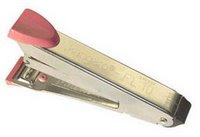
Two devices that I always felt have held their own and weathered the onslaught of progress are the nail-clipper and the stapler. If a person who had slipped into a coma in the sixties were to magically wake up today, he would struggle to recognise most of the contraptions strewn around, but the bulb of recognition will light up when he sees the nail-clipper or the stapler. And, for all you know, the light of recognition will not be from a bulb but from a CFL or LED lamp.

True, there have been attempts to spruce up the image of the stapler with more elegance and styling, but, for me, the style represented by Kangaro Model 10 has always been the one that comes to my mind when I think of a stapler. In fact, much of the iron content in my blood has come from the staple pins that shopkeepers would have thoughtfully used to close a packet of chips or masala peanuts and that would have dropped inside and mixed with the contents as I hurriedly tore open the packets to get my greedy hands in.


Alas, the days of the stapler are numbered, if we are to believe this post ( shared by Sowmya). The pin-type stapler model is on its way out. Welcome, the stitch variety.

R.I.P, pin stapler. Live on, nail clipper.

Sunday, July 13, 2008

Gender bias

Hillary Clinton lost the Democratic nomination for president because of "gender bias" in the news media, according to a Johns Hopkins University analysis that found the New York Democrat has attracted marked press discrimination. ( Source)

An article in Slate, in November last year, had discussed this possibility and had cited a study done in India, to predict that even if Hillary were to win the elections, she might not last more than one term.

The study that Slate referred to was one carried out by economists Esther Duflo and Petia Topalova.

In 1991, explains the article, almost none of India's village councils were headed by women; the 1991 constitutional amendment passed to redress this imbalance mandated the election of women as pradhans, or council heads, in a third of villages that were chosen entirely at random. This meant the villages reserved for female candidates were no different from other villages before the women-only elections.

Based on a survey they carried out, Duflo and Topalova found that the villages headed by women invested in more services that benefited the entire community than did those with gender-neutral elections, nearly all of which were won by men. Corruption was noticeably less. Issues such as supply of drinking water were tackled far better.

But, alas, the survey also brought the reality that ‘India's female pradhans were remarkably unappreciated for their efforts. Despite the objective upgrades in village amenities, both men and women living in villages headed by women expressed lower satisfaction with public services.’

Why this disconnect between the performance and recognition of female leaders? To find out the answer, Slate refers to another study. In an experiment on gender perceptions, psychologists Cameron Anderson and Francis Flynn gave one group of MBA students the original case study done by Harvard Business School on a venture capitalist, Heidi Roizen. Another group received a copy that was identical in every way, except that "Heidi" became "Howard."

How was Ms. Roizen perceived by students who read of her assertive style in the case? It depended whether she was presented as a man or as a woman.

‘Anderson and Flynn report that while both Howard and Heidi were rated as equally competent (they were the same person, after all), students described the female version of the character as overly aggressive, and were much less likely to want to work with or hire her. So the decisive, assertive traits that are often valued in leaders are received very differently when observed in women than when seen in men. Howard was a go-getter. Heidi was unlikably power-hungry.’

‘But there is some preliminary evidence (PDF), that the success of India's first wave of female pradhans is starting to change attitudes, perhaps bringing India one step closer to gender-neutral village politics.’

Hmm, I wonder how the findings on the Indian women pradhans would have been received had Esther Duflo been a man?


Sunday, July 06, 2008

@#$%!*

Without meaning to pass any moral judgement on fellow bloggers, I have often wondered, why so many of them feel the need to use ‘f’ and other ‘swear’ words routinely. In fact, some of these swear words are used as mere fillers, often out of context. As many of these said bloggers are excellent writers, this cannot be due to inadequate vocabulary. There must be a deeper reason.

But, why do we need to curse, at all? And why do most curse words invariably contain reference to a sexual act, some bodily functions or excreta?

Steven Pinker dwelt on this theme in his book, “The Stuff of thought”. ( I have not read the book, just a review). Pinker believes cursing is rooted in a primordial part of our brains and swearing was actually the first form of language. He points to the fact that brain-damaged patients who lose the power of articulate speech often retain the ability to curse like a sailor. "Since swearing involves clearly more ancient parts of the brain," Pinker says, "it could be a missing link between animal vocalization and human language." So, cursing is ‘animal behaviour’. The same parts of the brain are involved when you bump your head and yell, ‘Oh f#@&!' as when you step on a dog's tail and get a very sudden howl."

An article in New York Times, titled. “Almost before we spoke, we swore” explored the same subject. Cursing, it said, is a human universal. Every language, dialect or patois ever studied, living or dead, spoken by millions or by a small tribe, turns out to have its share of forbidden speech.

‘The very concept of a swear word or an oath originates from the profound importance that ancient cultures placed on swearing by the name of a god or gods. At the same time, there was a commandment that the “Lord’s name cannot be used in vain”. So, an ever-fresh selection of euphemisms about dirty subjects has long served as an impressive engine of linguistic invention.’

‘Using PET scans of the brain, investigators have examined the physiology of cursing, how our senses and reflexes react to the sound or sight of an obscene word, and how complex an act the urge to speak the unspeakable may be. Participants show signs of instant arousal. Their skin conductance patterns spike, the hairs on their arms rise, their pulse quickens, and their breathing becomes shallow. The person is gripped by a desire to curse, to voice something wildly inappropriate. Higher-order linguistic circuits are tapped, to contrive the content of the curse. The brain's impulse control center struggles to short-circuit the collusion between limbic system urge and neocortical craft, and it may succeed for a time. Yet the urge mounts, until at last the speech pathways fire, the verboten is spoken, and archaic and refined brains alike must shoulder the blame.’

Or, perhaps cursing is a coping mechanism, a form of anger management that is often underappreciated.

A chimpanzee who is really gearing up for a fight doesn't waste time with gestures, but just goes ahead and attacks. By the same token, nothing is more deadly than a person who is too enraged for expletives - who cleanly and quietly picks up a gun and starts shooting.

So, rather let him curse and let off steam, than pick up a gun to shoot you.

Saturday, July 05, 2008

Zero-intelligence investors

Whenever the Sensex dips a bit, the papers carry a photograph, the next day, of shell-shocked traders staring disbelievingly at the screen in front of them and watching the prices slide rapidly before their eyes. My usual reaction is, “Good. Serves the idiots right”. A system where stock prices don’t correlate with the fundamentals or the technical parameters is as good as a lottery to me.

In fact, the only correlation that I could discern, before I got over the madness, was that the Sensex would unfailingly rise, a few minutes after I had sold off some shares, and tumble a few minutes after I had bought some shares. In a manner of speaking, I was cross-subsidizing the Stock Market.

Jeffrey Kluger, author of the book “Simplexity”, writes about the ways of the stock market:

Never mind what you think about the exquisitely complex organism that is the world’s financial market. Never mind the hundreds of millions of thoughtful investors and their billions of well-considered trades. For every market analyst who sees traders as the informed and educated people they surely can be, there are scientists who see them another way entirely; as atoms in a box, billiard balls on a table, unthinking actors who obey not so much the laws of economics, as the laws of physics. The things that result from those actions may be undeniably extraordinary- the creation or destruction of trillions of dollars of wealth in a matter of hours- but down at the fine-grained level at which the transactions are made, the players themselves can be remarkably simple things.

..When the tide of the market shifts, most of us shift with it; when it flows back, the other way , we do the same. We like to think we are informed by trends, but often as not, we’re simply misled by them, snookered by what everyone else is doing into concluding that we ought to do the same.

..Economic models always begin with the assumption of perfect rationality, of a universe of logical people, all doing what they can to master their utility. But, physicists studying economics begin with the assumption that people can’t think.

I agree with the physicists. When a Ponzi scheme is exposed, one is always amazed, in hindsight, at the fact that so many seemingly sensible people allowed themselves to be conned.

Friday, July 04, 2008

Take a print-out of this post..

After reading through all the enlightening, online responses to the question, “What are you optimistic about?” posed by The Edge Foundation, in 2007, I still felt the need, recently, to pick up the book that has been published by them, with the same compilation.

Reading stuff online is all very well, but there’s nothing to beat the print version and the convenience of reading it wherever you want to, be it on a flight, in the bathroom, at work…

One of the contributors, Walter Isaacson, has expressed his optimism on this very point, namely, that he is hopeful about the future of printing technology:

I am very optimistic about print as a technology. Words on paper are a wonderful information storage, retrieval, distribution, and consumer product. That is why I appreciate the fact that many Edge forums are transformed into books, and it's why I hope someday that there is a gorgeous Edge Magazine that I can flip through and touch. Imagine if we had been getting our information delivered digitally to our screens for the past 400 years. Then some modern Gutenberg had come up with a technology that was able to transfer these words and pictures onto pages that could be delivered to our doorstep, and we could take them to the backyard, the bath, or the bus. We would be thrilled with this technological leap forward, and we would predict that someday it might replace the internet.

This is an interesting way of looking at progress, from both directions. Imagine if we had been going around only by automobiles for 500 years. Then some inventor came up with an amazing two-wheeled vehicle that eliminated the need to fill any fuel, which could be pedalled manually and which could be parked easily against a tree, and which did not belch out any smoke, we would be thrilled at this technological leap and predict that some day, this device- let’s call it the bicycle- might replace the car…

Wednesday, July 02, 2008

Why I look so young.

“If I am looking much younger now than ever, it is because I have stopped eating any food item that is white in colour- such as rice, milk, curd ,salt, sugar, etc, from the age of forty”, actor Rajnikanth is quoted in today’s papers.

I found this very interesting.

I have met, and I am sure you too have met, many people with their own dietary preferences. I know some hard core vegetarians, a few vegans, and one or two who swear by organically-grown vegetables and fruits.

Moving along the continuum, I have a vegetarian friend who is partial to fish and some who consume only white meat, not red meat. There is a European colleague who takes only red meat, mainly beef, that too after making sure that the cattle had been allowed to graze in open meadows (eating chicken, according to him, induces stress in our bodies, as the meat comes from creatures raised and traumatised in packed poultry farms. Avoid at all cost, he implores).

Some consultants recommend green leafy vegetables, some advise you to lay off fats and some like Atkins who have made a fortune by asking people to avoid carbohydrates. So, there are so many categories in which you can slot people based on the diet they prefer or the diet they steer clear of.

But, this is the first time I have come across a person who shuns food that is white in colour.

I too would like to start a new category. Suppose, I start a fad by limiting my diet to food substances that begin only with the letter ‘b’, like bread, butter, broccoli, biryani, bisi bela bath, bagala bath, beans, baby corn, beef, batata vada, burger, boori ( as poori is pronounced is some parts of Tamilnadu), barotta ( as pronounced in some parts of….), biscuits, bakery products, butterscotch ice cream… Raj’s B-Diet, it will be called. No, that won’t find me followers. Maybe, I should simply start a cult that avoids all items with names that begin with the letter “x’ or “z”. “The secret of my eternal youthfulness is that I have always shunned zebra meat…” I will proclaim

Sunday, June 29, 2008

Weather forecast by drinking wine.

In his book, “Super Crunchers”, the author Ian Ayres refers to the work done by Princeton economist, Orley Ashtenfelter, on the parameters that affect quality of wine. Ashtenfelter went on to develop a quantitative analysis to predict the price of wine, from the weather data in the year in which the grapes were grown. He had the temerity, says Ayers, to reduce his theory to a formula:

Wine quality= 12.145+0.00117 winter rainfall+0.0614 average growing season temperature- 0.00386 harvest rainfall.

Though this might prove useful to connoisseurs of wine and those who need to invest in the vineyards, I don’t see much practical use, outside this narrow domain.

If we can use Ashtenfelter’s formula in reverse, and predict the next year’s average temperature and harvest rainfall, based on the quality of wine sold this year, there might be some interesting applications.

Saturday, June 28, 2008

Catch the phrase?

An article in The Slate, ‘hunts for clues on what makes a catchphrase catch on and which ones deserve to be cast aside. And to make distinctions among the welter of catchphrases in use today, to identify variations and to distinguish the ones that still have some life in them’ and explains the different phases :

It is possible to think of catchphrase use in stages. There's Stage 1, when you first hear a phrase and take pleasure in its imaginative use of language on the literal and metaphorical level.

Then there's Stage 2, when you use it to establish "street cred” or convey a sense of being au courant.

Then there's Stage 3, when the user acknowledges a phrase's over-ness and tries to extract some final mileage out of it by gently mocking it, usually by using ironic quotes, or adding "as they say" to the end.

Finally, there's Stage 4: terminal obsolence, dead phrase walking.


As an example of Stage 4, the author mentions the phrase, “at the end of the day”. (In a post, I had also wondered why this particular phrase was so popular with cricket commentators and players.).

Being part of the corporate world, and as a regular in the seminar circuit, I hear and help spread quite a few catchphrases myself. At a recent meeting, I heard the phrase, “in terms of” used more than a hundred times (starting with “What I want to present in terms of setting the agenda for the meeting” and ending with, “ what I want to summarise here in terms of concluding this meeting….”).

Lights on, ready, double action...

Why do Indian movies where actors play double or multiple roles continue to enthrall audiences? Why are stories where the same actor plays the parts of son, father and grandfather, or quadruplets separated at birth so common here?

What is it about Kamal Haasan’s ten-role film that has people queuing up to watch it on the day of release? And, why is this type of multi-roling rare in Hollywood fims? A character going out in disguise, yes, but donning roles of different characters, quite rare.

Some decades back, when stage play was the norm, double roles would have been a novelty and also a necessity due to shortage of actors. It was an interesting stage-craft and watching the actors live and switching roles with rapidity would have drawn gasps of admiration from the viewers. This fascination would have been carried over when movies came on to the scene, thanks to the tricks that the camera could be made to play.

But, in these days of graphics and sophisticated animation, when voices can be dubbed and sound-engineered, where make-up techniques have evolved to make the ugliest of males look like the prettiest of females (and vice versa, to keep the post gender neutral), where cinematographic methods can easily enable Kamal Haasan to act out all the characters of Mahabharatha (including the 100 sons of Dhritarashtra), why should we be surprised or awed by the performance at all? Any two-bit artist who has a sufficient reserve of narcissism, who has the patience to let his/her face be painted, glued and otherwise brutalized can show off his/her histrionic/hertrionic talents without much difficulty. So, why the fuss? What purpose do these ‘double roles’ serve?

The best example of someone donning a double role in real life for a very noble cause was revealed to me a few years back. In one of the minor cricket matches (Chennai, fifth division league), a star opening batsman of the team batting first, got out cheaply. He was immediately whisked away to the nearest barber shop, his head tonsured and sent in again at No.5 or 6 as a different batsman. He managed to score an impressive 64 runs. Of course, the opening batsman didn’t come out to field, due to ‘injury’.

Learning from this excellent story, we should make better use of Tendulkar. Due to practical limitations, we can’t let him bat eleven times, but let’s say he is sent in to bat at No 2, 6, and 10 positions, named respectively Twodulkar, Sixdulkar and Tendulkar. He goes in at No 2, whacks a century, comes back to the pavilion, colours his hair, goes back at No 6, scores another century, runs back to the pavilion, puts on a fake moustache, goes in at No 10, scores another half century… Of course, batsmen at No 3,5,7,8,9 have to play out their parts well, and make sure that they don’t create a situation where Tendulkar has to play out a double role in real time. And, when India is fielding, the look-alikes of Two-dulkar and Sixdulkar, created by the make-up crew of Shahrukh Khan, will have to stand at third man and long on, with caps and goggles. No one will notice the difference, especially since the real Tendulkar’s fielding is nothing much to write about, these days.

This would be a far better application of multi-roling, don't you think?

Saturday, June 21, 2008

Traffic discipline

A typical morning at the railway level crossing near Bangalore and a typical evening at the road junction at Hanoi. (both videos via BoingBoing.)

Nothing warms the heart more than viewing such scenes where complete orderliness prevails and life goes on peacefully.

Diamonds may not be forever.

In a post, two years back, I had linked to the e-book titled Diamond Invention that reported on the illusion created about the scarcity of diamond, to prop up the prices artificially.

A recent article in The Smithsonian says:

Natural diamonds aren't particularly rare. In 2006, more than 75,000 pounds were produced worldwide. A diamond is a precious commodity because everyone thinks it's a precious commodity, the geological equivalent of a bouquet of red roses, elegant and alluring, a symbol of romance, but ultimately pretty ordinary……diamonds are simply crystallized pure carbon, just as rock candy is crystallized sugar—an ordered array of atoms or molecules.

Credit for the modern cult of the diamond goes primarily to South Africa-based De Beers, the world's largest diamond producer. Before the 1940s, diamond rings were rarely given as engagement gifts. But De Beers' marketing campaigns established the idea that the gems are the supreme token of love and affection. Their "A Diamond Is Forever" slogan, first deployed in 1948, is considered one of the most successful advertising campaigns of all time. Through a near total control of supply, De Beers held almost complete power over the diamond market for decades, carefully hoarding the gemstones to keep prices—and profits—high
.

The article reports that lab-grown gemstones are now available, that are indistinguishable from natural diamonds and this could trigger the beginning of the end of the high-price era. True, artificially diamonds are not exactly cheap today, but once the development costs are amortised, the price is bound to come down.

“A diamond for everyone” could be the new marketing slogan.

There's hope for this planet.....

In a lovely post, Sunil Laxman makes an ‘astute observation’ on the ‘land of liberty’.

“I learnt one of the first rules of living in a consumer paradise. In order to live the American life, one had to buy lots of stuff continuously, but remember to upgrade constantly, and get rid of the old stuff. .. There is a ton of “junk” here in this country that is perfectly good and useable, and which would be very valuable to lots of people around the world.”


He goes on to discuss a corollary to this observation – that, if you happened by chance to retain the stuff long enough, they would acquire antique value, and you could end up making a fortune.

Leaving aside the corollary for the moment, consumerism of the American variety has been discussed much in recent years, with a self-evident fact being reinforced that a linear process of production, distribution, consumption and disposal cannot last long in a planet with finite resources.

One solution is proposed in this article in WorldChanging, which I heartily endorse. What we need to do to save the planet, says the author, is to work less.

..our long work hours allow us to produce and buy more and more “stuff,” resulting in a greater pressure on resources and an inevitably stream of more waste…..by reducing work hours, Americans would reduce the energy used for transportation, and even more importantly, that they would reduce the energy necessary for the production of goods – as Americans trade time for money, they would consume and produce less.


The good news is that some American companies are beginning to think that a 4-day week is a good idea. Unfortunately, they want to make it a 10-hour day. This is completely wrong, argues the author. This will only increase stress levels. ‘The real solution to this problem is to go to a four-day workweek of eight-hour days. Total production would be reduced slightly, but this will make us more sustainable”, he recommends.

I support this idea. Not just for America, but India too. Not because I will need to work less, believe me. Because I want to make a supreme sacrifice of my working hours to save this planet.

May I use this opportunity to reiterate my humble suggestion of redesigning the calendar and banning Mondays forever?

Thursday, June 19, 2008

To see or smell?

While reflecting here on the challenges posed by dysfunctional sense organs, I had quoted Oliver Sacks to the effect that a person born deaf was likely to be more handicapped than a person born blind.

What about ‘becoming blind” and ‘becoming anosmic ( losing the ability to smell)? Jonah Lehrer quotes from a book called “Scent of desire” by Rachel Herz:

In one study that contrasted the trauma of being blinded or becoming anosmic [losing you sense of smell] after an accident, it was found that those who were blinded initially felt much more traumatized by their loss than those who had lost their sense of smell. But follow-up analyses on the emotional health of these patients one year later showed that the anosmics were faring much more poorly than the blind. The emotional health of anosmic patients typically continues to deteriorate with passing time, in some cases requiring hospitalization
.

Jonah adds:

As you can probably guess, the French novelist was right: there is something uniquely sentimental about the buttery whiff of a seashell-shaped cookie (or any other odor). This is because smell and taste are the only senses that connect directly to the hippocampus, the center of the brain's long-term memory. Their mark is primal and indelible. All our other senses (sight, touch and hearing) are first processed by the thalamus and only then sent along to the hippocampus. As a result, these senses are much less efficient at summoning up our past
.

What a finely tuned and optimized system the human body is!

Update 09/07/08; An article in Slate, written by a person suffering from anosmia, talks about the miseries of losing one’s smell. The author, Elizabeth Zierah, partially disabled by a stroke at an early age, writes that she found the experience of losing her smelling ability later on, far more traumatic. “As the scentless and flavorless days passed” she writes, I felt trapped inside my own head, a kind of bodily claustrophobia, disassociated. It was as though I were watching a movie of my own life. When we see actors in a love scene, we accept that we can't smell the sweat; when they take a sip of wine, we don't expect to taste the grapes. That's how I felt, like an observer watching the character of me”

God!

In this post written soon after his mother’s death, Amit Varma narrates how he, as a non-believer in God or souls, and without the attendant comforting philosophies of the afterlife, had to deal with death as simply death. He defends his atheism thus:

The conviction that there is no God is irrational because one cannot prove a negative. (How do you prove that something does not exist?) However, it is entirely rational to not believe in something whose existence has not been demonstrated. I don’t believe in dragons or fairies because no one has yet proved to me that they exist. Ditto God. I am not asserting that God does not exist, but simply saying that I don’t believe in the existence of God because I see no evidence of Him (or Her, or It). This is not a dogmatic position: if you can prove to me tomorrow that God or dragons exist, I will start to believe in them. Until then, I remain in disbelief. That’s atheism.

But his is not a militant brand of atheism, adds Amit:

What other people choose to believe in is none of my business, and I respect their right to their beliefs. But the right to religion does not imply the right to force it on others. I object when people try to coerce others into conforming with their beliefs, believing that their religion gives them the license to infringe on the rights of others. Religion in the private domain and in community settings can be useful, and a force for good, but too often in recent times, it has been used to justify the worst excesses: genocides, riots, terrorism, and all kinds of coercion.

Christopher Hitchkens, author of the book,” God is not great” is far more critical of religion, the medium through which the illusion of God is constantly propagated. Religion, he argues, poisons everything and will be responsible for the destruction of all the hard won human attainments. In the concluding chapter, he writes:

Religion has run out of justifications. Thanks to the telescope and the microscope, it no longer offers an explanation of anything impossible. Where once it used to be able, by its total command of a world-view, to prevent the emergence of rituals, it can now only impede and retard- or try to turn back- the measurable advances that we have made
.

Christopher furnishes exhaustive data on the destruction caused in the name of God and argues that religion must be stamped out ruthlessly.

While agreeing with Christopher’s conclusions, I still think that his reasoning and logic could have been better. He fails to establish clearly that religion does more harm than good. Citing incidents that reveal the destructive capabilities of religion or arguing that it has caused “harm” or has the potential to cause harm are not enough. Because a corresponding argument can be put forth, with examples, that religion has also done some good, binding people together, providing a framework for moral values, etc.

For instance, I can, with equal ease, put together a fat book called “Sports must be banned”, completely ignoring the plus points of brotherhood and harmony that sports have promoted, and instead packing it with stories of how fans have gone on murder sprees after football games, or talk about the killing during the Munich Olympics, or about the scandals involving drugs and betting to rest my case.

Unlike Christopher, Amit has made his point in a moderate and balanced manner and, further, is open to changing his views if evidence presents itself at a later date. Which is what ‘scientific temper’ is all about.


Saturday, June 14, 2008

Which of the senses would you give up?

In an outbound team-building exercise that I took part, we were split into three groups of five members each and marooned on three different “islands”. Members of Group A (of which I was a part) had their feet tied together and were ‘immobile’. Members of Group B were deaf and dumb and gagged and fitted with ear-plugs. While those from Group C were blind-folded. The objective was to get the members of Groups B and C from their islands that were about to be deluged, over to Island A, in about 45 minutes. Vital information on survival tools was available only with the deaf and dumb, and needed to be communicated to others through sign language..

The pressure and the intensity could be experienced, thanks to the build-up provided by the coordinator. And, finally, of course, we could empathise profoundly with the challenges of being disabled in any manner.

Later, we were discussing which of the disabilities was more “preferable”, under the circumstances, if we had been given the Hobson’s choice. Obviously, we could not come to a consensus. Each had its own drawbacks and a silver lining. And, for us, it was only a temporary disability. Those of us who were blindfolded could still be made to visualize, by providing graphic description. The deaf could lip-read as they had the language skills.

What about those unfortunate ones who are born with such infirmity, in the real world? Does being born blind pose more challenges than being born deaf? Or, is it the other way?

In an absorbing article called “A deaf world”, Oliver Sacks says:

“Whether deafness is ‘preferable’ to blindness, if happens in later life, is arguable; but to be born deaf is infinitely more serious than to be born blind- at least potentially so. For the prelingually deaf, unable to hear their parents, risk being severely retarded, if not permanently defective, in their grasp of language, unless early and effective measures are taken. And to be defective in language, for a human being, is one of the most desperate of calamities, for it is only through language that we enter fully into our human estate and culture, communicate freely with our fellows, acquire and share information. If we cannot do this, we will be bizarrely disabled and cut off- whatever our desires, or endeavours, or native capabilities. And indeed we may be so little able to realize our intellectual capacities as to appear mentally defective.”

Beethoven would never have managed his musical feats, had he been pre-lingually deaf. He was ‘lucky’ to have developed deafness, only after he was 26 years old, and had developed the ‘ear’ for music.

The manholes of Mumbai

In Mumbai, city officials are upset by an American warning about the risks of falling into manholes in India's commercial capital during the monsoon season. Jairaj Phatak, the municipal commissioner, estimates that 10 people or fewer have died in such a manner in recent years. (via).

A post in the Mumbai Metblogs links to the news item on the travel advisory and comments angrily:“Maybe they should deploy more staff to sort out visa backlogs instead of such studies”

Here is an old post, I came across via the same Mumbai Metblogs, where the blogger narrates his nightmarish encounter with the Mumbai sewage system, thanks to an open manhole.

Maybe the bloggers at Mumbai Metblogs ought to dip into their archives, once in a while.