Saturday, October 28, 2006

I am back....

As I promised my regular reader(s), I am back at my desktop, at the crack of dawn.

And what did I get to read , first thing in the morning. An elderly American couple, Randall Barnhart, 62, and his wife Carole, 61, were awakened in their rented apartment in the Malaysian island of Langkawi, in the early hours of the morning earlier this month by religious officials conducting a raid on ‘khalwat’ couples. Under Islamic law which operates alongside the civil code in Malaysia, ‘khalwat’- close proximity between a man and a woman who are not married- is forbidden. Mr Barnhart said that the officials demanded to see his ‘woman’ and insisted on being shown their marriage licence and passport The two have been married for 40 years now.

I had a similar traumatic experience last month. I was woken up in the middle of the night by this person who insisted on seeing my marriage certificate. Now, I am not usually rattled by such demands, even when woken up from a deep slumber. But, an entirely new dimension or twist was introduced to the drama, when I realized that the person demanding to see the certificate was my wife. Since then, I have been carrying a copy of my marriage certificate in my wallet, along with my driver's licence.

Another piece of news that amazed me was that Nalini Srikaran, a convict in the Rajiv Gandhi assassination case, had moved the High Court, seeking remission of her sentence. Photograph of Nalini shows that she is a frail, tiny woman. And, yet she has managed to move the High Court- which is a huge building weighing thousands of tons. Incredible what one can do with will power.

And, finally, there is this photograph of Jimmy Carter with Prime Minister Manmohan Singh, during which the peanut former gave the latter a ‘pat for India’ on its impressive growth. On which part of the anatomy does one pat India? Or did he symbolically give a pat to Manmohan Singh on the premise that he was the icon for India? Why can’t the man talk sense? And what happened to his younger brother, Jimmy Cart, and his elder brother, Jimmy Cartest?

Friday, October 27, 2006

Blogging will be light.............

I am simply amazed at the dedication shown by some spirited bloggers to the cause of keeping their readers constantly educated /engaged/ enraged/ amused/bemused/ curious/ furious, as the case may be. Such is their sense of accountability that they feel obliged to forewarn the readers about an impending lull in the activity or explain, post-facto, why they went missing for a few weeks/days/hours.

“Blogging will be light the next few days, as I will be traveling/slogging/shifting”, they will inform their readers, with a lump in their virtual throats. .

A prominent blogger felt it necessary, last month, to offer a detailed explanation on why he could not manage even a single post the previous day, apparently the first such post-less day in months. He promised his readers that he would post feverishly the next day and make up. Another blogger returning from a trip that he had to unexpectedly undertake, apologized profusely to his readers and sought pardon for this AWOL misdemeanour.

The most amazing was the case of a blogger who was about to embark on a two-week tour. In a guilt-laden tone he begged forgiveness from his gentle readers for letting them down and suggested that if they should find the absence unbearable, they could perhaps dip into his archives, adding that he particularly recommended the ones that he had posted in September 2005. Whaa?

Anyway, I thought I will inform all my regular readers who hang on to every word of mine, that blogging will be light the next few hours, as I intend to go to sleep now and wake up only in the morning. If you find my absence unbearable and the boredom intolerable, do keep reading the Sep 2005 archives of the blogger I have mentioned in the para above.

Tuesday, October 24, 2006

Death or marriage

Once upon a time there was a king who had this unique way of dispensing justice. When a subject was accused of a crime, public notice was given that on an appointed day, the fate of that accused person would be decided in the king's arena. When all the people had assembled in the galleries, the king gave a signal, a door beneath him opened, and the accused subject stepped out into the amphitheatre. Directly opposite him, on the other side of the enclosed space, were two doors, exactly alike and side by side. It was the duty and the privilege of the person on trial, to walk directly to these doors and open one of them. He could open either door he pleased. If he opened the one, there came out of it a hungry tiger, the fiercest and most cruel that could be procured, which immediately sprang upon him, and tore him to pieces, as a punishment for his guilt.

But, if the accused person opened the other door, there came forth from it a lady, the most suitable to his years and station that his majesty could select among his fair subjects; and to this lady he was immediately married, as a reward of his innocence. It mattered not that he might already possess a wife and family, or that his affections might be engaged upon an object of his own selection:

Now, the king had a lovely daughter, who was the apple of his eye and, as it happens in all these stories, a young man of low station dared to fall in love with her. Coming to know of this clandestine affair, the furious king announced that the young man would undergo the usual trial in the arena.

While the young man was facing the two doors, the princess was also torn between two emotions. If he opened the door behind which lay the tiger, he would die instantly. If he opened the door behind which lay the lovely lady chosen by the king, he would be married to her instantly – which possibility the princess found equally repulsive.

After some agonizing moments, prompted by the princess, the young man chose the door- and, lo and behold, out came not the dreaded tiger, but the lovely lady, who then proceeded to tear him apart with her claws and dug her fangs deep into his neck, instantly killing him.

That last para came from my sick mind, but- if you haven’t already- do read the original classic written by the American humorist, Frank Stockton, to find out how he has ended this story.

Wednesday, October 18, 2006

Maybe, even He does not know...

As the cliché goes, we live in an ever-changing world. Nothing remains the same. Ice caps melt, the USSR breaks up, East and West Germany unite, Afghanistan gets liberated from the clutches of the Taliban, Saddam Hussein is ousted, oil prices go up and down, Vajpayee gives way to Manmohan Singh, Abdul Kalam’s hair grows longer and becomes greyer, hundreds of species become extinct, Desipundit decides to wind down…………

Amidst all this turmoil and turbulence, only two things have remained constant.

Ajit Agarkar’s presence in the Indian cricket team. At various times, Tendulkars have taken sabbaticals, Gangulys have been sidelined, Laxmans have been axed, Kumbles have been dropped, Irfan Pathans made to carry drinks, and Zaheer Khans sent on vanavas, Kaifs asked to take a walk. But, Agarkar? A permanent fixture in the team for several decades now. When was the last time he did anything of significance to justify his place? How does he manage to cling on? What is his magic? What are his survival techniques?

Shobha De’s presence, year after year, at the Economic Times Awards function. Mittals may not make it to the function, Ambanis may be cold-shouldered, Premjis get ignored, Bajajs kept out, Godrejs sneered at, Birlas snubbed, Tatas overlooked, but Shobha De? No, sir. You can see her prominently featured in the photo section of the ET the next morning, grinning from ear to ear. ‘Shobha De, socialite, at the awards function’ will be the title. Who or what exactly is a socialite? Can I become one or is it open only to wives of eminent men? Is there a qualifying exam? Does one seek accreditation from an authorized agency before one can claim to be a socialite? At what stage in one’s social life or after attending how many parties does a mere wife or a mere corporate manager metamorphose into a glamorous socialite? What are her credentials to get invited to a function that is organized to felicitate industrialists?

Who knows the answers to these questions?

As the Rig Veda concludes, solemnly, in this hymn, pondering over the origin of the Universe and Cosmology,

“ He, who surveys it all from highest heaven,
He knows or maybe even He does not know.”

Friday, October 13, 2006

Happy Marriage.

Marcus Buckingham, in his book “The one thing you need to know” refers to the conclusion of a team of psychologists led by Dr.Sandra Murray of SUNY, Buffalo, on what is the defining characteristic of a happy marriage.

Conventional wisdom says that a happy marriage is founded on clear-eyed understanding and acceptance of each other. If this were true, then when a husband rates his wife high on ‘patient’, ‘warm’ and ‘sociable’ but lower on ‘open and disclosing’, and his wife rates herself in the same way, they should be a very happy couple. Put more simply, when their patterns of ratings match, their level of satisfaction with the marriage should be high. Right? “Wrong’ say the researchers..

In the study carried out Dr Murray, 105 couples were asked to rate each other on a list of qualities such as “kind and affectionate”, “tolerant and accepting”, “patient”, “warm”, etc and then asked to rate how rewarding and satisfying they found their relationship.

Surprise. A match between the husband’s ratings of his wife and the wife’s’ ratings of herself showed no correlation whatsoever to how happy they were in the relationship. (Not that there was a negative correlation either.) However one distinct pattern did emerge. In the happiest couples, the husband rated the wife more positively that she did on every single quality. For some reason, the husband in a highly rewarding relationship consistently credited his wife with qualities that she didn’t think she had. These perceptions may not be real, but they nevertheless served to cement the relationship.

The research also showed that when you find a flaw in your spouse, you shouldn’t try to compartmentalize it and set it off against a positive trait, as in, “Yes, she is a short-tempered person, but on the positive side, she is also caring and creative”. This doesn’t help. Sooner or later, these weaknesses that lurk in the wings for a while will leap out of the shadows like a villain and spoil the fun.

Instead, the researchers tell us, when you notice a flaw, recast it in your mind as an aspect of a strength. Thus, “She’s not impatient, she’s intense”. Or. “She’s not narrow-minded, she’s focused”.

“Satisfied partners give a positive spin on information and evidence to see their partner in the best possible light. In general, those who are satisfied see qualities in their partners that the partners do not see in themselves. Moreover, those who are satisfied see virtues in their partner that are not obvious to others, such as friends. Over time those who are idealized the most are together longer and are happier”, concludes Dr Murray.

In short, find the most generous explanation for each other’s behaviour and believe it. This is the One Thing you need to know about happy marriage.

So, now you have it in a nutshell. Practice it carefully. If your wife whacks you on the head with an umbrella, remember she is not trying to smash your skull, but is trying to give you a gentle head massage and improve blood circulation to your medulla oblongata. If she adds potassium cyanide in your coffee, she is not scheming to poison you; she is enriching her knowledge of chemical reactions. When she screams at you in that shrill voice which rattles the entire neighbourhood, she is not taking it out on you, but is exercising her vocal cords to become an opera singer. And, when you are stretched out on the sofa and she calls you a lazy slob, the last thing on her mind is criticism of your behaviour; she wants to shake you out of your complacency and inspire you to move on to greater heights on the Maslowian scale.

There, I have just unleashed to the blog world, the secret of a happy marriage.

Thursday, October 12, 2006

Meaningless milestones

Did you observe Sachin Tendulkar’s uncontrolled ecstasy when he reached his century mark, playing for the India Blues last week? All that wild gesticulation for scoring a mere 100 runs, that too in an inconsequential practice match! How juvenile can one get?

And, that Rahul Dravid, last year. Grinning and beaming on numerous television shows when he was about to play his hundredth test match. Was he under the delusion that he had conquered the world in 100 days or something?. I mean to say, cricket is just a game. Must we be subjected to this vulgar exhibition of unrestrained emotion over a non-event?

God, the fuss that some companies make when they break into the Fortune 100 list. Do they seriously think their customers are bothered or impressed with these corporate gimmicks and these ridiculous lists of Top 100 or Top 200?

The hullabaloo that some newspapers create when a new party comes to power and completes 100 days. Damn it, they have been elected to rule for 5 years. Why split their tenure into little chunks of 100 days? Why stand on the roof and shout when they complete a mere 100 days in power? .

The less said about some of these new-age Kollywood actors, the better. Actor A is felicitated for acting in 100 films, Music Director B for scoring music for 100 movies, Producer C when his movie has been screened for 100 days. What imbeciles. Can’t they find anything better to do, than commemorating some meaningless milestones? Bah!

It is not as if they have done something significant, like reaching their 100th blogpost, as I have done with this post.

Wednesday, October 11, 2006

The last of the Gandhians

The Hindu while reporting the passing away of Mr. Ravindra Varma, former Union Minister, refers to him as ‘one of the last links in the chain of Gandhians’.

Mr. Varmas’ age is mentioned as 81, which means that he would have been exactly 23 years old when Gandhi passed away in 1948. While I could not believe that anybody could become a full-fledged Gandhian in his early twenties, I gave him the benefit of doubt when I read that he had been exposed to Gandhi’s teachings at an early age and as a member of the Gandhi Peace Foundation had practised these ideals, long after Gandhi had exited the scene.

Over the years, I have seen this description of ‘last Gandhian” being conferred on so many different persons, alive and dead. – Jayaprakash Narayan, J.P.Kripalani, Morarji Desai, Nana Sita, Sunderlal Bahuguna, A.K.Anthony, Dr.Sheela Nayar, collectively to the Sangh Parivar (?), H.S. Duraiswamy, I.K.Gujral, that I used to wonder who the ‘last and final” Gandhian would be.

It looks like the supply has finally run out and newspapers are now forced to change the description to “one of the last links in the Gandhian chain”. In a few years, this will change to “last link in the Gandhian chain”, and after some more passage of time, the chain will be forgotten and Gandhi finally laid to rest.

I am not so sure about the ‘freedom fighter”, though. Last year, I came across a couple of khadi clad persons traveling on ‘freedom fighter’s” quota in a train. They must have been around 65-70 years of age. I kept wondering how intense their participation in the freedom struggle must have been at the ripe old age of 5 or 10 . We can expect to meet such freedom fighters for the next 60 years and then the ‘link to the chain of freedom fighters” for another 100 years after that.

Tuesday, October 10, 2006

Volte-face

On a recent visit to Helsinki, a friend and I spotted a pigeon that was stranded on the pavement, near a shopping mall. Either it had forgotten how to fly or had been grounded by an injury. A couple of teenaged girls went over, knelt down and stroked the bird gently, struggling to hold back their tears.

Seeing this, my friend who is a passionate, and even fanatical, vegetarian commented, “These shameless Finns! They have absolutely no qualms or compunction whatsoever in slitting the throat of any reptile, bird, fish, rodent or mammal for food- from reindeer and boars to wild ducks and salmon . So, why all this phony fuss over a wounded pigeon? Who are they trying to fool? Why this hypocrisy!

“Fair observation”, I said, “but tell me, for a person whose avowed mission in life is to not harm animals, how come you are wearing a leather belt? Leather doesn’t exactly grow on trees?

“Ha, the belt? You ask me why I wear a leather belt. Otherwise my pants don’t stay up. That’s why”, he replied instantly, not even making eye contact with me.

Saturday, October 07, 2006

I name thee....

I wonder why George Bush Sr couldn’t find some other first name for his son and chose to give him the same name of George Bush. Surely, there was no dearth of names, John, William, Keith, Michael, Richard, for Bush Sr to choose from. If someone in the house shouts “Georgie”, won’t it cause unnecessary confusion? What’s the tradition behind having the same first names for father and son? Brand identity? Cashing in on the fame?

Of course, there are some unusual traditions in parts of South India as well. I know of a family which insists on naming the first son as “Muthuswamy” after their village deity .So, the grandfather, his first son and the first grandson are all Muthuswamies. And, following the practice in parts of Tamilnadu, the son pre-fixes the name of the father to his own name. Thus each of them becomes Muthuswamy Muthuswamy. If a hypothetical situation arises where the grandfather wants to make a settlement deed dividing his property between his son and grandson, the lawyers will need to draft out the contract involving “Muthuswamy Muthuswamy , son of Muthuswamy Muthuswamy , hereinafter referred to as the party of the first part and 1) Muthuswamy Muthuswamy , son of Muthuswamy Muthuswamy and 2) Muthuswamy Muthuswamy , son of Muthuswamy Muthuswamy, hereinafter referred to as parties of the second part”. Such intricacies and complexities don’t baffle these hardened lawyers, but am I glad I can use the ‘cut and paste’ option in Word!

In one of his stories, P.G.Wodehouse narrates the joke about a visitor at the law firm of “Peabody, Peabody, Peabody and Peabody”.

Visitor: Can I meet Mr. Peabody?
Lawyer: Sorry, sir. He is away today.
Visitor: What about Mr. Peabody?
Lawyer: Ha, he is at the Old Bailey right now
Visitor: Surely, I can see Mr. Peabody then?
Lawyer: Alas, no sir; he is busy with another visitor.
Visitor: At least, is Mr. Peabody in?
Lawyer: That’s me, sir. How do you do?

I can visualize the same scene at the house of the Muthuswamies.

A famous blog post by Sidin, two years back, on the travails of South Indian men, lamented the fact that the moment South Indians are given names like Parthasarathy Venkatachalapathy, they start off at a disadvantage. I was however cheered by the recent news that the name Seetharaman Narayanan has mesmerized a whole lot of people in the world and the person bearing that name has gone on to inspire a Flick fan club. There’s hope yet.


Monday, October 02, 2006

Gandhi is sentenced........

The Universe was created 13.7 billion years ago, our sun was born 5 billion years back, earliest life forms came into being 3.8 billion years back, primitive animals appeared 700 million years back, mammals evolved 200 million years ago, homo sapiens emerged 600,00 years ago…..

Don’t you love the way the entire past can be compressed on an inverse logarithmic scale and 13.7 billion years dismissed in one sentence?

Or, when you try to compress the story of someone like Gandhi, in a single paragraph.

“Gandhi was born in 1869, educated in law and admitted to the British bar in 1891, moved to South Africa in 1893, fought for elementary rights for Indians living there, returned to India in 1914, initiated the non-cooperation movement in 1919, established the civil disobedience movement in 1921, marched to Dandi on his Salt Satyagraha in 1930, launched the Quit India movement in1942, won freedom for India in 1947 and was assassinated in 1948.”

It makes it look as if he put in just 4 or 5 days of work in his entire life. He got involved in our freedom struggle only at the ripe old age of 45, then did something noticeable once every few years and had long interludes in between. From 1930 to 1942, for example, he seems to have enjoyed one long break.

Of course, of course, he did a lot many more things and we could fill pages and pages about him. You and I know that. But in 2200 AD, this is how he will be appear in history textbooks.

Aren't you reminded of Solomon Grundy who was born on Monday, christened on Tuesday, married on Wednesday, took ill on Thursday, worse on Friday, died on Saturday and buried on Sunday? Whether these refer to days of the same week, or why he should take ill the day after his marriage are questions posterity won't have answers for.

Saturday, September 30, 2006

Deep thoughts......

Ancient philosophers used to ponder the question, “Let’s assume that you buy a new knife. Six months later you change the wooden handle alone, retaining the same blade. One year later you change the blade alone, retaining the wooden handle that you changed six months back. Are you now holding the same knife that you bought a year back or a different one?”

Or look at this question. Flight IC 945 takes off on Monday, with a set of crew members operating a certain aircraft and with a bunch of passengers. On Tuesday, Flight IC 945 takes off with a different crew operating a different aircraft and with a completely different bunch of passengers. How can both flights be IC 945, just because they are operating on the same route? Nothing else is the same.

None of you know anything about me, except that my name is Raj. I am just a virtual entity as far as you are concerned. Suppose tomorrow, someone starts a blog on another URL, calls it Plus Ultra and signs his name as Raj, will you know the difference? Worse, suppose someone steals my password, uses my URL and posts blogs in the name of Raj, will it matter at all to you?

Or I use the same URL and same blog name Plus Ultra, but start posting in the name of Zabernosky, would you care? Will the virtual entities Raj and Zabernosky mean the same to you, as the content and style will be the same? Will the images of both these characters be the same in your mind? Or Raj will be clean-shaven and Zabernosky will have a long beard?

Profound questions. Profound questions. Must think.

Wednesday, September 27, 2006

United, at last

Through a combination of chance and circumstance, the following individuals came to occupy berths 1 to 6 of a II Class compartment of a train that left Chennai Central for New Delhi. These berths, as you are aware, are usually inside a separate, closed cubicle and the occupants found themselves in constant company of each other, right through the 36-hour journey.

‘A” was male, Tamil-speaking, Hindu, belonged to the so-called forward community and was a non-vegetarian (to use that quaint Indian expression)

‘B’ was male, Kannada-speaking, Hindu, came from a backward community and was a vegetarian

‘C’ was male, Marathi-speaking, Hindu of forward community and was a vegetarian

‘D’ was female, Bengali-speaking Muslim (minority community) and a non-vegetarian

‘E’ was female, Hindi-speaking, Catholic (minority community) and a non-vegetarian

‘F’ was male, Hindi-speaking, Muslim (minority community) and a non-vegetarian

Back to the II class compartment. In such long-distance trains, conversation tends to flourish and becomes quite animated at times. Heated arguments and fist blows are not uncommon.

When dinner was served at Sulurpet, B whispered to C, a fellow vegetarian, that he found the smell of non-veg food quite overpowering and wished that the Railways would serve only vegetarian food. Hearing which A, D, E and F exchanged glances that clearly indicated that B and C should keep their abnormal preferences to themselves and not try to pass judgement on the dietary habits of the majority.

When it was time to sleep, D who had been allotted an upper berth requested F if she could take his lower berth, obviously appealing to his sense of chivalry. F gave in reluctantly but commented that when women these days sought equality in all other fields, why did they seek special treatment when it came to queues, lower berths, etc? A, B and C nodded in approval. But E, the other female in the group, came to the support of D and rebuked C, A, B and F for lack of elementary consideration to a person who belonged to the same gender as their mothers and sisters.

When the train reached Kazipet, ‘A’ who knew no Hindi wanted to buy something from a vendor who knew no Tamil or English. This irked A who commented aloud that Hindi zealots were shoving Hindi down the throats of South Indians and wondered what had happened to Nehru’s assurance in Parliament that it would not happen. B and D supported this view, but E and F felt that this was ridiculous and that anybody who called himself an Indian should be proud of the national language which was Hindi.

Near Nagpur, the conversation turned to the over-crowding of Mumbai and C, who was a Shiv Sena supporter, observed that the only practical solution was to ask all non-Marathi people who came in after 1990, to leave Mumbai. A, B. D. E and F pounced on him for his parochial views and reminded him that Mumbai belonged to the whole nation.

At Bhopal, while buying a bottle of mineral water, A accused B of belonging to a state that unreasonably withheld Tamilnadu’s rightful share of the Cauvery water. C intervened and asked both to hold fire, stating that the whole issue was overblown by the politicians and enlightened citizens shouldn’t get carried away. D, E and F nodded approvingly. B, supported by A, then trained his gun on C and asked him to lay off, as the latter came from a state that was making a completely illegitimate demand on a territory (Belgaum) that had been an integral part of Karnataka for ages. D, E and F nodded approvingly, while C argued vehemently that Marathi being the dominant language in Belgaum, it was foolish to keep it in Karnataka.

At Gwalior, discussions turned to the recent comments made by the Pope on Muslims and D and F expressed their displeasure to E. Butting in, A, B and C felt that both the Pope and the Muslims should apologise to each other and take a few lessons in tolerance from Hinduism. This drew derisive sniggers from D, E and F united in their Abrahamic faiths.

At Agra, A was heard talking on his mobile phone to his son studying at Pilani. He kept down the phone and explained that because of the shameful policy of reservation in Tamilnadu, people belonging to the forward community were forced to admit their sons/daughters in institutions in far-off places. C was quite empathetic but B.D.E and F took umbrage at this statement and argued that unless affirmative action was taken, the minority would remain suppressed for ever.

So many different issues had been dissected during the journey. Each of them, A. B. C. D. E and F had taken up strong positions on each issue and found himself/herself forming part of or pitted against different groups comprising different individuals at different times, demonstrating yet again that India was a fascinating country which could be divided in so many different ways.

As the train neared Delhi, the TTE informed them that the train would be delayed by one more hour, due to a derailment that had happened a few miles ahead.

A. B, C, D, E and F were finally united and unanimous in their criticism of the Indian Railways, the Indian Govt and the Indian bureaucrats. “Will things never change?” they cried in unison.

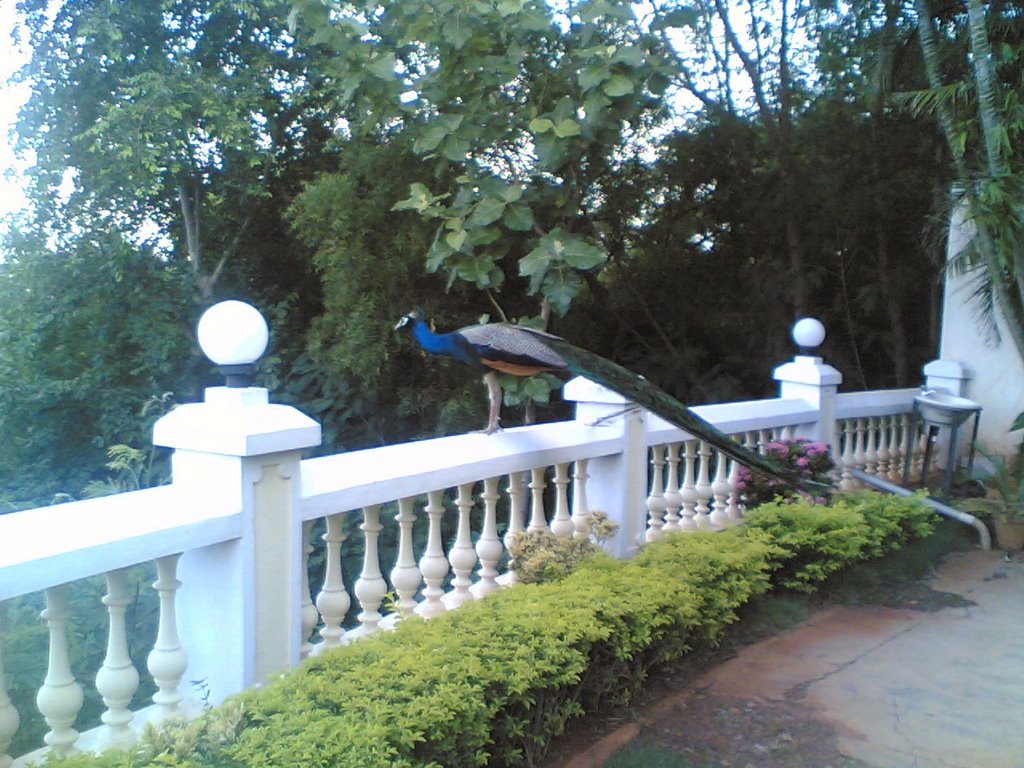
The feathered visitor

I was with two of my colleagues yesterday at the open-air restaurant of the Taj Garden Retreat, Madurai, when this magnificent creature descended from somewhere, looked in our direction, quickly sized up our potential, ruled us out as prospective mates, decided against a display of its full plumage and majestically settled down on the railing close to us.


One colleague concluded that Lord Muruga was making a pit stop while gallivanting on his ‘ vahana’ to bestow special and customised blessings to his loyal devotees, not to mention devote loyalees. So, the said colleague closed his eyes, folded his hands, and bowed reverentially, chanting “ Muruga, Muruga”, much to the bemusement of some foreigners in the adjoining table.

The other colleague, being of a more practical bent of mind, reached for the bowl of peanuts and threw out a handful to the bird which accepted the offering without too much of a fuss and conveyed through its authoritative body language that it was rightfully entitled to the meal.

And I? I had the presence of mind to go a few steps nearer and take a quick snap on my mobile phone, before the bird took off gracefully, continuing on whatever noble mission it was engaged in.

Same situation, but three different responses from three different people.

Saturday, September 16, 2006

The death of the salesman

Different professions boast of different core competencies. Doctors, for example, are extremely proficient in looking busy and walking at a brisk pace without their stethoscopes falling off their necks; they undergo years of training before they get this right. Architects cannot be matched when it comes to rolling tracing-paper and sharpening pencils; lawyers have that special gift of being able to rattle out a volley of inane expressions like “My Lord”, “ Your Honour” and “Prosecution rests its case” without spitting even once.

But, what about the traveling salesman? Yes, the wheeler-dealing, smooth talking, oily salesman? What special skills does he have in his armoury, you ask. Can he hold a candle to these stethoscopic docs, sharpening architects and filibustering, unsalivating lawyers, you snigger and ridicule in a tone dripping with unalloyed sarcasm and unadulterated contempt

Long, long ago, before you techies, nerdies, yuppies and other assorted puppies in the blogosphere were born, envisaged or even dreamt of, Uncle Raj began his illustrious career as a salesman and will therefore proceed to silence you critics.

What marks the traveling salesman from lesser professionals is the amazing ability to track down the best eating joint in any of hundreds of towns and cities in his territory. He alone has the trained nose to locate the roadside joint famous for its biriyani or that shop near the bus stand where the best masala milk is available after 9 pm.

Starting out as a salesman in Tamilnadu, I therefore knew where to pick up the best halwa in Tirunelveli, the cashew macaroons from Tuticorin (local legend had it that only the Fernandos knew the right mix of egg white, cashew, sugar, etc to give the macaroons that magical texture), peanut candies from Virudhunagar, Ooty vegetables from Coimbatore, mangoes from Thathachariar gardens in Srirangam, bananas from Namakkal, and hundreds of such rare delights.

Promoted and in charge of entire South India, the repertoire extended to mango jellies from Rajahmundry, banana chips from Cochin, pickles from Kovvuru, jackfruit papads and cashew supari from Mangalore (not to forget the Gadbad ice creams there), Kundas from Belgaum, the Maddur Railway station vada (such was the brand image that even when an outlet was opened on the highway, 3 km away from the station, the vada was still referred to as Maddur Railway station vada), the large-sized Tatte idlis of Tumkur, the mirchi bajjis from a roadside vendor in Bagalkot, pink sweets ( I have never bothered to ask what its called) from K.C. Das in Bangalore ( Strangely ,when I look for the same sweets in the many K.C.Das outlets in Kolkata, I don’t spot them).

As my canvas widened and I had the whole of India to cover, unimaginable goodies could be spotted in every nook and corner of the country. India, trust me, is a culinary cornucopia and is truly an epicurean’s paradise.

Later, foreign trips meant the mandatory duty-free shopping for Toblerones, Lindts and the Ferrera Rochers.

The salesman when he returned from a tour was welcomed warmly into the house by members of his family, his baggage quickly ransacked, the ‘eatable’ instantly removed and devoured. The salesman, therefore, was highly valued by society at large and his important role acknowledged and appreciated. He walked with his head held high.

Alas, times have changed, the world is flatter and the planes and trains are faster. Tirunelveli halwas made the previous evening reach Chennai the next morning and are sold out of Maruti vans as fresh stock; jackfruit papads can be procured from Nilgiri’s departmental stores round the corner, banana chips are ubiquitous, Ooty vegetables can be picked up in most vegetable shops, rossogolla tins of reputed brands can be spotted in many shops, and Toblerones and Ferrera Rochers are sold in paan shops.

Sadly, the salesman is therefore an unwanted species today, his skill set having become anachronistic and irrelevant. The notice that one sees today on the gates of apartment complexes ( “Sales people not allowed”) bears grim testimony to the fact of the death of the salesman.

Tuesday, September 12, 2006

Waves

Continuing with my series on the mobile phone……..

A colleague who was on a flight from Delhi and I (on a flight from Chennai) arrived in Mumbai airport at around the same time and were to meet up and take the same car to go to the other end of the city.

To locate him in the crowd, I sent an sms to his mobile phone, which was on ‘roaming’ mode in Mumbai. That meant that radio frequency signals from the transmitter of my phone had to reach the closest base station, get beamed to a satellite through a dish antennae, on to some switching station in Delhi, get re-routed to Mumbai over the satellite again and reach the receiver of his mobile phone through the closest base station. It all happens in a jiffy, but it has to take such a circuitous route. At least, this is how I believe it works.

He then dialed back my Chennai number. As I too was on ‘roaming’ mode, the voice signal from the transmitter of his phone had to be transformed into a code to reach the closest base station, get beamed to a satellite through a dish antennae, log on to a switching station in Chennai, get diverted to Mumbai and reach the receiver of my phone through the closest base station.

It so happened that the said colleague was about twenty feet away , had spotted me and was signaling to me with his right hand,even as he was talking over the mobile phone held in left hand.

Like me and my colleague, there were tens of people in the airport, hundreds in Santa Cruz cell area, thousands in Mumbai and millions of people in the world trying to connect and were jamming all frequencies and bandwidths and generally cluttering the atmosphere with electromagnetic radiation or whatever it is these things work on. If human beings had been provided with an additional sense organ to detect such microwaves, each of our brains would have suffered instantly from information overdose and blown its fuse.

The comedian George Carlin wrote in his book, “Brain Droppings” :

"Think of how much information, in the form of radio energy, there is flying through the air, all around us, all over the world, right now and all the time. AM, FM, UHF, VHF, shortwave radio, television, walkie-talkies, cell phones, telephone, satellites, microwave relays, faxes, pagers, taxi calls, police, sheriff, hospitals, fire departments, telemetry, navigation, radar, military, government, financial, legal. medical, media, etc, etc, etc. Trillions and trillions and trillions and trillions of electronic information flying around the world at all times. Think of that. Think of how busy the air is.

Now think of this. A hundred years ago there was none. None. No radiation at all. There was silence all around.."

Think about it.

Sunday, September 10, 2006

11/09/2001

How and when did the terrorist attack on September 11th in the USA, come to be referred to as ‘nine-eleven’? I tried to google for information on when the expression was first used and by who, but couldn’t find any leads. Does anybody know?

Terrorist attacks and other human tragedies are usually referred to in terms of the location of the incident- as in Mumbai blasts, Bali killings, London bomb blasts, attack on Indian Parliament, Munich massacre, Bhopal gas tragedy, Godhra train massacre, etc. How many of us remember the exact date on which any of these incidents happened?

An article in Time magazine (sometime in 2002) had reported that the American Dialect Society had voted ‘nine-eleven” as the ‘term of the year”. Linguists felt that there was a kind of aura or mystique to the date, as 911 was also the number for emergency calls in the US. Also, as more than one place was involved in the attack, it was difficult to assign a single geographical name to the incident- such as 'New York building crash'. Another explanation was that ‘9/11’ being a number made it sound as unemotional and impersonal as possible. Referring to the horrific incidents as the ‘events of 9/11’ somehow seemed to help in distancing one from the tragedy.

The term may have been coined by TV journalists, because it was catchy and fitted in easily in headlines and ticker tape crawlers. But not all terms and words coined by journalists become popular or find ready and universal acceptance. CNN had tried to create a buzz around the words, “War on Terror’, but it didn’t catch on .

A better explanation is that the term appealed to the ‘wisdom of the crowds’ and stayed on. It is the ‘crowd’ that intuitively seems to know which expression describes the incident best; should it be called a ‘tragedy’, ‘massacre’, ‘ killing’, ‘carnage’, ‘blasts’ or simply by the date ?

One Sunday morning, when the doorbell rang.....

I was absorbed in a nice juicy chitchat with a friend on my mobile phone, when the doorbell rang. Continuing with the conversation and holding the phone between my ears and shoulder in the manner guaranteed to give one a sprained neck, I opened the door.

It was the Cable TV guy who had come to collect his monthly subscription. He too had a mobile phone in his hand and was carrying on quite an animated dialogue with some other customer of his. Tilting his head as I had done, parking his mobile phone on his shoulder and barely making eye contact with me, he continued to talk on the phone, while pulling out a card from a folder, with his right hand.

I signed the card, took out my wallet from my trousers and handed him a five-hundred rupee note, while laughing over something my friend told me on the phone.

Now, the monthly subscription, for some reason, comes to Rs 355/- . So, the cable TV guy signaled to me with the five fingers of his left hand that he would like to have five more rupees from me, so that he could return Rs 150/-. All this while, his irate customer on the mobile phone continued to engage his attention.

He collected the five-rupee coin, handed over Rs 150/- to me and walked across to the next house to ring the bell – still mumbling something on his mobile.

I closed the door, returned to my sofa and carried on the conversation with my friend.

Much later I realized that the two of us had been talking continuously, yet not exchanged a word between us, while a transaction worth Rs 355/- had taken place.

A metaphor for our techno-obsessed times? Or a tribute to our multi-tasking capabilities?

Saturday, September 09, 2006

The confessions of a cured hypochondriac

In the opening page of his classic, “Three Men in a Boat”, the author Jerome K Jerome, describes the turmoil he had to go through whenever he read anything relating to diseases.

“It is a most extraordinary thing, but I never read a patent medicine advertisement without being impelled to the conclusion that I am suffering from the particular disease therein dealt with in its most virulent form. The diagnosis seems in every case to correspond exactly with all the sensations that I have ever felt.

I remember going to the British Museum one day to read up the treatment for some slight ailment of which I had a touch--hay fever, I fancy it was. I got down the book, and read all I came to read; and then, in an unthinking moment, I idly turned the leaves, and began to indolently study diseases, generally. I forget which was the first distemper I plunged into-- some fearful, devastating scourge, I know--and, before I had glanced half down the list of "premonitory symptoms," it was borne in upon me that I had fairly got it.

I sat for awhile, frozen with horror; and then, in the listlessness of despair, I again turned over the pages. I came to typhoid fever--read the symptoms--discovered that I had typhoid fever, must have had it for months without knowing it--wondered what else I had got; turned up St. Vitus's Dance--found, as I expected, that I had that too,--began to get interested in my case, and determined to sift it to the bottom, and so started alphabetically--read up ague, and learnt that I was sickening for it, and that the acute stage would commence in about another fortnight. Bright's disease, I was relieved to find, I had only in a modified form, and, so far as that was concerned, I might live for years. Cholera I had, with severe complications; and diphtheria I seemed to have been born with. I plodded conscientiously through the twenty-six letters, and the only malady I could conclude I had not got was housemaid's knee.”

Exactly the kind of thoughts that race through my hypochondriac mind whenever my attention is drawn to one of the many articles that appear in newspapers and magazines, describing, in painstaking detail, the symptoms of the latest virus fever raging in the city or some other ailments affecting the heart, brain or the liver of the upwardly mobile. I need to pause and check out if the symptoms described do not correspond exactly with some of the sensations that I had felt in the recent past. The thing about hypochondria is that you cannot treat it; once you acknowledge that it is a disease that merits treatment, you validate and reinforce the hypochondriac’s belief that he is ill and start a self-perpetuating doom loop.

I therefore steer clear of these articles and make sure that I don’t even make any eye contact with them. Far better to stick to the cartoons, trust me. I may be guilty of escapism, but at least I can be assured of good health.

Thursday, September 07, 2006

The uncaring world.

The humble crow. Black all over. Doomed to this achromatic existence, when every other creature on earth is resplendent in multiple colours. Did its early ancestor fall into a cauldron of ink or tar and pass on the darkened genes to its descendants in a Lamarckian manner? Does this shade of minimum light and maximum darkness infuse the species with a higher survival value? Or was it just a case of selective and black comedy perpetrated by the Maker?

The elevator in my building. All day long it goes up and down. Hundreds of people get in and get out and move on. But the elevator? Imprisoned in that lonely shaft for its entire lifetime. Condemned to its vertical movement. Horizontally challenged. Quietly serving. Up. Down. Up. Down. And yet uncomplaining.

The perfume bottle. 200 ml capacity. Each day I use it, the drop in level inside the bottle is hardly noticeable. Even after a month. Will the perfume last for ever? Is the bottle like the Kamadhenu, I wonder? Alas, no. In three months, the perfume is completely used up. Evaporated. Gone. Never to come back. For ever. Vanished into thin air while spreading its sweet fragrance. Like the candle which self-destructs while providing light.

This keyboard. Quickly converts finger strokes to bytes and words. Is this ability only unidirectional? Can it convert words and bytes from the monitor into finger strokes and push them intra-nervously from my hands into my brain? So, that I can instantly download volumes of data and imprint in my memory? Or can it, with the Backspace key remove memories of unsavory incidents of my life. No, it can’t.

What a cruel, nasty, brutal, uncaring world!

Thursday, August 31, 2006

The terrific twenties

David Bodanis, a popular science writer, in his book E= MC2, says that one of the many similarities between Newton and Einstein was that both produced their best output before they turned thirty.

Newton achieved much of his success, in his mid-twenties. Back at his mother’s farm after his University had been closed because of the Plague, in an incredibly brief period of about eighteen months, he did fundamental work on developing calculus, conceiving the law of universal gravitation as well as working on key concepts for a study of mechanics that would apply throughout the universe.

Einstein, in a period of under eight months in 1905, again in his twenties- and while putting in full days at the Patent office where he was employed-came out with his first theory of relativity, the equation E = MC2, as well as his work that helped lay the path for lasers, atom bombs, space travel, computer chips, key aspects of modern pharmaceutical and bioengineering industry and all Internet switching devices.

Mozart in his teens had performed in many countries, but it was in his twenties that his composing talent blossomed. He started writing operas in German, a novel innovation as the tradition up to then was to write in Italian. He was keen on new instruments - he wrote major works for the early piano (which was smaller than the 19th C piano by at least two octaves). In his twenties, Mozart also composed horn and clarinet concertos for musician friends who specialised in these instruments but had no music to show off their skills. They are still the definitive concert works for horn and clarinet.

In my twenties, I became skilled at whistling in the bathroom, discovered that I could grow a beard if I didn’t shave for ten days in a row, managed to drive an Ambassador car up to third gear, started using spectacles, figured out the difference between billiards and snooker, learnt how to wear a tie and still breathe and as a traveling salesman was a storehouse of knowledge on the hundreds of railway stations and bus stands in South India, especially with respect to the location of the toilets in each of these places,.

So, as you can see, there is a definite pattern. So many creative geniuses have been most productive and prolific in their twenties.